

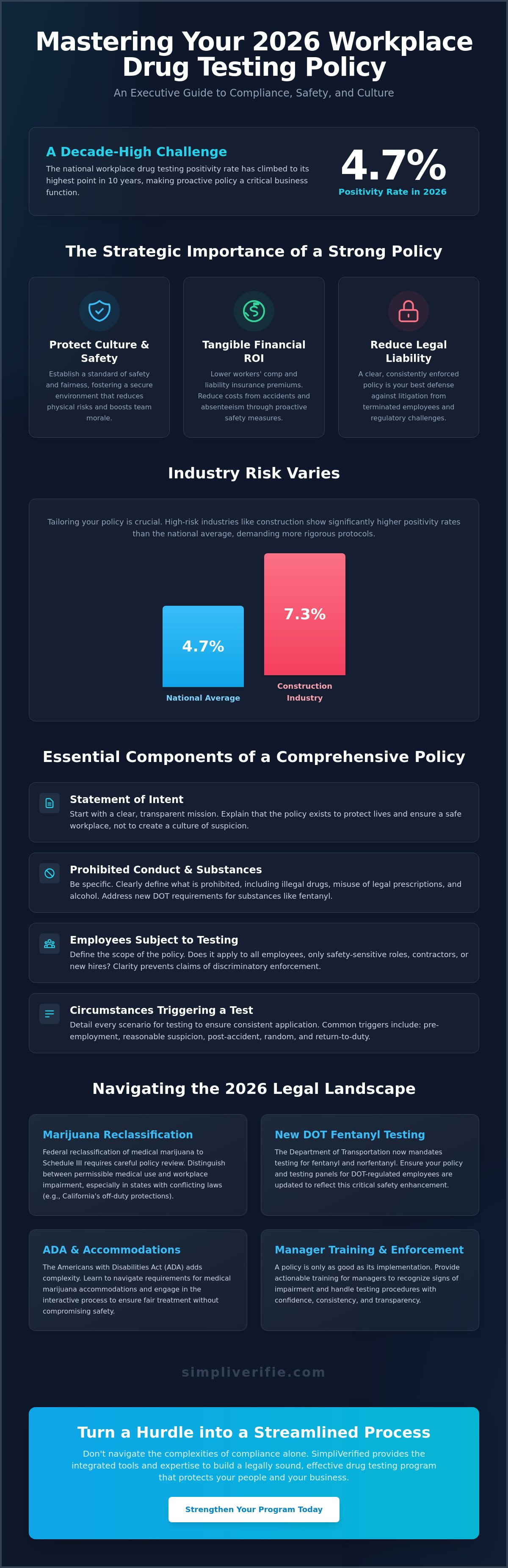
The national workplace drug testing positivity rate reached 4.7% in 2026, the highest level seen in a decade. If you're an HR leader or compliance officer, this trend likely confirms what you already suspect; maintaining a safe environment is becoming more complex. Between navigating the reclassification of medical marijuana to Schedule III and new DOT requirements for fentanyl testing, creating a workplace drug testing policy often feels like a legal minefield. At SimpliVerified, we understand the pressure to protect your organization's culture while avoiding litigation from terminated employees.
You shouldn't have to choose between bureaucratic headaches and workplace safety. This executive guide provides the clarity you need to master policy development in 2026. We'll walk you through the essential elements of a legally sound framework, from managing California's off-duty cannabis protections to implementing the latest FMCSA random testing rates. By the end of this article, you'll have a clear roadmap to improve your safety metrics and provide managers with dependable, easy-to-follow procedures. We'll help you turn a stressful administrative hurdle into a streamlined process that supports your company's growth and serenity.
Key Takeaways
- Understand how a proactive policy protects your organizational culture while reducing insurance costs and legal liability.
- Master the essential steps for creating a workplace drug testing policy that remains compliant with 2026 federal reclassifications and state-specific mandates.
- Learn to navigate complex ADA requirements and medical marijuana accommodations to ensure fair treatment of all employees.
- Gain actionable insights on training managers to recognize signs of impairment and handle testing procedures with confidence and transparency.
- Streamline your screening process by coordinating nationwide testing through the integrated tools provided by SimpliVerified.
The Strategic Importance of a Workplace Drug Testing Policy in 2026
In the current business environment, a drug testing policy is far more than a legal shield. It's a cultural safeguard. When you begin the process of creating a workplace drug testing policy, you aren't just checking boxes for compliance. You're establishing a standard for safety, productivity, and organizational integrity. A well-defined policy ensures that every team member understands the expectations, which fosters a sense of fairness and security across the entire workforce.
SimpliVerified recommends that every policy starts with a clear statement of intent. This introductory section should explain that the program exists to protect lives and livelihoods, not to create a culture of suspicion. By being transparent about your goals, you transform a bureaucratic requirement into a shared value. This clarity is essential in 2026, as shifting regulations require employers to be more precise than ever about their safety standards and testing protocols.
Protecting Company Culture and Employee Safety
Substance use in the workplace creates a ripple effect that touches every department. It's not just about the individual; it's about team morale and physical safety. When one person is impaired, their colleagues often have to pick up the slack or, worse, face increased physical risks. This is why many leaders are transitioning from a punitive organizational mindset to a protective one. Instead of looking for reasons to terminate, they're looking for ways to ensure a safe environment for everyone.
Effective policies aren't one-size-fits-all. You'll find the most success when you align your policy goals with your specific industry needs. For example, the construction industry saw a sector-wide positivity rate of 7.3% in 2026, representing a significantly higher risk profile than other sectors. Tailoring your approach ensures that your safety measures are relevant, practical, and respected by your staff.
The Tangible ROI of a Drug-Free Workplace
The financial benefits of a drug-free workplace are measurable and significant. Workplace accidents and chronic absenteeism related to substance use carry heavy costs, including lost time and decreased output. By creating a workplace drug testing policy that is proactive rather than reactive, you can significantly lower your workers' compensation and liability insurance premiums. Carriers often provide better rates to organizations that demonstrate a rigorous, documented commitment to safety.
Choosing the right approach is key to maximizing this return. Familiarizing yourself with modern drug testing methodologies allows you to select screens that provide the most accurate data for your specific environment. This technical precision helps eliminate doubt and builds trust in the system among your employees. Ultimately, workplace safety is a core business asset that directly supports your company's long-term growth and stability.
Essential Components of a Comprehensive Drug Testing Policy
Clarity is your best defense. When you are creating a workplace drug testing policy, the document must serve as a functional manual that managers can rely on during high-stress situations. A vague policy leads to inconsistent enforcement, which is often where legal challenges begin. To build a robust framework, you must specify exactly which substances are prohibited, which employees are subject to testing, and the precise circumstances that trigger a screen. Consistency ensures that every team member feels treated fairly, regardless of their role or location.
The first line of defense for any organization is a rigorous pre-employment drug test. This initial step sets the tone for your company culture before a candidate even signs an offer letter. It filters for safety risks early and demonstrates that your organization prioritizes a drug-free environment. For many HR leaders, this is the most critical component of a proactive risk management strategy.
Defining Prohibited Conduct and Substances
Your policy needs to go beyond simple definitions. In 2026, it's vital to distinguish between illegal drugs, the misuse of legal prescriptions, and alcohol consumption. With the DOT adding fentanyl and norfentanyl to drug testing panels this year, your internal lists should reflect these modern synthetic variants. You can't rely on outdated substance lists and expect to maintain a safe workplace.
The rise of hybrid work adds another layer of complexity. Your policy must explicitly define what "on duty" means for remote employees. Does the policy apply to a home office during set business hours? What about "on-call" staff? Addressing these nuances directly prevents confusion and ensures that your standards remain high, no matter where your team is working. If you're unsure where to start, SAMHSA's Drug-Free Workplace Toolkit provides excellent foundational resources for defining these parameters.
Establishing Clear Testing Occasions
A comprehensive policy details the "when" of testing to eliminate bias. You should outline protocols for random, reasonable suspicion, and post-accident testing. Defining "reasonable suspicion" is particularly important; it empowers managers to act when they observe specific, documented signs of impairment, such as slurred speech or erratic behavior. This protects the organization while also respecting the individual rights of the employee.
Don't forget the importance of return-to-duty testing. If an employee is given a second chance after a policy violation, a clear path for their return is essential. This includes a verified negative test result and potentially ongoing follow-up testing. Managing these moving parts can be a heavy administrative lift, but working with a partner like SimpliVerified makes coordinating these various test types a seamless part of your daily operations. This structured approach ensures that your safety metrics remain strong and your procedures remain defensible.
Navigating Legal Compliance and State-Specific Regulations
Compliance is often the most stressful part of creating a workplace drug testing policy. You're not just following one set of rules; you're balancing federal mandates with a rapidly changing patchwork of state laws. For organizations operating across state lines, this complexity multiplies. Legal review is a non-negotiable step when creating a workplace drug testing policy for a multi-state organization. It ensures your safety standards don't inadvertently violate local labor protections.
If you operate in the medical field, your policy must also align with healthcare compliance monitoring standards. Ensuring that your drug screening process meets these specific industry benchmarks is crucial for maintaining licensure and patient safety. At SimpliVerified, we help you navigate these intersections so your program remains both effective and legally sound.
Federal Requirements vs. Evolving State Marijuana Laws
The legal landscape shifted significantly on April 22, 2026, when the DOJ reclassified medical marijuana from Schedule I to Schedule III. While this doesn't legalize recreational use federally, it complicates how you handle accommodation requests under the Americans with Disabilities Act (ADA). You must also account for state-specific laws. For instance, California's AB 2188 and SB 700 prohibit discrimination based on off-duty cannabis use.
Most states still allow a "safety-sensitive" exception. If a role involves operating heavy machinery or direct patient care, you generally have more leeway to enforce stricter standards. Federal contractors must also remember their obligations under the Drug-Free Workplace Act. This act requires a zero-tolerance stance regardless of state-level legalization, making it a critical anchor for your policy framework.
Maintaining FCRA and Privacy Compliance
When you use a third party for screening, the Fair Credit Reporting Act (FCRA) applies. This means you must provide proper disclosures and obtain written authorization before conducting a test. If a result leads to an adverse employment action, you're required to follow specific pre-adverse and adverse action notice steps. This process prevents legal challenges and ensures transparency with your candidates.
Privacy is equally important. Employers have a legal and ethical duty to maintain the absolute confidentiality of drug test results by storing them in secure, separate medical files. Safeguarding this data isn't just a best practice; it's a legal necessity that builds trust between you and your team. By keeping these records separate from general personnel files, you protect the organization from claims of bias or privacy violations.
Practical Steps for Implementing and Enforcing Your Policy
Your policy only works if you implement it correctly. Once you've finished creating a workplace drug testing policy, the next step is a structured rollout. Transparency builds trust. Don't simply update the employee handbook and hope for the best. Use digital platforms to ensure every team member receives and acknowledges the new guidelines. This phase is also the perfect time to integrate your testing protocols into the broader employment verification workflow. When drug screening and background checks work in tandem, you create a seamless experience for new hires and HR staff alike.
Establishing an appeals process is another critical step. If an employee contests a result, they need a clear, fair path to follow. This procedural fairness protects your organization from claims of wrongful termination or bias. By providing a structured way to handle disputes, you reinforce the message that your policy is about safety and integrity, not just punishment.
Employee Communication and Training
Modern leadership in 2026 focuses on the total person. This means viewing substance use as a potential wellness challenge rather than just a disciplinary issue. Establishing an Open Door policy for self-disclosure allows employees to seek help before an accident occurs. Data from 2024 showed that fentanyl positivity was over 700% higher in random tests than in pre-employment screens, suggesting that use often starts or increases after a person is hired. Providing access to Employee Assistance Programs (EAPs) can save a career while maintaining a safe environment.
Train your managers to be your front line. They need to recognize impairment signs without letting personal bias cloud their judgment. Documentation is their best tool. Provide them with standard forms to record objective observations, such as slurred speech or erratic behavior. This protects the employee from unfair treatment and the company from legal challenges. Recurring training ensures that your leadership stays sharp as drug trends and legal requirements evolve.
Managing Positive Results and Discipline
Standardize your consequences to ensure equitable treatment across the board. Whether you're dealing with a first-time violation or a safety-sensitive breach, the response must be consistent. A Medical Review Officer (MRO) plays a vital role here. They verify if a positive result stems from legitimate prescription use, which adds a layer of expert validation to your process. This step is essential for levelling the playing field and ensuring that no one is unfairly penalized for necessary medical care.
If you're ready to modernize your approach and protect your team, partner with SimpliVerified to streamline your policy enforcement and testing coordination.
Strengthening Your Program with a Reliable Screening Partner
A policy on paper is only as effective as the systems that support it. Once the work of creating a workplace drug testing policy is complete, the focus shifts to operational reality. Managing a nationwide lab network and staying current with shifting regulations can quickly overwhelm even the most organized HR team. This is why a strategic partnership is essential. SimpliVerified removes the friction from this process by handling the logistics, from lab coordination to result verification. By integrating drug testing into a comprehensive background check strategy, you create a unified workflow that protects your organization from every angle.
Leveraging modern technology allows you to move away from fragmented systems. Real-time tracking and compliant record-keeping provide a level of transparency that manual methods simply can't match. When your screening data is centralized, you gain a clearer picture of your safety metrics and hiring efficiency. This technical precision is what allows modern organizations to maintain high standards without sacrificing speed.
Automating the Screening Lifecycle
Manual paperwork is a primary source of errors and delays. We've replaced these outdated methods with secure candidate portals that guide applicants through the testing process with ease. Direct lab integrations allow results to flow directly into your dashboard, significantly reducing turnaround times. This automation ensures that your policy triggers are consistent. Whether it's a pre-employment screen or a random test, the process remains the same every time. This consistency is your best defense against claims of procedural bias or unfair treatment.
Building a Culture of Safety with SimpliVerified
As your business grows, your screening needs will inevitably evolve. A scalable program allows you to add new locations or adjust for safety-sensitive roles without disrupting your existing operations. SimpliVerified provides the dedicated support needed to navigate the complex 2026 landscape. Whether you're adapting to new DOT fentanyl testing rules or managing medical marijuana accommodations, you'll have an expert partner to provide clarity. This support offers HR leaders peace of mind, knowing that their compliance is being monitored with professional rigor.
Ultimately, creating a workplace drug testing policy is an investment in your company's future. It signals to your employees and stakeholders that you value safety and integrity above all else. Choosing a reliable screening partner ensures that this commitment is reflected in every interaction. It transforms a complex administrative task into a smooth, positive experience for everyone involved. With the right tools and support, you can focus on your organization's growth while we ensure your workplace remains safe and compliant.
Building a Safer and More Compliant Future
Establishing a secure environment in 2026 requires a proactive approach to shifting legal landscapes. We've discussed how balancing federal reclassification with state-specific protections ensures your organization remains legally defensible. By focusing on transparency and manager training, you transform a complex administrative burden into a core pillar of your company culture. Master the complexities of creating a workplace drug testing policy by choosing a partner that prioritizes speed and professional rigor.
SimpliVerified provides the tools you need to maintain a high-performance environment with total serenity. You gain immediate access to over 15,000 collection sites nationwide, ensuring your team has convenient options for every test type. Our FCRA-compliant reporting and dedicated enterprise support take the guesswork out of compliance. It's time to replace bureaucratic friction with a streamlined, technology-driven solution that protects your organization's integrity.
Streamline your workplace safety with SimpliVerified drug testing services and build a foundation of trust that supports your entire team. You're now equipped to lead your organization with confidence and clarity.
Frequently Asked Questions
Can an employer fire an employee for a positive marijuana test in a legal state?
It depends on the specific state and the nature of the job. In states like California, laws protect employees from discrimination based on off-duty cannabis use. However, federal contractors and those in safety-sensitive roles must still follow stricter guidelines. If your organization falls under the Drug-Free Workplace Act, you generally maintain the right to enforce a zero-tolerance policy regardless of state-level legalization.
What is the difference between a 5-panel and a 10-panel drug test?
The primary difference lies in the breadth of substances screened. A 5-panel test typically covers the most common street drugs, including THC, cocaine, opiates, PCP, and amphetamines. A 10-panel test expands this list to include prescription medications and synthetic substances like benzodiazepines and barbiturates. Choosing the right panel depends on your specific industry risks and the level of safety required for each role.
How often should an employer update their workplace drug testing policy?
Employers should review and update their policies annually at a minimum. When creating a workplace drug testing policy, you must account for the rapid pace of legal changes, such as the April 2026 reclassification of medical marijuana to Schedule III. Frequent reviews ensure that your procedures remain compliant with the latest federal and state mandates. This proactive approach helps you maintain a safe environment while avoiding legal risks.
Is random drug testing legal for all types of employees?
No, random drug testing is not universally legal for every employee category. Many states restrict random testing to "safety-sensitive" positions where impairment could lead to immediate physical danger. While DOT-regulated roles require a 50% random testing rate in 2026, other industries must be careful to follow local labor laws. Always define your employee categories clearly to ensure your random testing program remains legally defensible.
What should a 'reasonable suspicion' checklist include for managers?
A manager’s checklist must focus on observable, objective indicators of impairment. It should include physical signs like dilated pupils or bloodshot eyes, behavioral changes like uncharacteristic outbursts, and performance issues like slurred speech or lack of coordination. Managers should document these specific indicators immediately to support their testing request. This structured documentation prevents bias and provides a factual basis for the testing process.
How do I ensure my drug testing policy is FCRA compliant?
Ensuring FCRA compliance involves following a strict process of disclosure and authorization. When creating a workplace drug testing policy, you must include clear steps for providing candidates with a standalone disclosure and obtaining their written consent. If a positive result leads to an adverse hiring decision, you're also required to follow the pre-adverse and adverse action notice requirements. SimpliVerified helps automate these steps to keep your program secure.
Can employees refuse a drug test if it's in the company policy?
While an employee has the legal right to refuse a test, doing so often carries significant consequences. Your policy should clearly state that a refusal will be treated the same as a positive result or a violation of employment terms. Most organizations use this standard to prevent team members from bypassing safety protocols. Clearly communicating these consequences during the hiring process helps set expectations and reduces procedural friction.
What is the role of a Medical Review Officer (MRO) in the testing process?
The Medical Review Officer (MRO) serves as a vital bridge between the laboratory and the employer. They are licensed physicians who review positive test results to determine if there is a legitimate medical explanation, such as a valid prescription. This expert review process adds a level of professional validation that protects employees from unfair treatment and shields employers from potential litigation. It's a standard best practice for any modern screening program.