Hiring
Drug Testing
Employment Screening


In 2023, the OIG excluded 2,122 individuals from federal healthcare programs, leaving facilities that lack automated healthcare compliance monitoring vulnerable to penalties exceeding $22,000 per violation. You're likely familiar with the stress of manual tracking, where a single missed license expiration or a high-turnover hiring surge creates a dangerous gap in your records. It's a constant struggle to balance operational speed with the rigid demands of federal oversight, especially when human error is an ever-present risk.
This guide promises to simplify that complexity by helping you build a robust, continuous monitoring program. You'll learn how to replace fragmented workflows with real-time alerts and automated verification systems that protect your patients and your reputation. We'll explore the specific strategies needed to achieve full audit readiness for state and federal inspections in 2026, providing the peace of mind your team needs to focus on patient care.
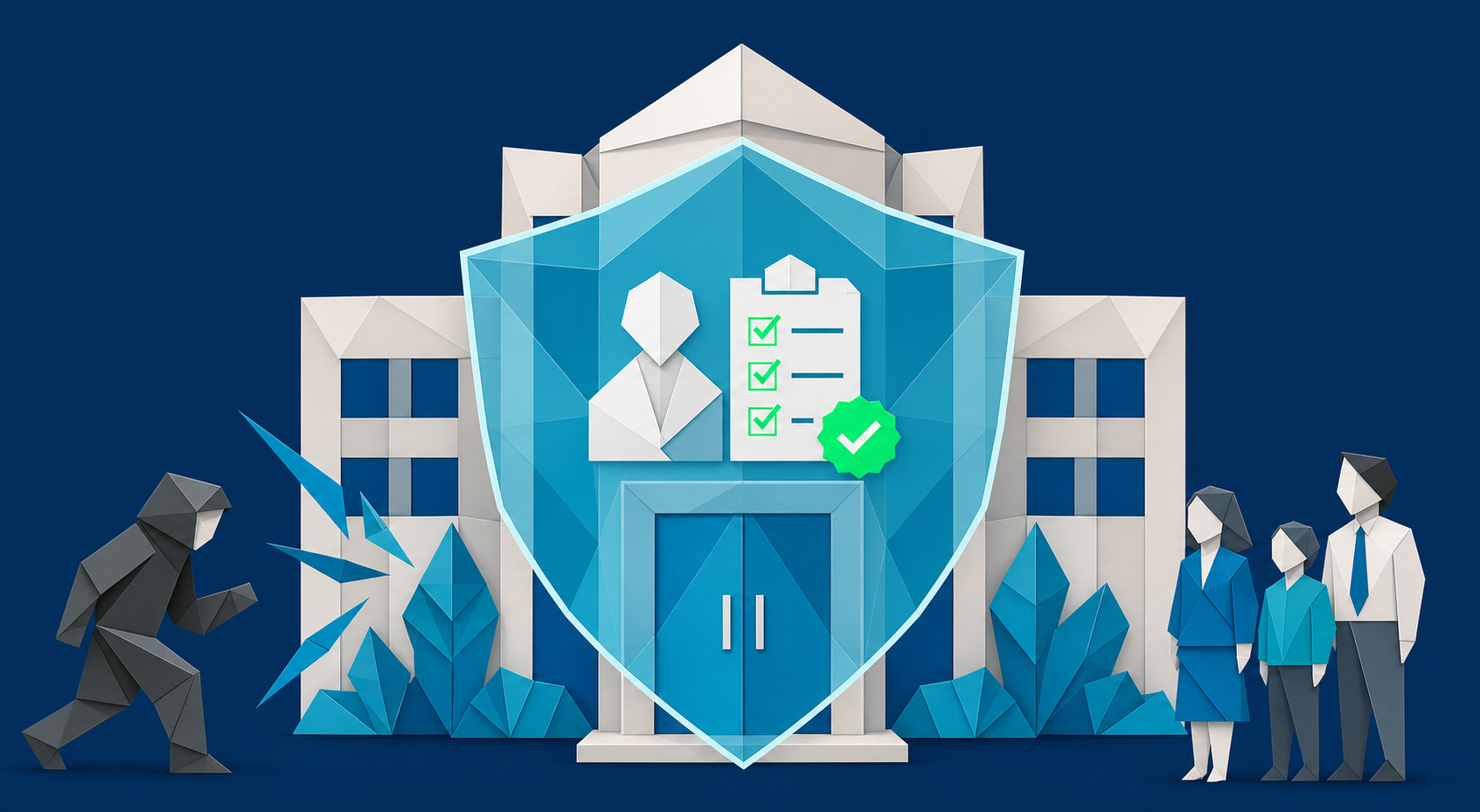
Healthcare compliance monitoring has evolved from a periodic administrative task into a continuous, automated internal audit process. By 2026, the standard for providers in Draper, UT, requires moving beyond the traditional annual background check. Modern monitoring creates a bridge between strict federal mandates like HIPAA and HITECH and the everyday actions of your clinical staff. It's a proactive shield that ensures every member of your team remains eligible to provide care at all times.
The 2026 regulatory environment demands real-time data streaming. Static reviews are no longer sufficient to meet the broader requirements of Regulatory Compliance within the medical sector. When hospital boards can see live status updates of their entire workforce, they achieve a state of tranquility of mind. This clarity allows leadership to focus on patient outcomes rather than worrying about hidden liabilities or sudden legal audits.
The financial consequences of oversight are severe. The Office of Inspector General (OIG) regularly issues Civil Monetary Penalties (CMP) that can reach $22,331 per item or service claimed as of late 2025. Employing even one person on an exclusion list can trigger a complete loss of Medicare and Medicaid reimbursement eligibility. This financial hit often accounts for 30% to 50% of a typical healthcare facility's revenue. Beyond the ledger, the reputational cost is devastating. Data from 2024 suggests that 68% of patients will switch providers if they learn a facility was cited for safety incidents linked to unverified staff.
Effective healthcare compliance monitoring requires a multi-layered approach to oversight. You must track data from several critical sources simultaneously to ensure your facility remains in good standing:
Relying on manual checks is a risk you don't need to take. Modern healthcare compliance monitoring systems provide instant alerts; they make sure your facility stays ahead of these regulatory bodies before a violation occurs. It's about turning a complex bureaucratic hurdle into a simple, automated safeguard for your practice.
Building a robust defense against regulatory penalties starts with rigorous healthcare compliance monitoring. Draper providers must align their internal policies with the OIG General Compliance Program Guidance to ensure every staff member remains eligible to work in federally funded programs. This process begins with consistent exclusion list screening. You must check the Office of Inspector General's List of Excluded Individuals and Entities (LEIE) and the System for Award Management (SAM.gov) at least monthly. Hiring an excluded individual can lead to Civil Monetary Penalties exceeding $20,000 per item or service claimed, according to 2024 federal enforcement data.
Sanction monitoring extends beyond the initial hiring phase. It involves tracking disciplinary actions across all 50 states. If a nurse practicing in Utah faces a license suspension in Idaho, your system needs to flag that change immediately. This proactive approach converts a complex bureaucratic task into a streamlined safeguard for your facility's reputation. It's about creating a culture of integrity where every provider is verified against the highest standards of professional conduct.
The Fraud and Abuse Control Information System (FACIS) provides a tiered approach to risk management. Level 1 meets basic federal requirements by searching the OIG and SAM databases. Level 2 adds state-specific data, while Level 3 offers the most comprehensive view available. Level 3 is essential for multi-state healthcare systems because it searches over 5,000 high-level sources, including state medical boards, pharmacy boards, and attorney general offices. This deep dive ensures nothing slips through the cracks. For a deeper look at these requirements, read our FACIS screening guide.
Primary Source Verification (PSV) is the only way to confirm a provider's qualifications with absolute certainty. We contact medical schools and licensing boards directly to validate degrees, diplomas, and active certifications. This eliminates the risk of fraudulent credentials, which have seen a rise in recent years. We also investigate any "gap" between graduation and professional practice, ensuring no hidden disciplinary issues exist during those periods. If you're looking to optimize your onboarding, check out our employment verification guide. Our automated tools make healthcare compliance monitoring fast and intuitive, providing the peace of mind you need to focus on patient care. You can simplify your screening process to keep your Draper clinic fully protected and compliant.
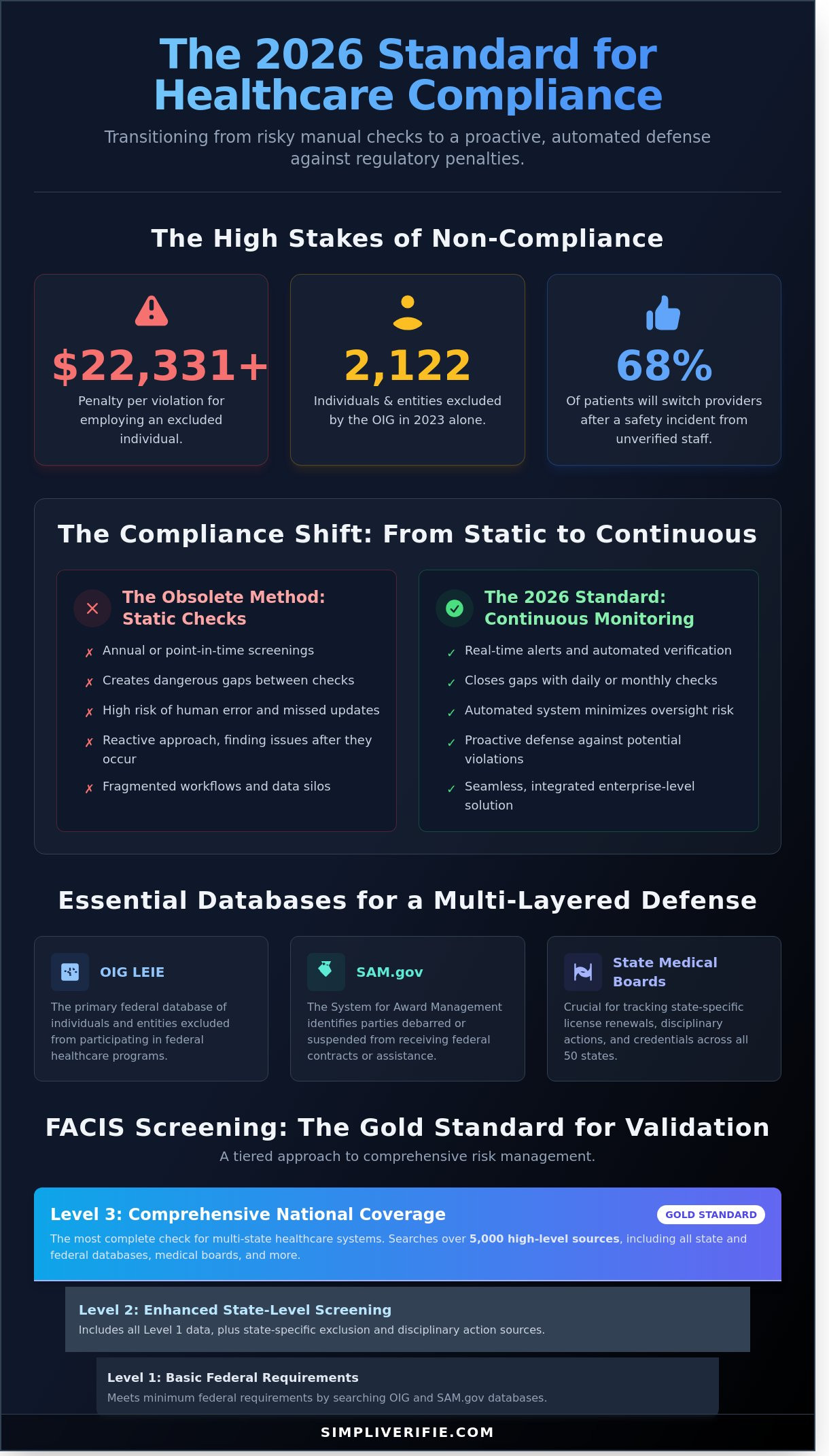
The traditional model of performing a single background check at the time of hire leaves a dangerous void in your security protocol. This "Compliance Gap" means that for 364 days a year, you're operating on outdated data. If a clinician in Draper faces legal trouble or professional sanctions shortly after their start date, your facility remains exposed until the next annual review. Continuous healthcare compliance monitoring eliminates this risk by providing real-time visibility into your workforce's current status, ensuring you don't miss critical changes that happen between cycles.
Transitioning from manual reviews to automated systems directly addresses common cost objections. Manual HR labor for monthly exclusion checks often consumes 15% to 20% of a specialist's monthly hours in mid-sized clinics. Automation replaces these labor-intensive tasks with instant digital pings. Consider a 2023 case where a healthcare provider faced over $150,000 in fines because an employee was added to the OIG exclusion list just three months after a "clean" annual check. Relying on outdated snapshots is a gamble that your budget and reputation shouldn't take.
Modern technology bridges the gap between local booking data and employer dashboards. When an active employee is processed through a participating jurisdiction, an alert triggers within 24 to 48 hours. To maintain strict FCRA compliance, our system ensures that all post-hire data is verified before you initiate any adverse action. This "always-on" oversight is vital for high-risk clinical roles where patient safety is the primary concern. It transforms your HR department into a proactive shield rather than a reactive record-keeper.
Efficiency increases when you remove human error from the compliance equation. By using API integrations, your system performs daily pings against federal databases like the OIG LEIE and SAM.gov. For a deeper look at the regulatory framework and the seven core elements of a program, the AAPC provides a comprehensive guide to healthcare compliance that explains the necessity of these checks. This shift allows your team to focus on growth and patient care while the software handles the healthcare compliance monitoring in the background. It delivers the peace of mind that comes from knowing your staff remains eligible to provide care every single day.
Establishing a modern compliance framework doesn't have to be a bureaucratic burden. Start by auditing your current data to identify where records are siloed. In many Draper clinics, credentialing files live in one department while HR records sit in another. Centralizing this information is the first step toward effective healthcare compliance monitoring. You can't monitor what you haven't mapped.
Once your data is centralized, follow these five steps to build a resilient system:
A one-size-fits-all approach is inefficient and leaves gaps. Physicians and nurses require monthly OIG and SAM checks alongside license standing verifications. For billing and coding staff, focus on financial sanction lists and state-specific exclusion registries. Don't overlook your mobile workforce. For the 12% of healthcare employees in Utah who work in home health or patient transport, recurring MVR checks are essential for safety. Incorporating drug screening and preventive health resources like Health Screen Test into this recurring cycle ensures your facility remains a high-integrity environment for patient care.
Your monitoring program must align with the OIG's Seven Elements of an Effective Compliance Program, originally outlined in 1998. This starts with a clear standard operating procedure (SOP) for exclusion hits. If a provider appears on a list, your team needs a pre-defined workflow to verify the identity and take immediate action. Training is the final piece. Ensure your HR and legal teams understand adverse action procedures under the Fair Credit Reporting Act (FCRA). This protects your facility from litigation while maintaining 100% audit readiness. Automated healthcare compliance monitoring removes the guesswork, allowing you to focus on patient outcomes rather than paperwork.
Ready to simplify your facility's safety protocols? Get peace of mind with our automated compliance solutions.
Managing healthcare standards shouldn't feel like a full-time administrative burden. At SimpliVerified, we strip away the friction that usually slows down validation searches. Our platform replaces manual spreadsheets with automated precision. We've built our systems to handle the heavy lifting so your Draper team can focus on patient outcomes rather than paperwork. By moving from legacy bureaucracy to a model of operational efficiency, we ensure your facility stays current with every OIG and SAM requirement without missing a beat.
Our enterprise-level integrations mean you get fast, accurate results that sync directly with your existing HR software. You don't have to toggle between different windows to verify a nurse's credentials or check a physician's exclusion status. Plus, you're never just a ticket number in a queue. Our expert support team is based right here in Draper, UT. When you call, you speak to a local specialist who understands the specific regulatory climate of the Beehive State. Our proactive approach to healthcare compliance monitoring protects your reputation and your bottom line.
Our real-time dashboards give you a bird’s-eye view of your entire staff's status in seconds. You can spot potential issues before they become liabilities. For larger health systems that manage these insights within a centralized hub, technology from Activu Corporation can help integrate these critical data streams into a mission-critical control room environment. We've automated the tedious parts of the job; the system sends out reminders for license renewals and recurring drug tests according to your specific schedule. This ensures you never miss a 2024 compliance deadline. Our per-verification pricing model supports your growth. You only pay for what you use, making it easy to scale your workforce up or down as patient volume fluctuates.
Modern healthcare demands more than just a background check at the time of hire. It requires a dynamic, ongoing strategy. A robust healthcare compliance monitoring program turns a legal necessity into a competitive strength. You'll gain the confidence that every professional in your building is fully vetted and authorized to provide care. It's time to stop worrying about audits and start focusing on excellence. We're here to help you transform your compliance process into a seamless part of your daily operations.
Schedule a consultation with our healthcare specialists today to see how we can secure your facility's future.
The healthcare landscape in 2026 demands a shift from reactive habits to proactive oversight. Relying on annual background checks creates dangerous gaps in your safety net. You need a system that offers continuous visibility into your workforce's credentials and standing. Modern healthcare compliance monitoring isn't just about avoiding fines; it's about protecting your patients and your organization's reputation every single day. By eliminating the blind spots associated with static checks, you can prevent costly OIG exclusions and legal liabilities before they escalate.
SimpliVerified streamlines this complex process through enterprise-level integration and a nationwide network of 15,000+ collection sites. Our team provides expert OIG, SAM, and FACIS validation to ensure your staff remains eligible and compliant in real time. We remove the friction from your administrative workflows so you can focus on providing exceptional care. You don't have to navigate these regulatory shifts alone. Our technology turns a bureaucratic burden into a seamless asset for your HR team.
Simplify Your Healthcare Compliance with SimpliVerified
Take the first step toward total tranquility of mind and a safer facility for everyone you serve.
Healthcare screening is a one-time background check performed during the hiring process to verify a candidate's history. It provides a snapshot of a person's past at a specific moment. In contrast, healthcare compliance monitoring is a recurring process that tracks an employee's status throughout their entire tenure. This ongoing oversight ensures you catch new exclusions or legal issues as they happen.
The Office of Inspector General (OIG) recommends that healthcare providers check the List of Excluded Individuals/Entities (LEIE) every month. Since the OIG updates its database monthly, this frequency is the industry standard for Draper clinics. Failing to perform these 30-day checks can lead to significant federal fines under 42 CFR Section 1003.
Continuous monitoring is fully compliant with the FCRA as long as you obtain clear, written consent from the employee. You'll need a disclosure and authorization form that specifically covers the duration of their employment. This legal step ensures transparency and provides peace of mind while protecting your organization from liability under federal background check laws.
If an employee appears on the SAM.gov list, you must immediately remove them from any role involving federal funds or contracts. The General Services Administration (GSA) uses this list to track individuals barred from procurement programs. Retaining an excluded person can lead to debarment, which prevents your entire facility from receiving federal payments or participating in government programs.
Modern healthcare compliance monitoring solutions integrate directly with popular HR platforms like Workday or BambooHR through secure API connections. This automation reduces manual data entry errors by approximately 35% and ensures your roster stays updated in real-time. It's a simple way to streamline your workflow without switching between multiple software systems.
Comprehensive monitoring includes automated alerts for professional license expirations and state board disciplinary actions. The system scans state databases daily to confirm that nurses, physicians, and technicians hold valid credentials. This proactive feature helps you avoid the 10,000 dollar daily penalties often associated with allowing staff to practice on an expired or revoked license.
Providers face Civil Monetary Penalties of up to 22,331 dollars for every individual service or item claimed while an excluded person was on staff. The OIG also imposes assessments of up to three times the total amount claimed to Medicare or Medicaid. These 2023 federal figures demonstrate the high cost of oversight failures for Utah medical practices.
FACIS Level 3 isn't a federal requirement, but it's the preferred standard for 95% of healthcare risk managers. It searches more than 3,000 sources, including state-level exclusions and debarment lists from all 50 states. Choosing Level 3 offers the most robust protection against negligent hiring claims and ensures no local disciplinary actions go unnoticed.