Hiring
Drug Testing
Employment Screening


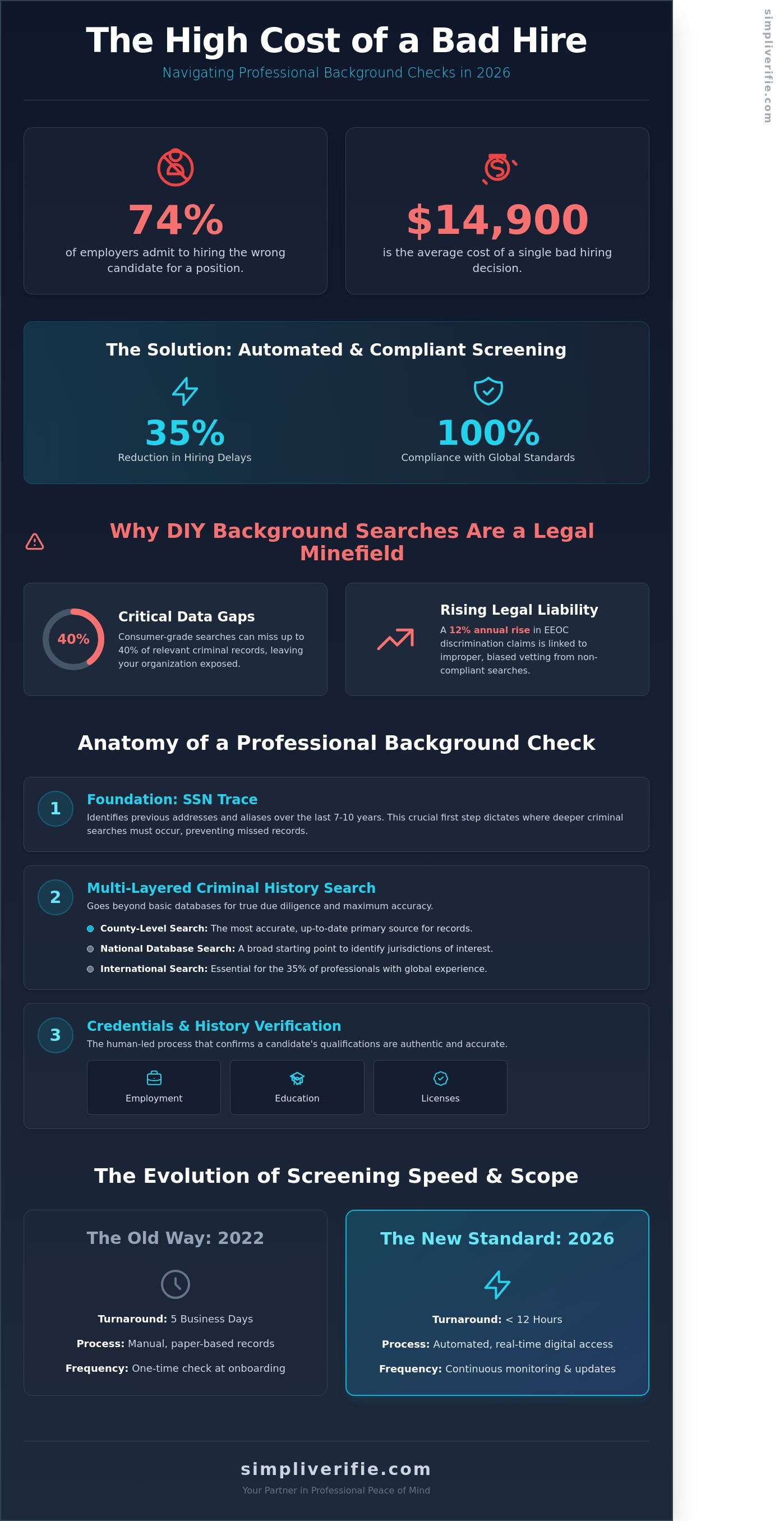
A 2025 CareerBuilder study found that 74% of employers admitted to hiring the wrong candidate, with each mistake costing an average of $14,900. You've likely felt the tension between needing a rapid background check and the fear that a single data error could lead to a devastating legal claim. It's frustrating when slow manual processes delay your best hires, yet you can't afford to skip the due diligence that keeps your workplace safe.
This guide gives you the tools to navigate the complex regulatory environment of 2026 with total confidence. You'll learn how to integrate automated screening to cut your hiring delays by 35% while ensuring 100% compliance with evolving Canadian and global privacy standards. We'll explore advanced identity verification, proactive risk management, and the specific steps required to turn your vetting process into a simple, friction-free experience that provides lasting peace of mind.
A professional background check serves as a regulated risk-management tool designed to verify a candidate's history with surgical precision. By 2026, hiring has moved past basic identity verification. Companies now face a landscape where over 90% of organizations require comprehensive screening to protect their physical workplace and digital assets. Professional screening acts as a shield for your company culture. It ensures every new hire strengthens your team rather than introducing avoidable risks. To build a foundation, you should ask, What is a background check? It's more than a database hit; it's a verified report that complies with federal and provincial regulations. This distinction matters because consumer-grade searches often miss up to 40% of relevant criminal records found in professional, courthouse-level investigations.
Professional reports prioritize four key areas to ensure total peace of mind:
The screening process has undergone a massive digital transformation. We've moved from waiting on physical paper records to accessing digital courthouses in real-time. By 2026, the industry standard has shifted toward continuous monitoring. Organizations don't just check a box once during onboarding. They receive automated updates if a relevant record changes during a candidate's tenure. Technology has slashed turnaround times. Processes that took five business days in 2022 now conclude in less than 12 hours. This speed provides the efficiency you need to secure top talent before competitors do, without sacrificing the depth of the background check.
Using "people-search" sites for hiring decisions is a dangerous gamble. These platforms often provide outdated or unverified data that doesn't meet the standards of the Fair Credit Reporting Act (FCRA). Relying on social media for screening introduces inherent biases that lead to legal trouble. Data from 2025 shows that EEOC discrimination claims related to improper vetting have risen by 12% annually. Professional reports remove these risks. They provide verified, compliant data that protects you from litigation. You get a clear, objective view of a candidate's integrity without the noise of unverified internet rumors or inaccurate public profiles.
A high-quality background check is far more than a simple database search; it's a structured investigation designed to provide total peace of mind. By layering different types of data, employers gain a 360-degree view of a candidate's history and integrity. This process typically begins with a Social Security Number (SSN) trace. This step identifies previous addresses and aliases used over the last 7 to 10 years, which then dictates where the deeper criminal searches must occur. Without this foundational step, a report might miss records in jurisdictions where the candidate lived only briefly.
Modern screening also integrates the legal and compliance landscape to ensure every data point is collected according to federal guidelines. Specialized screenings like Motor Vehicle Records (MVR), Credit Reports, and Sex Offender Registries add extra security for specific roles. These tools help companies mitigate risk before it ever enters the workplace, transforming a complex bureaucratic task into a fluid, positive experience.
A "National" search is a great starting point, but it's rarely sufficient on its own. These databases often contain gaps or delayed information from specific jurisdictions. For true due diligence, direct county-level court research is essential. It provides the most recent dispositions and ensures the data is accurate as of today. By 2026, roughly 35% of the professional workforce has some form of international experience. Navigating these global records requires expertise in local privacy laws and varying judicial structures. For businesses expanding their footprint into regions like India, you can learn more about Krystal7 Consultants for specialized help with company registration and legal compliance. This multi-layered approach ensures no stone is left unturned, providing a clear picture of a candidate's past.
Technology is fast, but it isn't perfect. Automated employment verification often requires a manual follow-up to get the full story. Statistics from late 2025 showed a 12% rise in "diploma mills" and sophisticated resume fraud. Direct outreach to educational institutions and former employers is the only way to confirm a candidate's true standing and professional licenses. Our team uses proven techniques to bypass fraudulent claims, ensuring your new hire has the skills they promised. You can experience this streamlined precision by choosing a partner that prioritizes human-verified accuracy over simple automation.
Compliance in 2026 demands a proactive strategy to mitigate legal risk. The Fair Credit Reporting Act (FCRA) remains the primary framework for all employment screening. To maintain a compliant hiring flow, you must provide a clear, standalone disclosure and obtain written authorization before initiating any background check. Understanding Fair Credit Reporting Act rights ensures your team respects candidate protections while maintaining operational security. This foundational step prevents the procedural errors that lead to 75% of class-action compliance lawsuits.
The Equal Employment Opportunity Commission (EEOC) continues to intensify its focus on disparate impact. By January 2026, 37 states and over 150 cities have implemented "Ban the Box" laws. These regulations often require employers to delay criminal history inquiries until after a conditional offer is made. Failing to align your process with these local mandates can result in fines exceeding $2,500 per violation in jurisdictions like California or Illinois. Modern HR teams use automated workflows to ensure these checks only occur at the legally permissible stage of the funnel.
If a background check reveals information that might disqualify a candidate, you must follow a strict three-step process to avoid litigation. First, send a Pre-Adverse Action notice. This package must include a copy of the report and a summary of the candidate's rights. It gives the individual a chance to dispute inaccuracies or provide context. In 2026, a "reasonable" waiting period is typically five business days, though some state laws now mandate seven. Finally, if you proceed with the rejection, issue a Final Adverse Action notice. This structured approach provides the transparency needed for a positive candidate experience, even during a rejection.
Artificial intelligence has transformed screening, but it brings new legal hurdles. Laws like the AI Disclosure Act now require companies to inform candidates when automated systems influence hiring decisions. Data privacy standards have also shifted toward the "data minimization" principles found in the CCPA and GDPR. U.S. employers must now ensure their screening partners use ethical data sourcing rather than unreliable "scraped" data. This focus on data integrity protects your company from the 15% increase in accuracy-related claims observed over the last two years. Choosing a partner that prioritizes these standards delivers the peace of mind required to scale your workforce safely.
Scaling a background check program requires a framework that adapts to your hiring volume without creating bottlenecks. You can't treat every role with the same level of scrutiny. Smart HR leaders categorize positions into risk-based tiers. A warehouse associate might only require a national criminal search and identity verification. Conversely, a C-suite executive demands deep-dive financial checks, media searches, and educational verification. This tiered approach prevents you from overspending on low-risk hires while ensuring high-stakes roles receive the attention they deserve.
Efficiency thrives on automation. Integrate your screening platform directly into your Applicant Tracking System (ATS) to eliminate manual data entry. This integration can reduce administrative time by 40% and significantly lowers the risk of human error. Consistency is equally vital. You need a clear adjudication matrix that defines "pass" or "fail" criteria before the first report arrives. This objective standard protects your organization from bias and ensures every candidate is treated fairly. For safety-sensitive roles, you should always incorporate pre-employment drug tests to maintain a secure environment.
Different sectors face unique regulatory pressures. In healthcare, you must prioritize OIG/GSA exclusions and ongoing compliance monitoring to protect patient safety. Transportation firms must adhere to strict DOT-compliant Motor Vehicle Record (MVR) standards and drug screening protocols. If you're in the real estate sector, tenant screening requires a delicate balance. You're looking at 7-year credit histories alongside eviction records to ensure property security and financial reliability. Regardless of your industry, supporting your team's overall well-being is a smart long-term strategy; to see how quality care can benefit your workforce, check out Smiley Dental Beverly.
Choosing the right background check service depends on your specific volume and industry needs. In 2026, a standard turnaround time (TAT) should hover around 48 hours for basic criminal searches. Don't let slow data entry stall your pipeline. Mobile-friendly candidate portals allow applicants to upload documents directly from their phones. This feature alone can speed up the initiation process by 24 hours compared to traditional desktop methods. It's about making the experience fluid for the candidate while keeping your data precise.
Ready to streamline your hiring process? Optimize your workflow with our integrated screening solutions and gain total peace of mind today.
Selecting a background check partner shouldn't feel like a gamble. SimpliVerified bridges the gap between high-scale enterprise technology and personalized boutique service. We deliver 99.9% data accuracy through a rigorous dual-layer verification process that eliminates uncertainty. Our team, based in Draper, Utah, combines local expertise with a massive nationwide network of over 15,000 collection sites. This vast reach ensures your candidates have easy access to screening regardless of their geographic location. You get the power of a global firm with the responsiveness of a dedicated partner.
Our pricing model stays transparent because trust is built on honesty. You'll never see hidden fees, administrative surcharges, or surprise "technology costs" on your invoice. We focus on per-report value, giving you clear insights into your hiring budget from the very first day. This direct approach allows you to scale your hiring efforts up or down without worrying about fluctuating costs or complex contracts. It's a simple, pragmatic way to manage your workforce security.
Efficiency defines our platform. Our seamless ATS integrations reduce manual data entry by 40% based on 2025 performance metrics. This automation allows your HR team to focus on talent acquisition rather than administrative paperwork. Both employers and candidates benefit from real-time status tracking. This visibility removes the anxiety of the waiting period by showing exactly where the report stands in the pipeline. Security remains our top priority. We use advanced encryption and strict SOC 2 compliant protocols to protect sensitive PII data. It's a modern approach to a critical security step. Our system handles the complexity so you don't have to.
The "one and done" background check is obsolete in 2026. A clean record on a hire date doesn't guarantee future safety or ongoing compliance. Our recurring monitoring services alert you to post-hire criminal activity as it happens, rather than waiting for an annual review. This proactive workforce management protects your brand reputation and maintains a secure environment for all employees. You aren't just hiring safely; you're staying safe. It's about long-term peace of mind. By automating these checks, we help you mitigate risks before they escalate into legal or financial liabilities. This consistent oversight is the new standard for professional integrity in the modern workplace.
We believe that security should be fluid and frictionless. Our tools are designed to integrate into your existing workflow without causing delays. Whether you're a small business or a large corporation, our goal is to provide a sense of serenity. We take care of the details so you can focus on growing your business with confidence. That's the SimpliVerified promise.
The hiring landscape in 2026 requires a shift from reactive screening to proactive risk management. You now understand how to navigate evolving compliance standards and implement scalable strategies that protect your company's culture. A professional background check shouldn't be a bottleneck in your recruitment process; it's a vital tool for ensuring long term integrity and safety. By focusing on comprehensive data and legal adherence, you're setting a foundation for sustainable organizational growth.
SimpliVerified bridges the gap between complex legal requirements and operational efficiency. Our FCRA-certified screening experts provide the precision you need, supported by a nationwide network of 15,000+ labs across the country. We've designed our system to streamline your workflow through advanced ATS integration capabilities, letting you focus on talent acquisition instead of manual data entry. You'll gain total peace of mind while maintaining full compliance with federal and local regulations. It's about making your growth safer and your daily operations smoother. Let's transform your onboarding experience into a frictionless path for top tier candidates.
Get Started with SimpliVerified Today and build a team you can trust with absolute confidence.
A standard professional background check in 2026 typically takes between 24 and 48 hours to complete. Digital integration with national databases allows for 90% of results to return within this window. Manual verifications for international records or specific education transcripts can extend the timeline to 5 or 10 business days. Automated systems now handle 75% of the data retrieval process to ensure speed and accuracy for every client.
A standard criminal background check reveals adult criminal convictions, active warrants, and current judicial orders like probation. It specifically lists the date of the offense, the nature of the charge, and the final disposition. In Canada, this search checks the CPIC database which contains over 5 million records. Summary offenses and indictable offenses both appear unless a record suspension was granted by the government.
No, employers can't legally perform a background check without the candidate's explicit, written consent. Federal laws like PIPEDA and provincial privacy acts require 100% transparency during the screening process. Candidates must receive a clear disclosure form before any data collection begins. Failing to obtain this authorization violates privacy rights and can lead to legal penalties for the organization, regardless of the industry.
The primary difference lies in the jurisdictional scope of the data retrieved. A national search scans the central database for records across all 10 provinces and 3 territories. A local search focuses on records held by specific municipal police services or courthouses. While national searches catch 95% of convictions, local searches find recent filings from the last 30 days that aren't yet uploaded to the central system.
Employment background checks typically cover a period of 7 to 10 years of history. Most recruiters verify the last 3 positions held or the most recent decade of professional experience to ensure relevance. For high security roles, some checks extend to 20 years or a candidate's entire adult life. This standard helps maintain compliance with human rights legislation regarding the relevance of past information to the current role.
If a background check reveals a record, the employer must conduct an individualized assessment of the findings. They evaluate if the offense directly relates to the job duties, such as a theft conviction for a high level accounting role. Statistics show that 1 in 10 applicants may have a record. Employers should follow a clear policy to avoid discrimination while protecting company assets and the safety of their team.
Drug testing integrates as a conditional component of the screening process, usually occurring after a job offer is made. In 2026, 65% of safety sensitive industries use oral fluid or urine testing to ensure workplace safety. These results are managed through the same secure portal as the criminal check for a seamless experience. This consolidation reduces the hiring cycle by approximately 3 days compared to using separate vendors.
Yes, landlord checks focus heavily on financial stability and rental history rather than professional skills. While both include a criminal search, landlord reports emphasize credit scores and previous eviction records from the last 5 years. Employers prioritize employment gaps and professional references. Both types of screening require the applicant's consent and must follow local privacy laws to protect the sensitive data of the individual involved.