
Hiring
Drug Testing
Employment Screening


Did you know that 1,681 new FCRA-related lawsuits were filed in the first quarter of 2026 alone? This staggering number confirms what many HR professionals already feel; the legal landscape for hiring is becoming increasingly tight. You're likely concerned about balancing federal mandates with new state-specific rules, such as the Virginia "Clean Slate" law that took effect this July. Understanding the exact background check consent form requirements is now your most important step in avoiding litigation and protecting your company's reputation.
At SimpliVerified, we believe compliance shouldn't be a source of stress or a bottleneck in your workflow. This guide will help you master the legal intricacies of FCRA-compliant forms to protect your organization and streamline your hiring process. We'll provide a clear checklist of required elements, explain the critical "standalone disclosure" rule, and show you how a digital-first approach creates a faster, more professional experience for every candidate.
Compliance isn't just a checkbox; it's the bedrock of a secure hiring strategy. To navigate 2026 standards, employers must understand that the legal foundation for every screening rests on two distinct documents. While they often arrive in the same digital packet, the disclosure and the authorization serve very different purposes under the Fair Credit Reporting Act (FCRA).
The Disclosure is a written notification that informs the candidate that a consumer report may be obtained for employment purposes. It's a "heads-up" required by law. The Authorization, on the other hand, is the candidate's formal, signed permission for you to proceed with that check. You cannot have one without the other, and their presentation is just as important as their content.
Many organizations fall into a costly trap by trying to save space. They might combine these two elements into a single, dense paragraph or bury them within a larger job application. Doing so is a major legal liability. Courts consistently rule that the disclosure must be "clear and conspicuous" and, most importantly, standalone. If your background check consent form requirements are tangled with liability waivers or "at-will" employment statements, you're essentially inviting a class-action lawsuit. SimpliVerified helps teams avoid these pitfalls by providing streamlined, automated templates that keep these documents separate and compliant.
In 2026, the regulatory environment is sharper than ever. The FTC and the Consumer Financial Protection Bureau (CFPB) have shifted their focus toward extreme candidate transparency. They're no longer just looking for the presence of a form; they're scrutinizing the clarity of the language. "Clear and conspicuous" means the notice shouldn't be hidden in fine print or obscured by complex legal jargon. It must be easily understood by the average applicant. SimpliVerified provides tailored solutions across various industries to help teams meet this standard without adding friction to the hiring process.
Timing is everything. You must provide the disclosure and obtain authorization before you order any report. While it's common to integrate these steps into the early application stages, you must maintain the "standalone" integrity of the disclosure. It cannot be a subsection of the application itself. It needs to be a distinct screen or a separate document that the candidate interacts with independently. This ensures the applicant isn't distracted by other information and fully understands what they're signing. By getting these background check consent form requirements right early on, you create a professional candidate experience that builds trust from the very first interaction.
If there's one area where HR teams consistently find themselves in legal hot water, it's the formatting of the disclosure. The Fair Credit Reporting Act is remarkably strict about how you present information to a candidate. The Standalone Disclosure rule is the requirement that a background check notice contains nothing but the notice itself. This means you cannot simply add a few sentences to the bottom of a job application or include it as a footnote on a multi-page PDF. To meet federal standalone disclosure requirement standards, the document must be separate, distinct, and entirely focused on the background check process.
Modern litigation often centers on "background check consent form requirements" that were ignored in favor of convenience. When you bundle the disclosure with other onboarding paperwork, you risk confusing the candidate. Courts have been clear: if an applicant has to hunt for the disclosure among other terms and conditions, the employer is liable. SimpliVerified streamlines this by providing digital systems that present the disclosure as a dedicated, single-focus screen, ensuring your process remains beyond reproach.
The biggest mistake an employer can make is adding "extraneous" information to the disclosure document. Liability waivers are the most dangerous addition. If you include a clause that asks the candidate to waive their right to sue, you've likely invalidated the entire disclosure. Other common errors include adding "at-will" employment statements, job descriptions, or complex legalese that explains company policies. Recent class-action cases have resulted in multi-million dollar settlements simply because an employer included a single sentence of non-disclosure text on the form. If you're unsure if your current forms meet these standards, you can learn more about our automated compliance tools that filter out these risks for you.
Meeting the "clear and conspicuous" standard requires more than just separating the document. You must also consider the visual presentation. In a digital-first hiring environment, font size and readability on mobile screens are critical. A disclosure buried in a tiny, 8-point font or obscured by distracting graphics won't hold up in court. Every candidate should be able to read and understand the notice without strain. SimpliVerified uses a clean, distraction-free design for all digital disclosures. This approach ensures the candidate focuses solely on their rights, which protects your organization while providing a more professional experience for the applicant.
Federal regulations under the FCRA establish a baseline for compliance, but they're often just the floor, not the ceiling. For employers with a distributed workforce, background check consent form requirements vary significantly from one jurisdiction to the next. Relying on a single, generic document for every candidate exposes your organization to regional legal risks that federal forms don't cover. To fully comply with federal laws while respecting local mandates, you must adopt a more localized approach to your screening documents.
Managing a remote team means you're likely dealing with candidates in states with "Ban the Box" laws or specific disclosure mandates. You must also include the "Summary of Your Rights Under the Fair Credit Reporting Act" as a mandatory attachment in every instance. This document ensures the candidate knows how to dispute inaccuracies, which is a key component of a fair hiring process. If you're also handling Employment Verification: The Complete 2026 Employer Guide, the intersection of state privacy laws and federal reporting becomes even more complex.
Beyond the initial hire, the concept of "evergreen" consent is a common stumbling block. While some states allow an authorization to remain valid throughout a person's entire tenure, others require you to re-disclose and get new permission every time you run a follow-up check. This is particularly relevant for roles requiring continuous monitoring or annual driving record reviews. Failing to refresh these authorizations in restrictive states can lead to the same litigation traps discussed in previous sections.
California’s Investigative Consumer Reporting Agencies Act (ICRAA) requires a specific checkbox allowing candidates to request a copy of their report. In New York, you must provide a copy of Article 23-A, which outlines how criminal histories should be evaluated fairly. Meanwhile, Washington’s Fair Chance Act limits when you can even present a consent form, often requiring you to wait until after a preliminary screening or interview. Each of these states has unique background check consent form requirements that demand precise language to avoid heavy penalties.
HR leaders often choose between a "most restrictive" approach, using the toughest state’s form for everyone, or using dynamic forms that change based on the candidate's address. The dynamic approach is usually better for the candidate experience. SimpliVerified automates this process by generating state-specific disclosures based on where your applicant lives and works. Our platform ensures that the right legal language appears at the right time, removing the manual burden of tracking legislative changes in 50 different states.
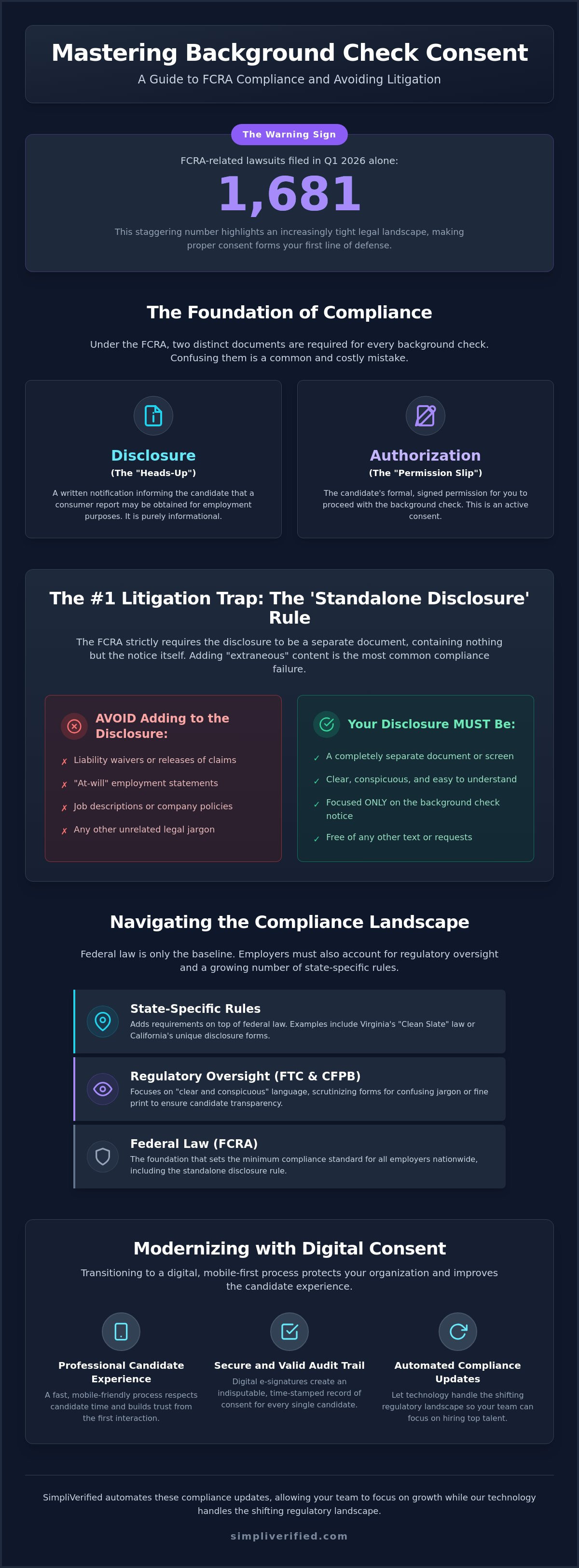
Switching from paper to digital isn't just a trend. By 2026, it's a necessity for any organization that values speed and legal security. Paper forms are a liability. They're easily lost, prone to messy handwriting, and often fail to provide the clear audit trail that modern regulators demand. Modern background check consent form requirements involve more than just the right words; they require a secure digital framework that proves the candidate was properly informed.
The legal validity of electronic signatures is anchored in the federal Electronic Signatures in Global and National Commerce Act (ESIGN) and the Uniform Electronic Transactions Act (UETA). These laws ensure that a digital signature carries the same weight as ink on paper, provided the process is transparent. Digital consent doesn't just satisfy the law; it drastically reduces data entry errors. When candidates type their own information into a secure portal, you eliminate the risk of misreading a Social Security number or a birth date, which speeds up your overall turnaround times. For a seamless transition, learn how SimpliVerified automates digital authorizations for your team.
Beyond the signature itself, maintaining a robust audit trail is your best defense in a courtroom. A digital system captures metadata, documenting exactly when the candidate viewed the disclosure and the precise moment they provided consent. This level of detail is impossible to replicate with traditional paperwork and provides an extra layer of protection against claims that a candidate didn't see the required notices.
To keep your digital process compliant, you must treat the disclosure as a distinct, unskippable screen. The candidate shouldn't be able to proceed to the authorization without first acknowledging the disclosure. This reinforces the standalone rule we discussed earlier. A compliant process requires a clear affirmative action, such as checking a box or typing a full name, rather than a pre-checked box or a hidden link. Finally, always provide a downloadable copy of the signed authorization to the candidate. This transparency builds trust and meets federal expectations for consumer access to their own records.
Recruitment in 2026 happens on the go. If your background check consent form requirements aren't mobile-optimized, you're likely losing candidates to friction. Forms must be readable on smartphones without zooming or horizontal scrolling. This is especially critical for high-volume hiring or field-based roles. Additionally, ensure your digital disclosures meet ADA compliance standards. Accessibility isn't just a legal requirement; it's about making your hiring process inclusive for every applicant. Reducing friction in these early stages prevents candidate drop-off and ensures a more professional experience from start to finish.
Meeting modern background check consent form requirements shouldn't feel like a full-time legal job for your HR team. SimpliVerified provides a technology-integrated platform that automates these complexities. Our solution plugs directly into your existing ATS or HRIS, allowing you to manage the entire screening process from a single dashboard. This integration eliminates the need for manual data entry and ensures that every candidate receives the correct, standalone disclosure at exactly the right time.
Regulations change fast. As federal and state laws evolve throughout 2026, our platform updates automatically to reflect new mandates. You won't have to worry about whether your forms are outdated or if a new state law has rendered your current process invalid. We handle the technical and regulatory heavy lifting so you can focus on building your team. Fast turnaround times are a core promise at SimpliVerified, and that speed begins with a seamless, compliant consent process that candidates can complete in minutes from any device. We provide dedicated support for various industries that require high levels of precision and reliability.
Healthcare and transportation sectors face unique hurdles that go beyond standard criminal checks. Managing additional consent for healthcare-specific searches like OIG/SAM or professional license verification requires a specialized approach. For more in-depth information, see The Ultimate Guide to Healthcare Compliance Monitoring in 2026. Our platform also supports continuous monitoring. This ensures that the background check consent form requirements are handled properly for ongoing screening, keeping your organization compliant throughout an employee's entire tenure.
We aim to reduce the administrative burden on your staff through smart automation. When you remove the manual steps from the consent process, you significantly lower the risk of human error. A polished, professional screening experience does more than just protect you legally; it builds immediate trust with your applicants. They see a brand that values their data privacy and follows rigorous standards. At SimpliVerified, we believe compliance isn't just about a form. It's about a strategic partnership that helps your organization grow with total peace of mind. Our team is ready to help you modernize your hiring workflow today.
Mastering background check consent form requirements is about more than avoiding a lawsuit; it's about building a culture of transparency and trust from day one. By prioritizing the standalone disclosure and adopting dynamic, state-specific forms, you protect your organization while respecting candidate rights. The shift toward digital-first authorizations ensures that your hiring process remains fast, accessible, and legally sound. Transitioning to these modern standards removes the friction often associated with legacy screening methods.
SimpliVerified acts as your strategic partner, offering the expertise and technology needed to navigate these complex regulations with ease. Our advanced technological integrations and dedicated compliance support provide fast, accurate results for HR leaders who need to move quickly without sacrificing rigour. We take the guesswork out of screening so you can focus on what matters most: growing your business with total peace of mind.
Streamline your hiring with SimpliVerified's compliant screening solutions and experience a smoother, more secure path to your next great hire. Your team deserves a process that is as professional and forward-thinking as the organization you're building together.
No, you cannot include the disclosure within a job application. The FCRA's standalone rule requires the disclosure to be a document that consists solely of that notice. Including it as a section of an application or bundling it with other onboarding paperwork is a common source of litigation. SimpliVerified automates this by presenting the disclosure on its own dedicated screen, ensuring candidates aren't distracted by extraneous information.
If a candidate refuses to sign, you cannot legally proceed with the background check. In most cases, you can choose not to move forward with the hiring process because the screening is a condition of employment. It's best to explain why the check is necessary for the role to provide reassurance and encourage the candidate to complete the process. This transparent approach helps build trust and often resolves any initial hesitation.
This depends on your state's laws and the language in your original authorization. While some states allow "evergreen" consent that lasts for the duration of employment, others require a fresh signature for every new report. Reviewing your background check consent form requirements for specific jurisdictions like California is essential to ensure your ongoing monitoring remains compliant with local regulations and protects your organization from liability.
You should generally keep signed forms on file for at least five years. This timeframe aligns with the statute of limitations for many federal and state claims related to background screening practices. Storing these documents digitally within a secure system like SimpliVerified makes it easier to produce a clear audit trail if your organization's practices are ever questioned. Digital storage also helps you maintain a clean, organized, and searchable record system.
Yes, a digital signature is just as legally binding as a physical one. The federal ESIGN Act and the Uniform Electronic Transactions Act (UETA) establish that electronic signatures carry full legal weight for FCRA compliance. Digital processes often prove more secure because they capture specific metadata, such as the exact time and IP address where consent was given. This provides a more robust defense than a simple paper signature could offer.
The "Summary of Your Rights Under the Fair Credit Reporting Act" is a mandatory document that explains the candidate's right to dispute inaccurate information. It must be provided as a separate attachment alongside the disclosure and authorization. This ensures the applicant is fully aware of their legal protections before the screening begins and provides them with the necessary contact information for federal agencies. It's a critical piece of the transparency puzzle.
The FCRA generally treats volunteers similarly to employees when a background check is conducted for "employment purposes." You must still provide a standalone disclosure and obtain written authorization before requesting a report. Some states may have specific nuances for volunteer screening, so it's wise to use a platform that automatically adjusts the background check consent form requirements based on the individual's role. This consistency ensures you don't overlook critical legal steps.
If a candidate claims they didn't understand the disclosure, it's a signal to review your form's clarity. The "clear and conspicuous" standard means the language must be easy for the average person to grasp without legal help. SimpliVerified uses straightforward, plain-English templates to minimize confusion and ensure every applicant feels confident and informed throughout the screening experience. Clear communication at this stage prevents candidate drop-off and builds immediate trust in your brand.