Hiring
Drug Testing
Employment Screening


An employee arrives for a shift with bloodshot eyes and slurred speech, and suddenly your morning goes from routine to high-stakes. You know that maintaining a safe workplace is your top priority, but the fear of a wrongful termination lawsuit or a misstep in state law can make you hesitate when seconds count. Successfully conducting reasonable suspicion drug testing Utah protocols requires more than just a gut feeling. It demands a precise balance of objective observation and strict legal adherence to protect your organization.
At SimpliVerified, we understand that confronting a potentially impaired worker is one of the most stressful tasks an HR leader faces. This guide provides the clarity you need to handle these sensitive moments with confidence and professional rigor. You'll master the latest 2026 compliance requirements, including the specific prohibitions of H.B. 130 regarding testing costs, and gain a practical checklist for contemporaneous documentation. We'll show you how to transform a complex regulatory burden into a straightforward process that ensures your team stays safe and your business remains protected.
Utah's approach to workplace safety is anchored by the Utah Drug and Alcohol Testing Act. This legislation serves as a protective shield for businesses, provided they follow the rules. Under Utah Code 34-38-1, private employers have the broad authority to test employees and applicants for drugs and alcohol to maintain safety and productivity. The law isn't just about enforcement; it offers a "Safe Harbor" provision that is a game-changer for HR leaders. When you follow the statute's requirements to the letter, your company receives significant protection from most legal claims related to testing, such as defamation or wrongful termination. It's about building a foundation of trust and legality before a crisis occurs.
A critical component of this legal framework is the Medical Review Officer (MRO). In Utah, a test result isn't considered final until an MRO reviews it. This independent doctor examines positive results to see if there's a valid medical explanation, like a lawful prescription. This step is essential for maintaining the integrity of your reasonable suspicion drug testing Utah program. It ensures that your decisions are based on confirmed medical facts rather than assumptions or misunderstandings. By integrating an MRO into your workflow, you demonstrate a commitment to fairness and accuracy that reinforces your company's credibility.
You can't legally test an employee in Utah without a formal, written policy in place. This document must be distributed to every employee, typically through an employee handbook or a standalone notice. Your policy needs to be explicit. It must define what constitutes "reasonable suspicion" and detail the exact consequences for refusing a test or testing positive. Distribution is just as important as the content itself. If an employee can claim they never saw the policy, your "Safe Harbor" protection might vanish. We recommend having employees sign an acknowledgment form to prove they've received and understood these rules, creating a clear paper trail for compliance.
Utah law is generous to employers who act in good faith. If you follow your written policy and the state's procedural requirements, you are generally immune from lawsuits for taking disciplinary action based on a positive test. However, this immunity has limits. It doesn't protect you if you use testing as a tool for harassment or if you apply the rules unevenly. For instance, testing a junior staff member for a behavior that you ignore in a senior executive creates significant legal risk. Consistency across all industries and organizational levels is the only way to maintain your legal standing. Your observations must always align with the legal standard of reasonable suspicion to ensure the process remains objective and defensible.
Identifying impairment in the workplace isn't about following a hunch or acting on a rumor. Under the Utah Drug and Alcohol Testing Act, your observations must be "contemporaneous and articulable." This means you need to document specific, observable facts occurring right now that suggest an employee is under the influence. It's the difference between saying an employee "looks off" and noting that they have glassy eyes and are struggling to maintain their balance while standing still.
Physical indicators are often the most direct evidence for reasonable suspicion drug testing Utah protocols. Look for bloodshot or watery eyes, slurred speech, or the distinct odor of alcohol or marijuana on their person or clothing. Behavioral shifts are equally telling. You might notice unusual irritability, extreme mood swings, or a sudden lack of coordination that interferes with their ability to perform tasks safely. When these signs appear, it's a best practice to employ the "Two-Person Rule." Having two trained supervisors observe the behavior independently adds a layer of objectivity and makes your documentation much harder to dispute in a legal setting.
It's vital to distinguish between immediate physical impairment and a long-term decline in job performance. While poor attendance or missed deadlines are HR issues, they don't always justify a drug test on their own. However, if an employee is involved in a workplace accident, this often serves as an immediate trigger for testing under most Utah policies. Focus on documenting "erratic behavior" by describing the actions you see, like stumbling or shouting, rather than attempting to guess a medical cause. If you're unsure how to structure your observation forms, partnering with a screening expert can provide the templates you need for clarity.
Consistency is your best defense against claims of profiling or harassment across all industries. Supervisors must be trained to focus on objective facts that apply to everyone equally. Never rely solely on hearsay or "office gossip" from other employees. If someone reports a concern, a supervisor must personally witness the behavior before moving forward. Detailed documentation acts as a shield, proving that your decision was based on safety and policy rather than personal assumptions. This approach protects your company culture and ensures that every team member feels treated with fairness and respect.
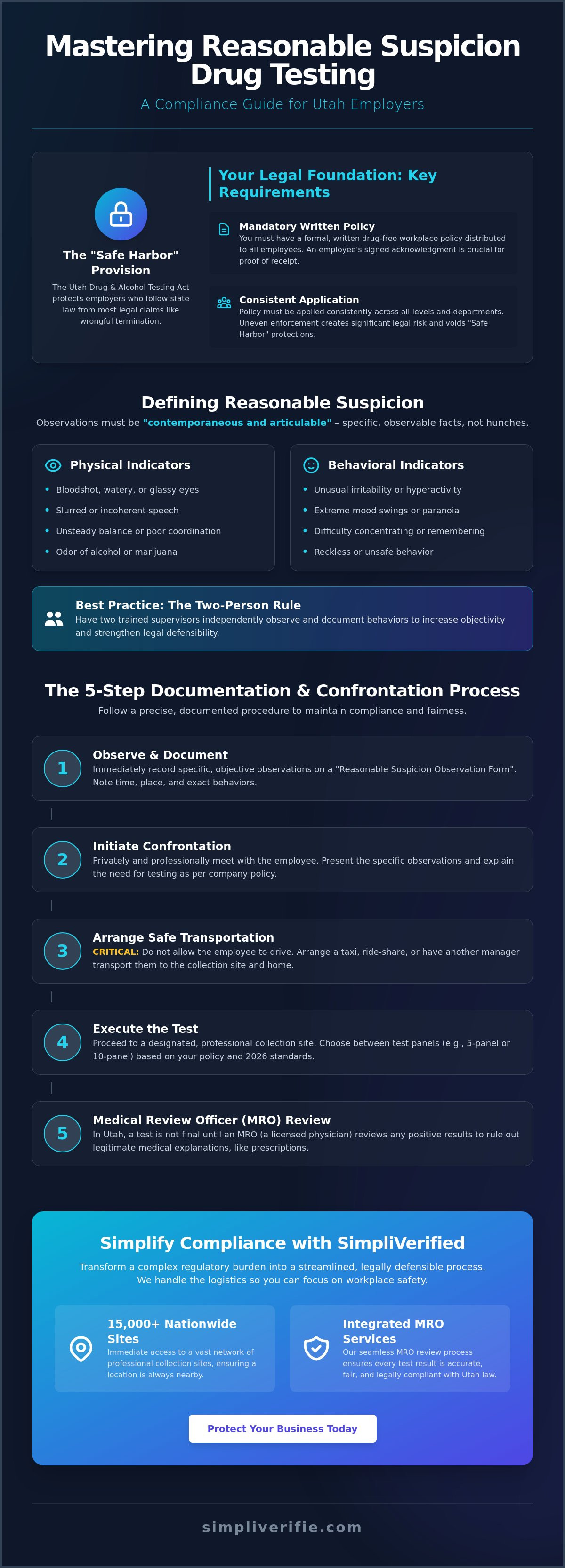
Once you've identified the signs of impairment, the clock starts ticking. You need to move from observation to action without skipping a beat. Documentation is your most important ally in this phase. A well-prepared Reasonable Suspicion Observation Form serves as the factual backbone for any future actions. It's not enough to just notice something; you must record it with precision to stay compliant with the Utah Drug and Alcohol Testing Act. This documentation creates a clear, objective record that justifies the need for reasonable suspicion drug testing Utah procedures.
Accuracy matters more than speed here. Your report should include the exact time, the specific location, and a detailed description of the behaviors you witnessed. Avoid using subjective labels like "drunk" or "high" in favor of descriptive, objective phrases. Write that the employee "stumbled twice" or "spoke with a slurred cadence." List any witnesses who also observed the behavior. Both you and a second supervisor should sign and date the report immediately. Completing this step before you administer the test ensures that your decision remains grounded in facts rather than the final results.
Approaching an employee is often the most daunting part of the process. You should invite the individual to a private, quiet space away from their peers to maintain confidentiality and dignity. This isn't an interrogation; it's a conversation about safety. Use a script that focuses on your observations and company policy. You might say, "I've noticed you're having trouble maintaining your balance and your speech is slurred. Because of our commitment to a safe workplace, our policy requires a drug test when these signs are present."
Expect denials or even aggressive responses. Maintain professional empathy while remaining firm on the requirement. If the employee refuses the test, explain clearly that refusal carries the same weight as a positive result under your policy, which may include immediate termination. Sticking to these steps ensures your reasonable suspicion drug testing Utah protocol remains a tool for safety rather than a source of liability. This structured approach helps HR leaders across various industries manage high-pressure situations with confidence and poise. By relying on a steady partner like SimpliVerified, you can focus on the human side of the interaction while we handle the logistical rigor of the testing itself.
Once you've completed the documentation and held the private meeting, the focus shifts to the physical execution of the test. This phase is fraught with logistical hurdles that can create significant liability if handled incorrectly. Managing reasonable suspicion drug testing Utah requires a commitment to safety that extends beyond the workplace walls. You must ensure the integrity of the sample while simultaneously protecting the employee and the public from potential harm. Professionalism during these moments prevents the situation from escalating and keeps your compliance record clean.
The biggest liability trap for Utah employers is allowing a suspected employee to drive themselves to the testing facility. If an accident occurs while they are behind the wheel, your company could be held responsible for any resulting damages or injuries. You should always arrange for a supervisor to drive the individual or utilize a commercial ride-share service. Document these transportation details, including the time of departure and the specific method used. After the collection is complete, ensure the employee is safely transported to their home rather than back to the office. This proactive approach minimizes risk and demonstrates a duty of care that protects your organization's reputation.
Choosing the right screening level is essential for obtaining actionable results. A standard 5-panel test covers the most common substances, including marijuana, cocaine, opiates, phencyclidine (PCP), and amphetamines. However, many employers now opt for a 10-panel screen to include prescription medications like benzodiazepines or barbiturates. It's also vital to navigate Utah's medical cannabis landscape carefully. Even with a valid medical card, private-sector employees in Utah are generally not protected from disciplinary action for off-duty use if your written policy prohibits it. For a deeper look at these requirements, see our 2026 Employer Guide to Compliance and Safety.
Sample integrity relies on a strict chain of custody. This process tracks the specimen from the moment of collection until it reaches the lab, ensuring no tampering or switching occurs. Once the test is administered, you should place the employee on paid administrative leave until the results are verified by a Medical Review Officer. Paying the employee during this period prevents potential wage and hour claims and keeps the process professional. If the result is negative, the employee can return to work without a loss of income, which helps preserve the employer-employee relationship and avoids unnecessary friction.
If you need a reliable partner to manage these logistics and ensure every step is handled with expert care, contact SimpliVerified today to access our network of over 15,000 collection sites.
Managing a workplace crisis is challenging enough without worrying about the logistics of the test itself. SimpliVerified bridges the gap between the strict requirements of Utah law and the practical needs of your HR team. We provide access to a nationwide network of over 15,000 collection sites; this ensures your employee never has to travel far for a compliant screening. This proximity is vital for reasonable suspicion drug testing Utah protocols, where time is of the essence and safety remains the top priority. By reducing travel time, you minimize the period of potential risk and move toward a resolution faster.
Our integrated Medical Review Officer (MRO) services provide a final layer of certainty and tranquility d'esprit. As established in the legal framework, an MRO review is essential for confirming positive results and maintaining the integrity of your program. Since January 1, 2026, a standard non-DOT 5-panel test typically starts at $52, which includes these professional review fees. With the implementation of H.B. 130 on May 6, 2026, Utah employers must cover these costs directly without seeking reimbursement from the individual. SimpliVerified provides transparent, predictable pricing to help you stay compliant with these financial regulations while ensuring every test meets the updated SAMHSA cutoff levels effective as of February 2026.
Our digital platform is built for speed and absolute clarity. You can track the status of a test in real time, from the moment the employee arrives at the collection site to the release of the final lab report. This visibility significantly reduces the duration of paid administrative leave, saving your company money and minimizing operational downtime. Every report we generate is fully secure and FCRA-compliant. We prioritize protecting sensitive data while giving you the objective facts needed to make confident employment decisions. Our technology removes the friction from the process, turning a complex administrative task into a few simple clicks.
We believe that workplace safety should be straightforward and accessible. Navigating a "reasonable suspicion" case requires a partner who understands the nuances of various SimpliVerified Industry Solutions. Whether you're managing a fleet of drivers or a corporate office, our dedicated support team is available to guide you through complex testing scenarios. We focus on the granular details of compliance so you can focus on your business's growth. Our commitment to simplicity transforms a high-stress event into a manageable, professional experience that reinforces your company’s culture of safety and integrity.
Navigating the complexities of reasonable suspicion drug testing Utah requires a blend of legal precision and professional empathy. You've learned that success hinges on contemporaneous documentation and strict adherence to the Utah Drug and Alcohol Testing Act. By focusing on objective observations and ensuring safe transportation for suspected employees, you protect your business from liability while prioritizing the well-being of your entire team. Staying compliant with 2026 regulations doesn't have to be a source of stress when you have the right protocols in place.
SimpliVerified is here to transform this challenging process into a seamless part of your safety strategy. We offer access to over 15,000 collection sites and provide expert MRO review on every test to ensure absolute accuracy. Our Utah-based support team in Draper is ready to help you manage even the most sensitive compliance scenarios with ease and professionalism. Let us handle the logistics so you can focus on leading your organization with clarity and peace of mind.
Partner with SimpliVerified for Compliant Utah Drug Testing and build a safer, more reliable workplace today.
Reasonable suspicion in Utah is based on specific, contemporaneous, and articulable observations concerning an employee’s appearance, behavior, speech, or body odors. Physical signs like bloodshot eyes, slurred speech, or the smell of alcohol are common indicators. When conducting reasonable suspicion drug testing Utah, you should also look for behavioral changes, such as a sudden lack of coordination, that suggest immediate impairment while on the job.
Yes, Utah employers must have a written drug and alcohol testing policy before any testing can occur. Under the Utah Drug and Alcohol Testing Act, this policy must be distributed to all employees and clearly outline the circumstances under which a test is required. Without a properly distributed policy, your business loses the "Safe Harbor" legal protections that shield you from various liability claims during the process.
Employees have the right to refuse a test, but doing so typically carries the same consequences as a positive result. Your written policy should state that refusal to undergo testing is grounds for disciplinary action, including immediate termination. It's vital to explain these consequences to the employee during the confrontation to ensure they understand the stakes of their decision and the impact on their employment status.
Utah’s medical marijuana law does not protect private-sector employees from disciplinary action for a positive test. Even if an employee holds a valid medical card, you can still enforce a drug-free workplace policy that prohibits cannabis use. The law allows you to take action, including termination, if an employee tests positive, regardless of whether the use occurred off-duty or for medical reasons during their personal time.
Observations should be conducted by supervisors or managers who have received specific training in identifying the signs of substance impairment. We strongly recommend using the "Two-Person Rule," where two separate supervisors witness and document the behavior independently. This dual-observation approach creates a more objective record and significantly strengthens your legal defense if the testing process is ever challenged in a court of law or administrative hearing.
Testing an employee without a factual basis for suspicion exposes your company to significant legal risk. You could lose the immunity provided by the Utah Drug and Alcohol Testing Act, leaving you vulnerable to lawsuits for defamation or wrongful termination. Additionally, as of May 6, 2026, H.B. 130 prohibits charging employees for medical exams. Improper testing could lead to regulatory penalties and a loss of organizational credibility.
We recommend placing the employee on paid administrative leave while waiting for the test results to be verified by a Medical Review Officer. Paying the employee during this period prevents potential wage and hour disputes and demonstrates that you're acting in good faith. If the result is negative, the employee can return to work without a loss of income, which helps maintain a positive and supportive workplace culture.
A 10-panel test is often better for reasonable suspicion drug testing Utah cases because it covers a broader range of substances, including prescription medications like benzodiazepines. While a standard 5-panel test identifies common street drugs, a more comprehensive screen ensures you don't miss impairment caused by legal or synthetic substances. Choosing the right panel with the help of a partner like SimpliVerified ensures your workplace remains safe.