
The Rise of AI-Driven Candidate Fraud — And Why Identity Verification Must Come First
By SimpliVerified • Background Screening & Compliance
Artificial intelligence is transforming hiring. Recruiters use AI to source talent, screen resumes, and automate communication. Candidates use AI to refine resumes and prep for interviews. In many ways, this evolution is positive.
But there is a darker side emerging.
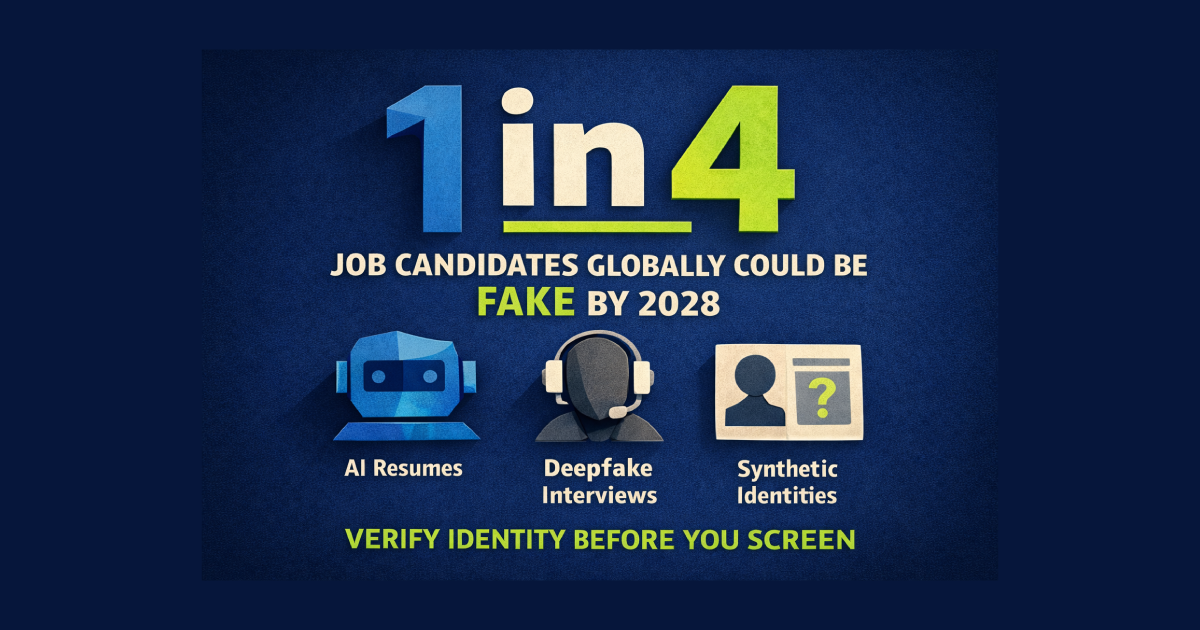
Gartner predicts that by 2028, 1 in 4 job candidates globally could be fake or fraudulent — driven largely by AI-generated resumes, deepfake interviews, and synthetic identities.
What once required sophisticated fraud rings can now be executed with widely available tools and minimal technical skill. For employers, that creates a new kind of risk: impersonation at scale.
The New Face of Candidate Fraud
Traditional hiring fraud involved résumé embellishment or minor misrepresentation. Today’s fraud is fundamentally different.
AI tools can now generate complete employment histories, create “polished” candidates who interview well on paper, and support synthetic identities that appear legitimate at first glance.
- AI-generated resumes that look authentic and consistent
- Deepfake-assisted video interviews
- Synthetic identities built from partial or stolen personal data
- Credential and document manipulation that appears “real enough” to pass casual review
Remote and hybrid hiring makes this even harder to detect. When interviews and onboarding are digital, identity becomes the first and most important variable to validate.
Why Traditional Background Checks Aren’t Enough
Background screening remains essential — criminal searches, employment verifications, and compliance checks help reduce risk and support responsible hiring.
But most screening workflows share a critical assumption:
The person being screened is who they claim to be.
If that assumption is wrong, a “clean” report may only confirm that the identity is fabricated, stolen, or misrepresented. In other words: you can’t verify a history reliably if you haven’t verified the identity first.
Research Signals a Growing Threat
Across the HR, cybersecurity, and risk communities, the direction is consistent: candidate fraud is increasing, and AI is accelerating its scale.
Analysts have highlighted rising incidents of:
- Generative AI used to fabricate resume content and job histories
- Synthetic identity fraud (blended real + fake personal data)
- Deepfake-enabled impersonation during virtual interviews
- Fraud attempts aimed at gaining access to systems, payroll, or sensitive data
The practical takeaway for employers is simple: identity fraud is no longer rare, and “gut feel” is no longer a reliable control.
Gartner’s Warning: Prepare for Identity-Centric Risk
Gartner’s prediction reflects a broader shift toward identity-centric security risks across the digital landscape. When AI can replicate voice, appearance, and documents, organizations need layered verification approaches — not single-point checks.
Hiring is, at its core, an identity transaction. Employers grant access to systems, facilities, payroll, and sometimes sensitive intellectual property. When identity is compromised, the downstream consequences can include:
- Data breaches and unauthorized system access
- Financial fraud and payroll diversion
- Regulatory exposure and audit challenges
- Reputational damage
- Increased insider-threat risk
Want to reduce identity fraud without slowing down hiring?
Ask about Applicant VID — government ID validation, live selfie confirmation, and facial matching at the start of screening.
Request Pricing & AvailabilityThe Shift Toward Identity Verification at the Start of Screening
A growing number of organizations are moving identity verification to the beginning of the workflow. The logic is straightforward:
Confirm the identity before you verify the history.
Modern identity verification typically includes:
- Government-issued ID validation
- Biometric confirmation (live selfie capture)
- Facial comparison between ID photo and selfie
- Liveness detection to prevent spoofing
The best solutions are designed to be candidate-friendly — often completing in about a minute — minimizing friction while significantly reducing fraud exposure.
Regulatory and Compliance Considerations
Employers in regulated industries face increased scrutiny and higher consequences when identity controls are weak. Healthcare, financial services, staffing, education, and government contractors often need stronger documentation and clearer audit trails.
Identity verification can support due diligence by improving process integrity, strengthening documentation, and reducing the risk of “screening the wrong person” when downstream compliance requirements depend on the candidate being authentic.
Practical Recommendations for Employers
1) Assess identity risk in your hiring workflow
Map your hiring process from application to onboarding. Identify where identity assumptions are made — especially in remote interviews and digital document collection.
2) Verify identity before background screening begins
Validate the candidate’s government ID and confirm a live person is present before criminal searches, verifications, and compliance checks are initiated.
3) Train recruiters and hiring managers on red flags
Awareness matters. Equip teams to spot inconsistencies in video interviews, suspicious documentation patterns, and behavior that signals impersonation.
4) Align HR with cybersecurity and risk management
Candidate fraud is no longer only an HR concern. It can become a system-access and data-security issue quickly. Cross-functional ownership strengthens prevention.
5) Protect candidate experience
Fraud prevention shouldn’t punish legitimate candidates. Choose identity verification that is mobile-friendly, fast, and clear — so your process remains respectful and efficient.
The Future of Hiring Is Identity-First
AI will continue to advance. Deepfake capabilities will improve. Synthetic identity schemes will become more sophisticated.
Background screening remains essential — but it must be anchored to a verified identity. In a world where identity can be convincingly manufactured, trust needs a new starting point.
The hiring landscape has changed. Screening must evolve with it.
Add VID Verification to your screening workflow
Reduce candidate fraud with Applicant VID, live selfie capture, and facial matching — at the start of the background screening process.
Learn More