Hiring
Drug Testing
Employment Screening


Did you know that recent industry studies reveal 78% of job applicants admit to misrepresenting themselves on their resumes? You likely already understand that hiring the wrong person isn't just a mistake; it's a direct risk to your company culture and your financial bottom line. Relying on an incomplete background check or manual verification processes often leaves your business vulnerable to legal non-compliance and significant security threats. It's a stressful burden that most HR teams simply don't have the time to manage effectively.
This guide proves that professional screening is much more than a simple history. It's the foundation of your business security and your hiring integrity. We'll show you how to replace slow, error-prone methods with a streamlined, compliant workflow that delivers results in 24 hours or less. You'll learn exactly what a modern screening includes so you can make hiring decisions with total peace of mind throughout 2026. Let's transform your onboarding into a fast, intuitive, and reliable experience that protects your organization's future.
In the digital age, the concept of a "background" has split into two distinct categories. While social media users focus on visual aesthetics and video call filters, the 2026 labor market views it as a non-negotiable pillar of security. Professional background assessments have evolved beyond simple data collection. They now serve as a strategic tool to ensure organizational integrity and safety. This shift replaces generic data with actionable professional insights, allowing leaders to make decisions based on verified reality rather than polished resumes. It's about moving from a superficial glance to a deep, reliable understanding of a candidate's history.
A professional background is a verified history of an individual's credentials, conduct, and legal standing. You shouldn't confuse a simple Google search with a professional screening report. Public data is often incomplete, outdated, or entirely inaccurate. In contrast, a regulated background check provides a high-fidelity view of a candidate's past through secure, legal channels. It's a comprehensive look at who a person is when they aren't being watched. A background check is a regulated investigation into a person’s history.
Modern screening focuses on three core pillars to establish trust:
The definition of a "clean" background changes depending on the industry. In healthcare, the focus remains on vulnerable sector clearances to protect patients and maintain high standards of care. In the finance sector, credit checks and regulatory compliance take priority to mitigate risk. A 2024 industry report showed that 85% of employers discovered discrepancies in candidate histories, highlighting why specific context is vital. We've moved from reactive checking, which only looks for red flags, to proactive cultural protection. Technology now allows for faster, more intuitive screenings that remove friction from the hiring process. This automation creates a fluid experience for both the employer and the candidate, ensuring tranquillity of mind from the very first interaction. By using advanced algorithms, modern platforms flag relevant data without compromising the candidate's privacy or the employer's time.
In the industrial and manufacturing sectors, workplace safety is a dual responsibility involving both vetted personnel and reliable equipment. While background screenings secure your team, Slideways, Inc. provides the essential plastic guide rails and conveyor components that ensure your physical operations remain safe and efficient.
A professional background check functions as a multi-layered shield for your organization. It goes beyond a simple name search; it builds a 360-degree profile based on identity, experience, and integrity. This structured approach eliminates guesswork and replaces it with verified data. It ensures your hiring decisions rest on facts rather than intuition. By breaking down the screening report into essential layers, you can identify potential risks before they enter your workspace and protect your company culture.
Effective screening requires a multi-jurisdictional strategy. Relying solely on a national database often misses local nuances. Many of the 3,143 county courts in the U.S. don't report to federal systems in real time, which can lead to significant gaps in data. A robust search includes county, state, and national records to capture the full picture. Integrating a sex offender registry search is a non-negotiable step for workplace safety. This is vital for roles involving vulnerable populations or public interaction. Additionally, civil litigation history reveals patterns of legal disputes or financial liability that criminal records might hide. When conducting these searches, following EEOC guidance on background checks ensures your process remains non-discriminatory and legally compliant.
Identity is the foundation of every report. Social Security Number (SSN) tracing confirms the candidate's history and identifies previous addresses where records might exist. Once identity is clear, the focus shifts to professional history. A detailed employment verification prevents resume fraud. Recent industry data shows that 70% of workers admit to lying on their resumes at least once. Validating education and professional licenses ensures the candidate possesses the technical expertise they claim. This verification process transforms a background check into a tool for quality assurance and long-term stability.
Specialized roles require deeper insights. Motor Vehicle Reports (MVR) are essential for any position involving driving or company vehicles. Modern drug testing protocols maintain a safe environment while respecting local regulations. Many forward-thinking companies are moving toward continuous monitoring for active employees rather than one-time checks. This proactive stance helps identify risks before they escalate into liability issues. For comprehensive protection against these and other business risks, SI Insurance provides a wide range of coverage options for organizations. Tailoring these components to specific job requirements makes the process efficient and relevant. If you're looking to streamline your hiring, you can explore our automated screening solutions to save time and reduce friction.
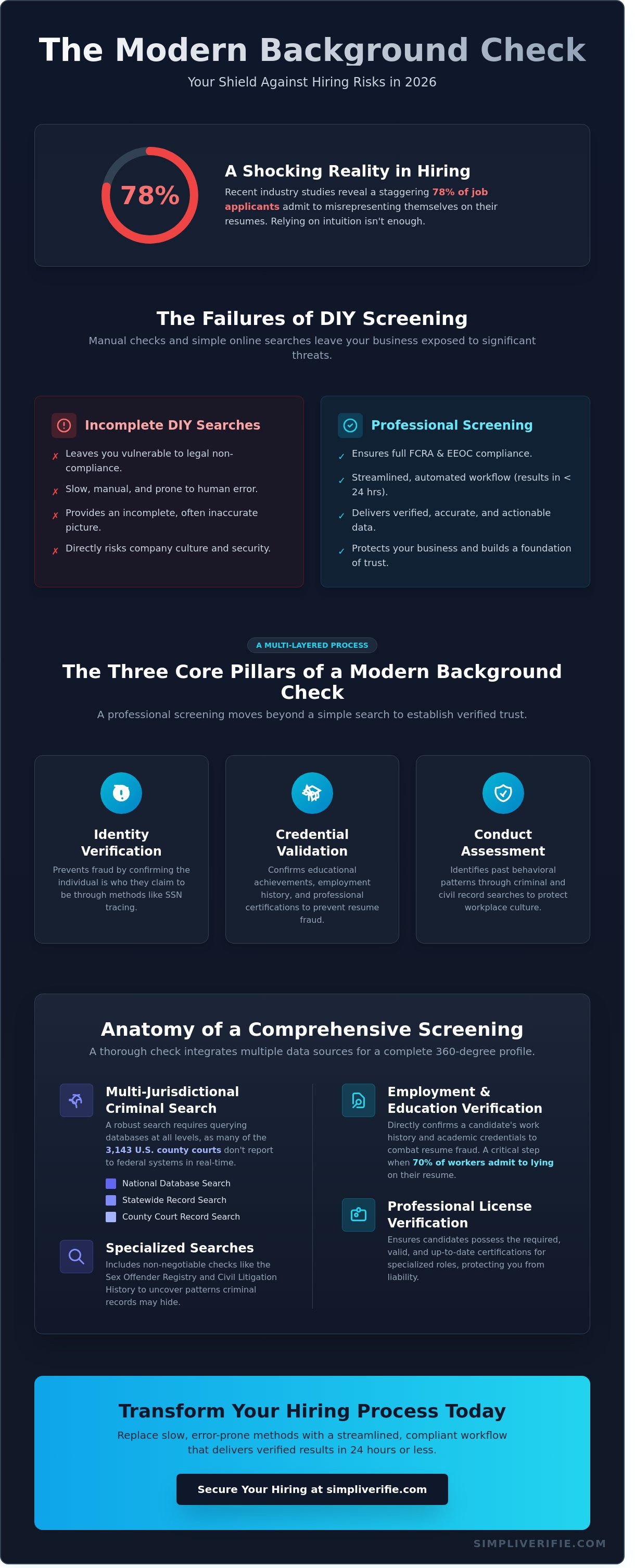
Relying on "free" online search engines creates a false sense of security. These platforms often aggregate data from outdated public sources that don't meet the rigorous standards of a professional background check. When businesses skip professional verification, they expose themselves to negligent hiring claims. A 2023 industry survey revealed that accuracy remains the top priority for 75% of employers, yet DIY methods consistently fall short of providing reliable data.
Instant results frequently overlook recent criminal activity or records expunged within the last 12 months. This lag creates a dangerous window for error. DIY searches often produce "false positives" because they lack the sophisticated matching algorithms used by professional firms to distinguish between individuals with similar names. Verified data requires direct outreach to primary sources like courthouses and police records to ensure information is 100% current.
Security risks are another major concern. Non-professional tools often lack the encryption needed to protect sensitive candidate data. If you're using these sites, you might be violating privacy laws without knowing it. Employers must follow specific legal frameworks, such as the FTC guidance on using consumer reports, to maintain compliance. Failing to do so can result in heavy fines and damaged reputations, especially when handling personal identifiers.
Manual verification is a productivity killer. HR departments often spend 15 to 20 hours per week chasing previous employers or academic registrars. This fragmented approach leads to several bottlenecks:
Modern platforms integrate directly with your Applicant Tracking System (ATS), saving hundreds of hours annually. A centralized verification dashboard brings everything into one clear view. It replaces messy spreadsheets with a streamlined workflow, offering the peace of mind that comes from a professional, automated background screening process. This transition transforms a bureaucratic hurdle into a strategic advantage that supports your company's growth.
Compliance isn't just a legal hurdle; it's your primary shield against litigation. In 2026, the Fair Credit Reporting Act (FCRA) continues to dictate how you handle applicant data with strict precision. You can't afford mistakes here. Data from 2024 shows that FCRA-related class actions often lead to settlements exceeding $10 million for large enterprises. Staying compliant ensures your hiring process remains a tool for growth rather than a liability. It's about creating a transparent experience that builds trust from the very first interaction.
The Equal Employment Opportunity Commission (EEOC) actively monitors for discriminatory practices. They look for policies that unfairly exclude candidates based on protected characteristics. You should use the "Green Factors" to evaluate criminal history: the nature of the crime, the time passed since the offense, and the job's specific duties. You must also track state-specific "Ban the Box" laws. These regulations now cover 37 states and over 150 cities, requiring you to delay criminal history inquiries until after a conditional offer exists. This approach builds a fair, modern workplace culture while keeping you on the right side of the law.
Successful screening relies on three pillars. First, you must provide a standalone disclosure to the candidate. It can't be buried in a standard job application or employee handbook. Second, you need clear, written authorization before any background screening begins. Finally, if a report influences your decision not to hire, you must follow the adverse action process. Send a pre-adverse action notice first, including a copy of the report and a summary of rights. Give the candidate at least 5 business days to respond or correct errors. Only then can you send the final notice. This structure protects candidate rights while securing your firm's professional integrity.
Different sectors demand specialized oversight. For medical roles, healthcare compliance monitoring is essential to track OIG exclusions and state-level license sanctions in real-time. Transportation roles must adhere to Department of Transportation (DOT) standards, including specific motor vehicle record checks and drug testing history. If you hire across borders, your process must adapt to global standards like the GDPR in Europe or PIPEDA in Canada. Modern tools automate these complex layers, making international background checks feel as simple as local ones. This level of automation delivers total peace of mind for your HR team.
Secure your hiring pipeline with expert-led verification and total legal alignment. Contact SimpliVerified to automate your compliance today.
SimpliVerified operates on a "Simplicity First" philosophy. We've designed our screening technology to strip away the bureaucratic layers that typically slow down hiring. Our platform transforms a complex background check into a fluid, automated experience. We provide reporting that's fast and accurate for organizations of any size, ensuring you stay compliant with evolving labor laws without sacrificing speed. Most of our standard reports are processed within 24 to 48 hours, allowing you to move from candidate selection to onboarding without delay.
Our system handles the heavy lifting through enterprise-level integrations. We connect directly with your existing HR software and Applicant Tracking Systems (ATS). This integration eliminates manual data entry errors and saves your HR team hours of administrative work every week. By centralizing the process, we help you maintain a high standard of safety while keeping your focus on business growth. We've helped partners reduce their total time-to-hire by an average of 30% through these streamlined workflows.
We believe technology is most effective when backed by human specialists. SimpliVerified utilizes a nationwide network of thousands of collection sites to manage your pre employment drug test coordination. Our dashboard provides real-time status updates, so you're never left wondering about a candidate's progress. You won't deal with a generic call center; you'll work with a dedicated account manager. These experts provide personalized screening strategies and help you navigate the specific legal nuances of different jurisdictions.
Securing your team starts with professional-grade data. Our custom screening packages are built to fit your unique industry requirements, whether you need criminal history, professional license verification, or background integrity checks. This tailored approach provides the peace of mind necessary to protect your company's culture and assets. It's time to replace uncertainty with clarity and a process that respects your time. A faster, more reliable hiring experience is just one step away. Get a custom quote for your background screening needs and see how we make expert verification simple.
Navigating the professional landscape in 2026 requires more than a surface-level glance at a candidate's history. Modern hiring demands a rigorous vetting process that moves beyond manual DIY searches. These outdated methods often lead to legal pitfalls or incomplete data. By prioritizing FCRA-compliant screening and leveraging enterprise-grade technology, your business gains the agility needed to compete. You don't have to choose between speed and accuracy when you have the right tools in place.
Protecting your organization's integrity shouldn't be a bureaucratic burden. You can access a nationwide network of over 15,000 drug testing sites and seamless integrations that fit directly into your existing HR workflow. This proactive approach ensures you're making decisions based on verified facts rather than assumptions. It's about replacing uncertainty with clarity so your team can focus on long-term growth. Choosing a partner who understands these complexities makes all the difference in maintaining a safe, productive workplace.
Start your compliant background screening today with SimpliVerified and build your team with absolute confidence. Your next great hire is just a click away.
In 2026, a professional background check typically includes national, state, and local criminal records, employment history for the last 5 to 10 years, and education credentials. You'll also see professional license status and, for specific roles, credit reports that comply with federal regulations like the Fair Credit Reporting Act (FCRA). These reports provide a clear view of a candidate's integrity and professional history to ensure a safe hire.
A standard background verification usually takes between 24 and 72 hours to complete. While traditional manual searches could take 10 business days, modern digital platforms process 90% of requests within 2 business days. Factors like international record searches or slow response times from educational institutions can extend this timeline; however, most local criminal checks return results within 24 hours.
Free background search websites aren't legal for employment use because they don't comply with federal laws like the Fair Credit Reporting Act (FCRA). These sites often provide outdated information that lacks the accuracy required for hiring decisions. Using non-compliant sources exposes your company to legal risks and potential fines from regulatory bodies. It's safer to use a certified provider like SimpliVerified that guarantees data integrity and legal compliance.
A criminal record search only identifies past convictions or pending charges within police databases. In contrast, a full background check is a comprehensive profile that includes education history, employment references, and professional certifications. While a criminal search confirms safety, the full check validates a candidate's entire resume. This ensures they actually possess the 5 or more years of experience they claimed during the interview.
Employers should run a background check on current employees every 12 to 24 months to maintain a secure workplace. Industry data shows that 20% of organizations have moved toward continuous monitoring for high-risk roles in finance or healthcare. Regular re-screening ensures that your team remains compliant with internal safety standards. It helps identify potential risks that may have emerged after the initial hire, providing ongoing peace of mind.
Candidates have a legal right to dispute any inaccuracies found in their background check under federal laws like the Fair Credit Reporting Act (FCRA). If a report contains an error, the candidate can provide evidence to the screening agency. The agency then has 30 days to investigate and correct the file. This process ensures fairness and allows individuals to protect their reputation while helping employers make decisions based on accurate data.
If a background check reveals a criminal record, you must assess whether the offense is directly related to the specific job duties. Under Equal Employment Opportunity Commission (EEOC) guidance, employers should not have a blanket policy to disqualify candidates solely for a record, but rather conduct an individualized assessment. This includes considering the nature and gravity of the offense, the time passed since the conviction or completion of sentence, and the nature of the job held or sought.
Education verification is vital because approximately 40% of resumes contain inflated or entirely fabricated academic credentials. Confirming degrees and diplomas directly with the registrar's office protects your company from hiring unqualified staff. This step ensures that your new hire truly has the specialized knowledge required for the role. It reduces turnover costs and maintains the professional standards of your entire team over the long term.