
Hiring
Drug Testing
Employment Screening


Did you know that court filings under the Fair Credit Reporting Act (FCRA) surged by 45.3% in the first four months of 2026? This sharp increase in litigation highlights a growing reality: staying compliant with financial services industry background checks has never been more difficult or more critical. For HR leaders in the banking and securities sectors, the margin for error is shrinking while the cost of a mistake continues to climb.
You likely believe that hiring should be a bridge to growth, not a legal minefield. It's frustrating when conflicting state regulations and the intricacies of FDIA Section 19 slow down your onboarding and risk losing top-tier talent to faster competitors. SimpliVerified understands that you need a process that's both rigorous and remarkably fluid. We promise to help you master these complexities with a comprehensive framework for compliant, efficient hiring.
This guide provides a clear look at the latest 2026 regulatory updates, including the expanded FDIC de minimis exemptions and updated FINRA requirements. You'll gain practical strategies to reduce insider threats and accelerate your time-to-hire without sacrificing the accuracy your firm demands.
In the world of finance, trust is the primary currency. Because of this, financial services industry background checks are far more rigorous than those found in other sectors. These specialized screenings are designed to meet the high fiduciary standards of banking and investment firms. They go beyond basic identity verification to ensure every new hire aligns with the strict security requirements of the industry.
Regulatory bodies like the SEC, FINRA, and the FDIC maintain a watchful eye on how firms manage their human capital. For example, Section 19 of the Federal Deposit Insurance Act (FDIA) creates specific barriers for hiring individuals with certain criminal histories. Managing these requirements requires a proactive approach. It's not just about filling a seat; it's about protecting your institutional reputation from the devastating impact of a bad hire. A single compliance failure can lead to massive fines and a loss of client confidence that takes years to rebuild.
A basic county-level criminal search often fails to capture the full picture in a global financial market. Many white-collar crimes, such as wire fraud, embezzlement, or sophisticated money laundering, occur at the federal level and may not appear in local records. Relying on a standard search leaves your organization vulnerable to significant risk. You need a screening partner that verifies professional standing and licensing alongside criminal history. This ensures that a candidate's past performance and legal standing match the integrity required for a high-stakes financial role. Comprehensive checks must dig deeper to find records that general employment screenings often overlook.
HR professionals and recruiters in this space hold a fiduciary duty to their clients and shareholders. This means your hiring process must act as the first line of defense against insider threats. Implementing robust screening protocols aligns with broader Know Your Customer (KYC) regulations, which focus on identity and risk assessment to prevent financial crimes. By vetting employees with the same rigor used for clients, you create a culture of transparency and safety. A 'Position of Trust' is defined as any role where an employee has direct access to capital, sensitive client data, or the authority to execute financial transactions. SimpliVerified provides the tools to manage these high-stakes roles with confidence, ensuring your compliance workflow remains fluid and effective even as regulations evolve.
Building a robust screening strategy requires more than just a surface-level glance at a candidate's past. For financial services industry background checks, you must layer multiple types of data to create a full picture of risk. This starts with an in-depth criminal history search that spans federal, state, and county levels. Unlike standard searches, these should specifically target financial crimes such as embezzlement, money laundering, and identity theft.
Accuracy begins with identity verification. A Social Security Number (SSN) trace confirms the candidate is who they claim to be from day one. It also uncovers previous addresses that might hold hidden records. Compliance doesn't end at the border. You must also check candidates against regulatory sanction lists, including global watchlists like OFAC and the Specially Designated Nationals (SDN) list. Adhering to FINRA Rule 3110 ensures your firm investigates every applicant's background thoroughly before they step into a role of responsibility.
In banking, personal financial stability often correlates with professional reliability. Employers look for significant red flags like bankruptcies, tax liens, and outstanding judgments. These aren't necessarily automatic disqualifiers, but they provide context for a candidate's financial responsibility. SimpliVerified delivers clear, actionable credit insights that remain fully FCRA compliant. This data helps you make informed decisions without getting lost in technical jargon. If you want to see how these checks fit into a broader strategy, you can explore our expertise across various industries.
Resume fraud is a persistent risk in high-stakes financial roles. A candidate might claim a CPA or CFA designation they haven't actually earned. Verifying these professional licenses and certifications is a non-negotiable step. SimpliVerified uses a direct-outreach method for rapid employment verification, contacting institutions directly to confirm dates, titles, and degrees. This proactive approach eliminates the friction of waiting on slow institutional responses. By ensuring every credential is valid, you protect your firm's integrity and ensure you're hiring the expert talent you need to grow.
The legal framework surrounding financial services industry background checks is increasingly rigid. Compliance isn't just a hurdle; it's a vital shield for your organization. The Fair Credit Reporting Act (FCRA) serves as the primary governing law, emphasizing transparency and the protection of candidate rights. Given that FCRA litigation spiked by 45.3% in early 2026, maintaining a flawless screening process is a business necessity. Every step, from initial disclosure to final hiring decisions, must be documented and legally sound.
Other regulations add layers of complexity. The Gramm-Leach-Bliley Act (GLBA) requires you to protect the privacy of consumer financial data collected during the vetting process. Meanwhile, the Dodd-Frank Act influences executive hiring by demanding higher levels of transparency regarding compensation and professional history. SimpliVerified helps you manage these overlapping requirements with built-in compliance tools. These features automate the paperwork, reducing your administrative load while ensuring you meet every federal mandate without friction.
Section 19 prohibits individuals convicted of certain "crimes of dishonesty" or breach of trust from working in the banking sector. However, recent updates have changed how hiring managers navigate these rules. Effective October 1, 2024, the FDIC expanded "de minimis" exemptions, meaning certain minor offenses no longer require a formal application for a waiver. For example, the threshold for bad checks was increased to an aggregate total of $2,000 or less. Additionally, offenses punishable by three years or less now fall under these expanded definitions. Beyond federal laws, securities firms must also comply with FINRA Rule 3110(e), which requires member firms to verify the information on an applicant’s Form U4. Managing consent for candidates with older convictions requires a delicate, expert approach to ensure fairness while maintaining safety.
When a background check reveals information that might disqualify a candidate, you must follow a strict two-step adverse action process. First, you send a pre-adverse action notice, which includes a copy of the background report and a summary of the candidate's rights. This gives the individual a chance to dispute inaccuracies or explain the context of the findings. Under the FCRA, the adverse action period is the mandatory window between the pre-adverse notice and the final decision that gives candidates a fair chance to explain or dispute the report's contents. Only after this period can you issue a final notice. This process protects the candidate and shields your firm from claims of unfair hiring practices.
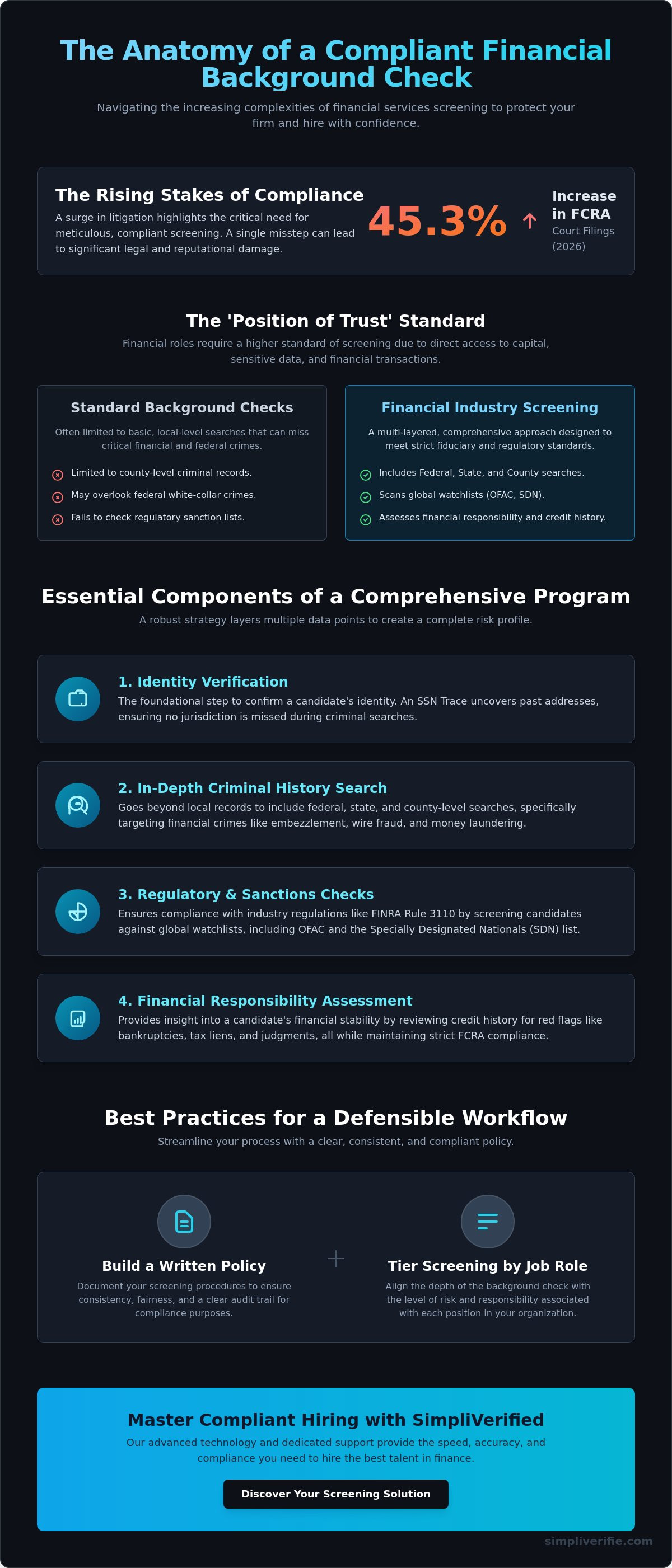
Efficiency in the hiring process can be the difference between securing a top-tier analyst and losing them to a faster competitor. To optimize your workflow, start by establishing a clear, written screening policy tailored to specific job tiers. Not every role requires the same level of scrutiny. A tiered approach ensures you apply the necessary rigor for executive positions while maintaining a swift path for entry-level staff. Integrating your financial services industry background checks directly into your Applicant Tracking System (ATS) further eliminates manual data entry and reduces the risk of human error.
Prioritizing turnaround time is essential, but it shouldn't come at the cost of compliance. Working with a dedicated partner like SimpliVerified provides you with personalized support for complex cases that automated systems might flag incorrectly. This human-centric approach ensures you don't just get data; you get context. If you're ready to modernize your hiring process and reduce friction, partner with SimpliVerified today to build a faster, more reliable onboarding experience.
Risk management doesn't end once the candidate signs their offer letter. In fiduciary roles, an employee's legal status can change overnight. Implementing continuous criminal monitoring allows your firm to receive real-time alerts regarding any new legal issues involving active staff. This proactive strategy balances employee privacy with institutional security. It ensures that your first line of defense remains strong long after the onboarding process concludes, protecting your assets and your reputation from internal threats.
The market is full of "instant" background checks that promise results in seconds. However, these often rely on outdated databases and can miss critical federal or county records. The hidden costs of these inaccuracies include regulatory fines and significant reputational damage. SimpliVerified balances rapid technology with human verification to provide maximum reliability. We set realistic expectations for turnaround times, ensuring that every financial services industry background check is as thorough as it is fast. This balance allows you to hire with confidence, knowing that speed hasn't compromised your firm's safety.
Selecting the right partner for your financial services industry background checks determines whether your hiring process acts as a bottleneck or a competitive advantage. SimpliVerified isn't just a service provider; we're a strategic ally. We bring deep expertise across various industries, with a specialized focus on the high-compliance world of banking and finance. Our team understands that in this sector, a single oversight can lead to significant regulatory consequences.
Our platform uses advanced technological integrations to simplify your daily workflow. We've designed our tools to plug directly into your existing systems, removing the need for manual data entry and reducing the risk of human error. This efficiency allows your recruiters to focus on identifying talent rather than managing paperwork. We provide factual, balanced reporting that stands up to the toughest regulatory scrutiny. Whether you're facing an audit or a routine compliance review, our documentation provides the clarity and accuracy you need to move forward with confidence.
Dedicated support is a cornerstone of our service. We don't use a one-size-fits-all approach because we know the nuances of financial industry requirements are complex. Our experts are available to help you interpret findings and navigate the specific rules that govern your institution. We prioritize a professional, business-quality experience that reflects well on your organization and respects the candidate's journey from start to finish.
Compliance-minded HR leaders prefer SimpliVerified because we deliver on the promise of absolute clarity. We've removed the friction often found in traditional screening methods, replacing it with a modern, intuitive interface. Our scalable solutions grow with your institution. Whether you're a local credit union or a national investment firm, we adapt to your volume and specific risk profile. We focus on building a climate of trust. This allows you to concentrate on your organization's growth while we handle the rigorous validation of your most sensitive data. We're committed to a partnership that values transparency and operational excellence above all else.
Every financial institution has unique needs based on its size, location, and the specific services it offers. We don't believe in rigid packages that include unnecessary services. Instead, we tailor our screening programs to meet your specific regulatory needs, ensuring your workflow is as efficient as possible. Our onboarding process is seamless and guided. We ensure your team feels supported and trained from the very first day. You don't have to manage the complexities of modern hiring alone. Contact SimpliVerified today to secure your financial institution's future.
The regulatory landscape for the financial sector continues to shift rapidly. As litigation under the FCRA rises and Section 19 exemptions evolve, your firm's approach to financial services industry background checks must be both proactive and precise. You've learned that a "position of trust" requires deeper scrutiny, ranging from federal criminal searches to continuous post-hire monitoring. These aren't just administrative hurdles; they're essential safeguards for your institutional reputation and capital.
SimpliVerified provides the expert guidance you need to manage these complexities without slowing down your hiring engine. We offer FCRA-compliant reporting and deep expertise in Section 19 and other financial regulations. Our team provides dedicated support directly from our Draper, UT headquarters, ensuring you always have a knowledgeable partner to handle complex cases. By choosing a partner that values clarity and reliability, you transform a stressful process into a fluid, positive experience for your team and your candidates.
You don't have to navigate these legal requirements alone. Secure your financial hiring process with SimpliVerified and build a culture of security that supports your long-term growth. We're here to help you hire with confidence and peace of mind.
A comprehensive screening includes criminal history at federal, state, and county levels, employment and education verification, and credit reports. It also incorporates searches of regulatory sanction lists like OFAC and the SDN list. These specialized financial services industry background checks ensure every hire meets high fiduciary standards and regulatory requirements from day one.
Most screenings are completed within three to five business days. The exact timeline depends on the depth of the search and how quickly external institutions respond to verification requests. SimpliVerified uses advanced technology to expedite these processes, but manual verification of professional licenses or international records can occasionally extend the turnaround time.
Section 19 remains highly relevant for fintech companies that operate as insured depository institutions or maintain certain partnerships with traditional banks. It's essential to determine if your specific business model falls under FDIC jurisdiction. Even for unregulated firms, following these standards helps mitigate risk when your team handles sensitive financial data and capital.
Employers can legally use credit reports to make hiring decisions for roles that involve financial responsibility or access to assets. You must follow the FCRA’s two-step adverse action process if the credit score is the primary reason for rejection. This gives the candidate a chance to explain significant issues like bankruptcies or tax liens before you make a final decision.
A standard check focuses on basic criminal and employment history, while a FINRA check must comply with Rule 3110. This requires member firms to verify all information on an applicant's Form U4. It often includes fingerprinting and a deeper dive into securities-related disciplinary actions that a general screening might miss during the hiring process.
Many institutions conduct annual re-screens to maintain compliance and security across the organization. However, implementing continuous criminal monitoring is a more effective modern approach. This provides real-time alerts if an employee is involved in new legal issues, ensuring your organization remains protected against internal threats without waiting for an annual review cycle to begin.
International background checks are necessary whenever a candidate has lived, studied, or worked outside the United States within the last seven to ten years. Global firms must verify these records to ensure no gaps exist in a candidate’s history. SimpliVerified handles these complex searches to provide a complete global risk profile while maintaining compliance with international privacy laws.
Finding a candidate on a regulatory sanction list like the SDN or OFAC indicates a significant level of institutional risk. Most financial services industry background checks treat these as critical red flags that may legally prohibit the individual from holding a position of trust. You should consult with your legal or compliance team to determine the specific impact on your hiring decision.