


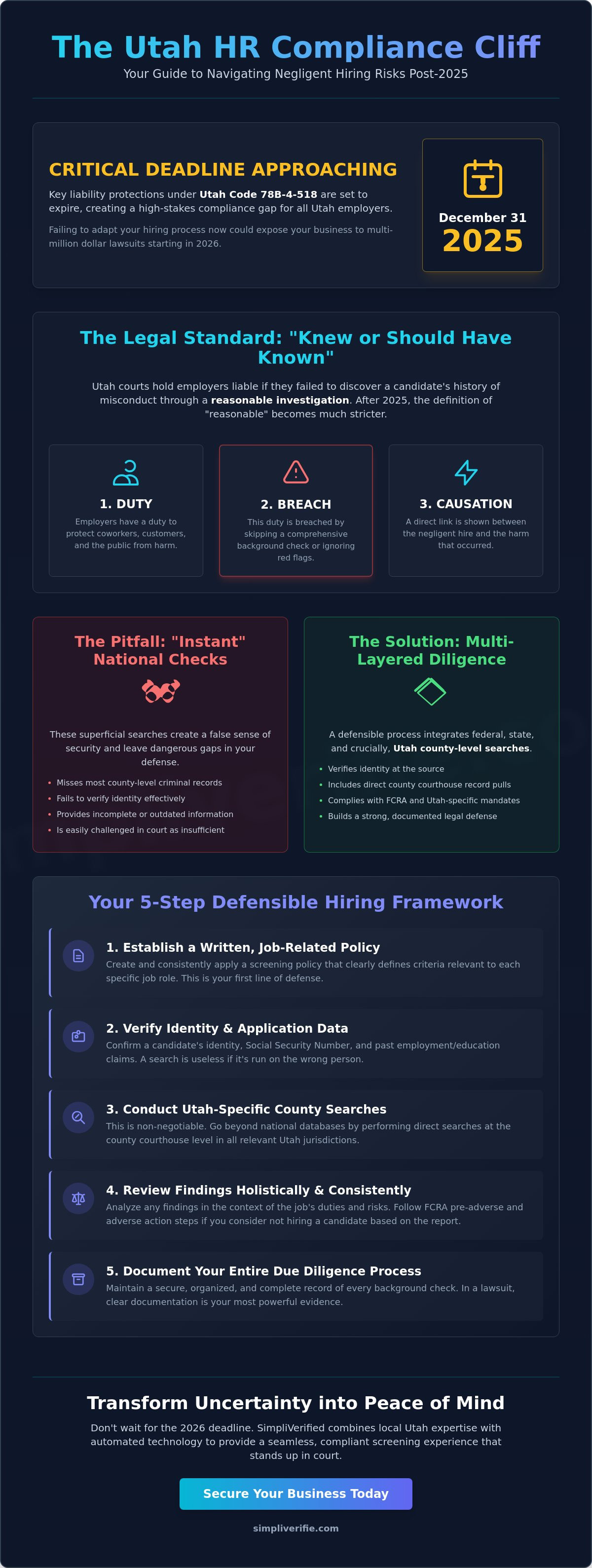
What if the legal protections your business relies on today vanished when the clock strikes midnight on December 31, 2025? For many Utah HR leaders, the upcoming expiration of specific liability protections in the Utah Code creates a high-stakes compliance gap. You likely already know that a single incident of employee misconduct can trigger a multi-million dollar claim, making the task of avoiding negligent hiring lawsuits in Utah more critical than ever.
At SimpliVerified, we believe that protecting your company shouldn't feel like a bureaucratic burden. We've designed this 2026 compliance guide to help you navigate these complex legislative changes while building a screening process that stands up in court. You'll learn exactly how to leverage Utah-specific exemptions and implement a defensible hiring workflow that transforms uncertainty into lasting peace of mind. We'll explore the technical requirements for legally sufficient background checks and the proactive steps necessary to secure your organization's future.
Key Takeaways
- Grasp the "knew or should have known" legal standard to proactively identify potential workplace risks before they escalate into costly liabilities.
- Navigate the 2026 legal landscape of Utah Code 78B-4-518 to ensure your business remains protected under evolving state immunity laws.
- Learn why relying on "instant" national checks creates dangerous gaps in your defense and how a multi-layered approach is key to avoiding negligent hiring lawsuits in Utah.
- Establish a customized 5-step due diligence framework that bridges the gap between federal FCRA requirements and specific Utah county-level mandates.
- Discover how SimpliVerified’s local expertise and automated technology provide a seamless, compliant screening experience that builds long-term peace of mind.
What is Negligent Hiring and Why is it Rising in Utah?
Negligent hiring is a legal theory that holds an employer liable for the actions of an employee if that employee harms a third party, such as a coworker or customer. In the eyes of the law, the responsibility doesn't just lie with the individual who committed the act; it rests on the organization that brought them into the workplace. Utah courts rely heavily on the "knew or should have known" standard. This means a business is legally vulnerable if it fails to discover a candidate's history of misconduct through a reasonable investigation. As we move into 2026, the definition of "reasonable care" has evolved. Employers can no longer rely on surface-level checks. They must demonstrate a proactive commitment to safety to succeed in avoiding negligent hiring lawsuits in Utah.
The consequences of a lawsuit go far beyond a simple legal fee. For a local business, the financial impact often includes massive settlements and skyrocketing insurance premiums. Perhaps more damaging is the loss of trust. A single public incident can destroy a brand's reputation in the community overnight. SimpliVerified works with employers to prevent these outcomes by providing the clarity needed to make informed, safe hiring decisions.
The Legal Standard: Duty, Breach, and Causation
To win a case in a Utah court, a plaintiff must typically prove three specific elements. First, they must show the employer had a duty to protect others from the employee's actions. Second, they must prove a breach of that duty, which often happens when a company skips a comprehensive background screening. Finally, there must be a direct link, or causation, between the hiring decision and the harm that occurred. Foreseeability exists when a reasonable person could anticipate that an individual's past conduct makes them a clear risk for future workplace violence or theft. When a business ignores red flags or fails to look for them, they're essentially accepting the legal liability for any future incidents.
Utah-Specific Risks for Small and Mid-Sized Businesses
Utah's economy is expanding rapidly, with the state's population growing significantly over the last decade. This growth, particularly in the tech and service sectors, has created a high-pressure labor market. Many managers feel tempted to use "shortcut hiring" to fill positions quickly, but this is a dangerous gamble. In areas like Salt Lake City and Draper, local juries are increasingly holding employers to higher standards of accountability. They expect businesses to protect their employees and the public. By using a professional partner like SimpliVerified, companies can maintain the speed they need without sacrificing the security that keeps them compliant. Taking the time to perform a negligent hiring risk assessment is now a fundamental part of avoiding negligent hiring lawsuits in Utah.
Utah Code 78B-4-518: Navigating Post-2025 Immunity
Utah's legislative landscape shifted significantly when the state introduced Utah Code 78B-4-518 in 2022. This statute was designed to provide a safety net for companies willing to give second chances to individuals with criminal records. While the original bill included a sunset clause for July 1, 2025, the 2026 legal environment remains defined by these core principles. It's a common misconception that this code offers a total shield from litigation. Instead, it provides limited immunity. This means a plaintiff cannot use an employee's criminal history as sole evidence of negligence unless specific conditions are met. Understanding these boundaries is the first step in avoiding negligent hiring lawsuits in Utah.
Even with these protections, "limited immunity" does not mean "freedom from being sued." A lawsuit can still be filed, forcing your company to spend time and resources on a legal defense. The statute simply limits what evidence a jury can consider. If your hiring process appears reckless or if you ignore blatant risks, the court may strip these protections away entirely. This makes a consistent, documented screening process essential for every Utah employer.
Industries with Specific Protections and Exceptions
The law specifically aims to help sectors like construction, manufacturing, and transportation. These industries often face labor shortages and provide roles where a past record might not directly impact job performance. However, a major exception exists for financial crimes. If a candidate has a history of fraud or theft, and you hire them for a role involving cash handling or sensitive financial data, the statutory immunity typically fails. For those in specialized fields, maintaining healthcare compliance monitoring is equally vital. In 2026, the intersection of state immunity and federal industry regulations creates a complex web that requires precise attention to detail.
What Constitutes "Willful Conduct" in Hiring?
The "gross negligence" trap is where most employers stumble. Utah law distinguishes between simple negligence, which is often protected, and willful conduct, which is not. Willful conduct occurs when an employer intentionally disregards a known risk. For instance, if a background report shows a recent history of violent behavior and the employer hires that individual for a position requiring home visits, the court may view this as a "willful" disregard for public safety.
To stay protected, your team must document the rationale behind every hiring decision. If a red flag appears on a report, don't just ignore it. Record why the candidate was still considered suitable for the specific role based on the nature of the crime and the time elapsed. This proactive documentation transforms a potentially "willful" label into a reasoned business decision. If you're looking to streamline this documentation, you can partner with SimpliVerified to ensure your background checks are thorough and legally defensible.
The High Cost of Inadequate Background Screening
Relying on $19.99 "instant" online checks is a gamble that rarely pays off in a courtroom. These databases often aggregate stale data and miss recent filings in Utah's 29 county courts. If a candidate was convicted of a crime in Salt Lake County three weeks ago, a national-only search might not show it yet. This gap creates a massive opening for liability when avoiding negligent hiring lawsuits in Utah. Real due diligence requires searching at the source where records are actually filed.
Courts apply the "Foreseeable Harm" rule to determine if an employer is at fault. This rule asks a simple question: should the employer have known the candidate posed a risk? If a comprehensive background check would've revealed a history of violence or theft, failing to run one makes any future incident "foreseeable" in the eyes of the law. While Utah Code 78B-4-518 offers some protection regarding certain criminal records, it doesn't excuse a total lack of due diligence. SimpliVerified helps you close these data gaps by providing verified, real-time information that stands up to legal scrutiny.
Common Pitfalls in the Utah Hiring Process
Many Utah managers still rely on a "good vibe" during an interview. This is a dangerous strategy. Without verified employment verification data, you're essentially taking a stranger's word for their professional history. Resume fraud is a growing trend, and skipping the verification step leaves your company vulnerable to unqualified or dishonest hires.
Consistency is your best defense. Screening some new hires but skipping others based on seniority or personal connections creates a pattern of negligence. If you skip drug tests for safety-sensitive roles, such as heavy machinery operators in Utah's construction or logistics sectors, you're bypassing a critical layer of workplace safety. A standardized screening policy ensures every candidate meets the same high bar for integrity and safety.
The MVR Factor: Negligent Entrustment in Utah
Negligent entrustment happens when you give a dangerous tool, like a company vehicle, to someone you know is incompetent or reckless. For Utah contractors with mobile workforces, Motor Vehicle Record (MVR) checks are non-negotiable. A candidate's driving history is the best predictor of their future behavior on the road. If you hire a driver with a history of reckless driving without checking their MVR, you're likely liable for any accidents they cause.
This risk often overlaps with negligent supervision. If you don't check a driving record at the time of hire, you can't effectively monitor or supervise that employee's road safety. Maintaining a clean fleet starts with a clear view of who's behind the wheel. Proactive screening isn't just about compliance; it's about protecting your team and your brand's reputation in the community.
5-Step Due Diligence Framework for Utah Employers
To protect your organization, you need a repeatable process. A standard background check isn't enough to satisfy 2026 legal standards. Implementing a structured framework is your best defense when avoiding negligent hiring lawsuits in Utah. This approach ensures you treat every candidate fairly while maintaining a secure workplace.
Step 1: Customizing Your Screening Policy
Your screening policy must align with the Fair Credit Reporting Act (FCRA) and Utah Code § 34-52-201. Employers should evaluate criminal records based on job-relatedness and the time elapsed since the offense. This prevents discriminatory practices while focusing on actual safety risks. Reasonable care represents the standard of due diligence an employer must exercise by conducting thorough background investigations to ensure a candidate's history doesn't pose a foreseeable risk to others. At SimpliVerified, we help you build these parameters into your automated workflow to ensure consistency across every department.
Beyond policy creation, you must execute multi-layered searches. Don't rely on a single database. Utah's court systems are decentralized; you need county-level searches for accuracy, state repositories for breadth, and federal records for crimes like interstate trafficking or white-collar embezzlement. Rigorous verification of past employment is equally vital. In 2025, industry reports showed that 78% of candidates misrepresent their experience or credentials on resumes. Confirming these details directly with past employers mitigates the risk of hiring someone unqualified for high-stakes responsibilities.
Step 4: Integrating Drug and Health Screenings
Drug testing serves as a central pillar of a safety-first culture. The Utah Drug and Alcohol Testing Act (U.C.A. § 34-38-1) provides legal protections for employers who test in good faith. You'll typically choose between a 5-panel test for general safety or a 10-panel test for roles involving heavy machinery, healthcare, or sensitive data. Integrating pre-employment drug tests ensures you identify risks before they enter your workspace. This proactive step is often the difference between a safe environment and a costly liability claim.
Finally, you must maintain a "Reasonable Care" audit trail. Documentation is your shield. Keep every report, verification log, and decision-making rationale in a secure, digital file. If a dispute arises, these records prove you didn't act with "willful disregard" for public or employee safety. SimpliVerified provides a centralized platform to store these records, making compliance audits simple and stress-free.
Ready to strengthen your hiring process? Partner with SimpliVerified to automate your Utah compliance today.
How SimpliVerified Protects Your Utah Business
Choosing a screening partner shouldn't feel like a gamble. SimpliVerified operates directly out of Draper, Utah, giving our team a distinct advantage in understanding local court systems and state-specific regulations. This regional presence means we don't just pull data; we interpret it through the lens of Utah's unique legal requirements. Our Utah-based experts provide personalized support that national call centers can't match. When you call our office, you speak with a professional who understands the Draper and Salt Lake City job markets intimately.
Efficiency drives our technology. We utilize advanced platforms that prioritize FCRA compliance while maintaining industry-leading turnaround times. Most of our standard reports are completed within 24 to 48 hours, ensuring your recruitment pipeline never stalls. These comprehensive reports are designed to stand up in a court of law, providing the documentation necessary for avoiding negligent hiring lawsuits in Utah. We focus on accuracy so you can focus on growth. Our reports provide the clarity needed to make confident decisions without the stress of administrative bottlenecks.
Beyond the Report: Continuous Monitoring
A single background check at the point of hire only captures a snapshot in time. By 2026, the risk landscape has shifted, making post-hire criminal monitoring a critical component of liability protection. SimpliVerified offers automated monitoring services that alert HR teams if an employee has a new criminal record. This proactive approach ensures your workplace stays safe long after the initial onboarding process is over. It removes the manual burden from your team and provides a layer of security that traditional methods lack. Continuous monitoring acts as an early warning system, allowing you to address potential risks before they escalate into legal liabilities.
Get Started with a Compliant Hiring Strategy
Peace of mind comes from knowing your hiring process is airtight. We recommend that Utah employers conduct a proactive audit of their current screening practices at least once every 12 months. This ensures your protocols align with the latest 2026 compliance standards. Our team is ready to help you identify gaps in your current strategy and implement a more robust solution. Don't leave your company's reputation to chance. Contact SimpliVerified today for a consultation and take the first step toward avoiding negligent hiring lawsuits in Utah through professional, reliable verification. We make the complex simple, so you can hire with total confidence.
Securing Your Utah Workforce for 2026 and Beyond
Compliance isn't a one-time task; it's a continuous commitment to safety and professional integrity. By following a rigorous due diligence framework and understanding the protections offered by Utah Code 78B-4-518, you're doing more than just checking boxes. You're actively avoiding negligent hiring lawsuits in Utah while building a culture of trust. Modern screening requires a partner who understands the local landscape and the high stakes of the 2026 regulatory environment.
SimpliVerified is headquartered right here in Draper, Utah. Our FCRA-certified experts provide the precision you need to make confident hiring decisions every time. With a nationwide network of over 15,000 collection sites, we make the screening process seamless for your candidates, no matter where they're located. Don't let complex regulations slow your growth or expose your company to unnecessary risk.
Protect your Utah business with SimpliVerified’s compliant screening solutions. We're here to help you hire with total peace of mind.
Frequently Asked Questions
Is negligent hiring a crime in Utah?
Negligent hiring is a civil legal theory rather than a criminal offense in Utah. It allows individuals to sue an employer for damages if an employee causes harm that the company should've anticipated. While the state won't impose jail time on executives for a bad hire, a 2023 industry study showed that average settlements for these cases often exceed $1 million. Employers mitigate this financial risk by partnering with SimpliVerified to ensure thorough vetting before a candidate's start date.
Does Utah Code 78B-4-518 protect all employers from lawsuits?
Utah Code 78B-4-518 provides limited immunity to employers but doesn't offer a total shield from all lawsuits. This specific statute, updated in May 2024, protects companies from being sued solely for hiring someone with a criminal record. However, this protection vanishes if the employer knew or should've known the employee posed a specific threat. You must still demonstrate due diligence through consistent screening to maintain this legal defense in court.
How far back can a background check go in Utah in 2026?
In 2026, background checks in Utah typically report criminal convictions indefinitely, though many reporting agencies follow a 7 year standard for non-conviction data. Under the federal Fair Credit Reporting Act, tax liens and civil judgments also generally expire after 7 years. SimpliVerified helps you navigate these timelines to ensure your reports remain compliant with both state regulations and federal standards. This precision is vital for avoiding negligent hiring lawsuits in Utah.
What is the difference between negligent hiring and negligent retention?
Negligent hiring occurs when an employer fails to investigate a candidate before they join the company. Negligent retention happens when an employer keeps a staff member after learning they're dangerous or unfit for their role. If a manager ignores a 2025 workplace violence report and that employee later hurts someone, the company faces a retention claim. Both scenarios create significant liabilities that require proactive monitoring and clear internal policies to protect your workplace.
Can a Utah employer be sued if they didn’t know about a criminal record?
You can still be sued if a court determines you should've known about a record through reasonable investigation. Utah law expects "reasonable care" during the recruitment process. If you skip a background check and hire a driver with three DUIs from 2024, you're likely liable for any subsequent accidents. Using SimpliVerified ensures you don't miss these critical details, providing the documented proof of due diligence needed to protect your brand and your bottom line.
What industries are most at risk for negligent hiring lawsuits in Utah?
Industries involving vulnerable populations or high stakes environments face the highest risk in Utah. Healthcare facilities, childcare centers, and home service providers are primary targets because their staff have direct access to private residences or sensitive individuals. According to 2025 insurance data, transportation companies also see high claim volumes. Companies in these sectors must prioritize avoiding negligent hiring lawsuits in Utah by implementing rigorous, multi-layered screening protocols.
How does the FCRA interact with Utah negligent hiring laws?
The Fair Credit Reporting Act (FCRA) acts as the federal baseline for how you obtain and use background information. Utah state laws work alongside these rules to define specific employer immunities and reporting limits. You must follow the FCRA's "adverse action" process if you decide not to hire someone based on their report. Failing to balance these federal procedures with Utah's specific statutes can lead to expensive class action litigation and regulatory fines.
What should I do if a background check reveals a criminal history?
You should perform an individual assessment to determine if the crime relates to the specific job duties. Consider the nature of the offense, how much time passed since the 2023 or 2024 conviction, and the candidate's rehabilitation efforts. Don't use a "blanket ban" policy, as this often triggers discrimination claims under EEOC guidelines. SimpliVerified provides the clear, accurate data you need to make these nuanced, informed decisions with total confidence and peace of mind.