Hiring
Drug Testing
Employment Screening


Did you know the U.S. Department of Labor estimates the cost of a bad hire for a small business can reach 30% of that employee's first-year earnings? In 2026, when every recruitment dollar needs to work harder, a single mistake does more than just drain your bank account. It stalls your projects, frustrates your best performers, and leaves you vulnerable to legal risks you can't afford to take. You've likely felt the sting of a candidate who looked perfect on paper but failed to deliver in practice, leaving you to pick up the pieces while your competitors move ahead.
We understand that building a team is your biggest investment and your greatest source of stress. This article reveals the hidden financial and cultural impacts of hiring errors and provides a simplified framework to protect your organization. You'll gain a clear understanding of the true cost of turnover beyond the initial salary and learn a repeatable screening process that brings peace of mind to your compliance strategy. From modern background checks to cultural alignment, SimpliVerified is here to help you hire with confidence and clarity.
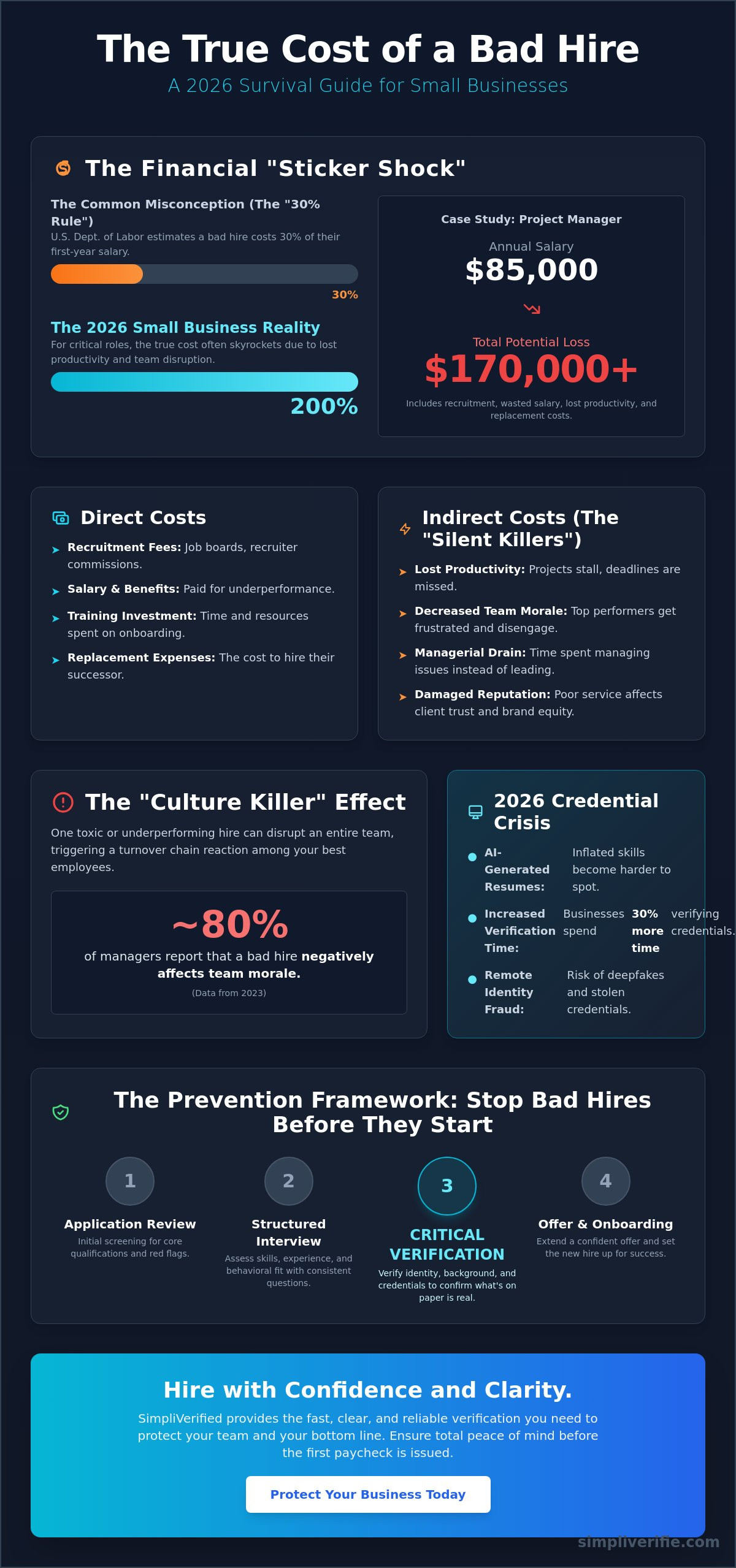
Hiring represents a significant milestone for any growing company. However, the financial reality of a mismatch is often far more severe than most owners realize. The cost of a bad hire for a small business is the cumulative loss of recruitment fees, salary, training time, and replacement expenses; in 2026, SHRM reports the average cost to replace a single employee has reached $56,500. This "sticker shock" can destabilize a firm's yearly budget in a single quarter.
Many entrepreneurs still rely on the "30% Rule," which suggests a bad hire costs 30% of their annual salary. Modern data shows this is a conservative estimate. For a small business where every role is critical, a hiring mistake often costs 200% of that employee's annual salary. If you hire a project manager at $85,000 and they fail within six months, your total loss could exceed $170,000 when you account for the disruption to your workflow.
You can easily track direct expenses like job board fees and recruiter commissions on a balance sheet. Indirect expenses are harder to quantify but move the needle further. You're paying for wasted training hours and suffering from lost opportunity costs while your top performers stop their own work to fix a new hire's errors. This frustration often triggers higher employee turnover among your most reliable staff, compounding your financial losses.
The hiring environment in 2026 is more complex than ever. AI-generated resumes have become the standard, making it easy for candidates to inflate their skills with professional-sounding jargon. Small businesses now spend 30% more time verifying credentials that often don't match the candidate's actual abilities. Remote work has also increased the risk of identity fraud, where individuals use deepfake technology or stolen credentials to secure positions. Dealing with these fraudulent hires isn't just a security headache; it's a massive financial drain that includes legal fees and lost data integrity.
Every hour a manager spends reviewing applications or conducting interviews is an hour they aren't generating revenue. You're paying for job board visibility and administrative overhead that yields zero return if the hire doesn't last. The "Ramp-Up" drain is particularly painful for small teams. You're likely paying a full salary for only 45% productivity during the first six months. If the hire fails before they reach full efficiency, that's pure capital down the drain. SimpliVerified helps you avoid this cycle by providing the clarity you need before the first paycheck is ever issued.
In a small business, every employee represents a significant percentage of your total output. When one person fails to perform or disrupts the workflow, the impact isn't just a localized dip in productivity; it's a systemic failure. The cost of a bad hire for a small business often manifests first as a culture killer. One toxic individual can spread negativity through a tight-knit team in weeks, creating a psychological burden on your most reliable staff members. This contagion slows down projects and forces your best people to spend their energy managing friction rather than hitting targets.
High achievers, often called A-players, quickly grow frustrated when they have to fix mistakes or cover the workload of a low-performer. This dynamic often triggers a turnover chain reaction. According to data from 2023, nearly 80% of managers report that a bad hire negatively affects the entire team's morale. When your top talent sees that poor performance is tolerated or that their own workload has doubled to compensate for a peer, they start looking for the exit. Understanding the True Cost Of A Bad Hire helps owners realize that the damage extends far beyond a single paycheck. Rebuilding a workplace culture after a high-profile termination is a slow process that requires months of transparent leadership to restore trust.
Small businesses don't have the massive PR budgets that corporations use to bury mistakes. Your brand is often only as good as the last interaction a client had with your staff. If a bad hire provides poor service or commits a technical error, the "Negative Review" factor kicks in immediately. A single one-star review can lower your local SEO ranking and deter dozens of potential leads. If a client with a lifetime value of $12,000 leaves due to a bad experience, that's a permanent loss to your bottom line. Small firms are less resilient to these hits because they lack the "brand padding" of a global entity. One person's mistake can tarnish a reputation you've spent years building in your local market.
The management tax is perhaps the most hidden cost of a bad hire for a small business. Owners often spend about 17% of their work week, or nearly one full day, "babysitting" or correcting the work of poor performers. For an entrepreneur, this is time stolen from strategic growth and business development. You can't scale your company if you're constantly mediating interpersonal conflicts or re-doing basic tasks. Protecting your time and your team starts with a more rigorous vetting process. Choosing to partner with SimpliVerified for your background checks gives you the clarity needed to hire with confidence, ensuring your team remains a cohesive unit focused on growth rather than damage control.
Skipping a background check isn't just a shortcut; it's a massive legal liability. In 2026, the legal environment for small businesses has become increasingly litigious. Negligent hiring occurs when an employer fails to check a candidate's history and that employee later harms a client or coworker. This oversight leads to catastrophic financial fallout. A single lawsuit often costs more than a decade of screening fees. Protecting your team starts with knowing exactly who you're bringing into the fold.
Employers have a legal duty of care. You're responsible for the safety of everyone your employees interact with during the workday. If a worker with a history of violence or financial fraud commits a crime on the clock, the business is often held liable for failing to know about their past. Recent legal data shows the average settlement for a negligent hiring claim in 2026 now exceeds $1.2 million. You'll find that The True Cost of a Bad Hire isn't just a lost salary; it's the potential end of your company. A documented, comprehensive background check serves as your primary legal shield. It proves you exercised due diligence and took reasonable steps to protect your environment. Without this paper trail, your defense in court is almost non-existent.
Small businesses are particularly vulnerable to insider threats. Because these companies often have fewer internal controls than large corporations, one dishonest person can easily drain a bank account or steal sensitive client data. Criminal searches and credit reports help identify high-risk candidates before they gain access to your assets. This is especially critical in regulated fields where the stakes are even higher. For example, healthcare compliance monitoring is no longer optional for small clinics. Failing to screen against exclusion lists can result in federal fines starting at $11,000 per day of non-compliance. When you calculate the cost of a bad hire for a small business, these regulatory penalties often outweigh the initial recruitment expenses. SimpliVerified helps you manage these risks through automated systems that flag issues before they become expensive legal battles. It's about maintaining your peace of mind while ensuring your business stays compliant and secure.
The cost of a bad hire for a small business is often hidden until it's too late. By the time a legal issue arises, the damage to your reputation and bank account is already done. Investing in a reliable screening process is the most cost-effective way to prevent these invisible dangers from surfacing. It's a proactive step that transforms a risky hiring process into a secure, predictable experience for everyone involved.
Hiring in 2026 requires a shift from intuition to a "Safety-First" protocol. You can't afford to rely on a gut feeling when the cost of a bad hire for a small business can exceed 30% of the employee's first-year earnings. SimpliVerified helps you build a tiered screening approach. This means you match the depth of your background check to the specific risks of the role. A warehouse manager requires different scrutiny than a remote data entry clerk. By automating the collection of basic documents and initial screenings, you free up your management team to focus on culture fit rather than chasing paperwork. Consistent employment verification builds a culture of integrity from day one. It sends a clear message that your business values honesty and transparency.
In 2026, credential inflation is a growing challenge for small firms. Education and professional license verification are non-negotiable filters to ensure your team has the skills they claim. An SSN trace is another vital tool. It confirms identity and uncovers jurisdictions where a candidate might have a hidden criminal record. For safety-sensitive roles, pre-employment drug testing remains a cornerstone of workplace safety. These steps don't just protect your physical assets; they protect your brand's reputation. Industry data from 2024 showed that nearly 40% of resumes contain some form of exaggeration. Implementing these filters early helps you avoid the high cost of a bad hire for a small business before they even walk through the door.
Rapport is great, but it's a poor predictor of performance. You should move toward behavioral-based questioning that asks for specific examples of past actions. Reference checks provide the necessary validation for these claims. They help you confirm soft skills and work ethic that a resume might exaggerate. Small business hiring managers should maintain a "Red Flag" checklist. This includes things like unexplained employment gaps or inconsistent dates during the interview. When you standardize these steps, you remove bias and replace it with data. This structured approach creates a predictable, professional experience for every candidate. It ensures that every person you bring on board aligns with your long-term goals and company values.
Hiring for a small team means every decision carries significant weight. When you consider that the cost of a bad hire for a small business can reach 30% of the employee's first-year earnings according to the U.S. Department of Labor, the margin for error is thin. SimpliVerified removes the technical and legal barriers that often make background screening feel overwhelming for small business owners. We've designed our platform to serve as your virtual HR department, providing the tools you need to vet candidates without requiring a specialized degree to interpret the results.
Our "Simplicity" promise ensures that you receive reports that are clear, actionable, and accurate. We use the same enterprise-level technology that Fortune 500 companies rely on, but we've scaled it to fit small business budgets and workflows. This means you get high-end data security and deep-dive reporting without the enterprise price tag. Our team prioritizes FCRA compliance at every step; this protects your company from the litigation risks that often follow improper hiring practices.
SimpliVerified operates from our headquarters in Draper, UT. This local presence means our team understands the specific regulatory environment and hiring culture of American small businesses. You aren't just another account number in a global database; you're a partner. To ensure comprehensive coverage, we maintain a nationwide network of over 15,000 collection sites for drug testing. This allows your candidates to complete their requirements quickly, regardless of their location. Our system integrates directly with popular hiring platforms, making background checks a natural, automated part of your existing workflow.
We've eliminated the friction typically associated with starting a new screening partnership. You can set up your account and run your first report in just a few minutes. Because small business hiring needs can fluctuate, we use a transactional pricing model. You only pay for the reports you actually need, which is the most cost-effective way to manage the cost of a bad hire for a small business. There are no monthly minimums or hidden maintenance fees to worry about.
Building a team is about more than just filling seats; it's about protecting the culture you've worked hard to create. You can take the first step toward a safer team today by requesting a compliant background check through our intuitive portal. Our experts are ready to help you hire with total confidence.
Navigating the talent market in 2026 requires more than just a good intuition. The financial reality is stark. Industry data shows that replacing a mid-level employee often reaches 150 percent of their annual salary. For a boutique firm, the cost of a bad hire for a small business extends far beyond the balance sheet. It erodes the culture you've worked hard to build and introduces unnecessary legal liabilities. By implementing a rigorous prevention framework, you protect your most valuable asset: your people.
SimpliVerified offers a streamlined path to this security. You'll benefit from FCRA-compliant reports delivered with industry-leading speed. Our expert support team, based in Draper, Utah, is ready to guide you through every step. We prioritize your budget with a transactional pricing model; you only pay for what you use. This approach ensures your screening process remains both effective and affordable as you scale.
Protect your business and hire with confidence; start your first background check today.
Building a high-performing team starts with making informed decisions from day one.
The average cost of a bad hire for a small business is roughly 30% of the employee's first-year earnings according to the Society for Human Resource Management (SHRM). For a position with a $50,000 salary, this represents a $15,000 loss in recruitment and training expenses. SimpliVerified helps you protect your margins by ensuring you hire the right person the first time.
You can identify a bad hire by monitoring their ability to meet 30 day performance milestones and assessing their impact on team morale. Watch for consistent tardiness or a refusal to adopt company workflows. If a new employee fails to meet 75% of their initial training objectives, it's a clear signal that the match isn't working. Early intervention protects your culture and bottom line.
A comprehensive background check prevents bad hires by verifying the accuracy of a candidate's professional history and identifying potential safety risks. Statistics from the Association of Certified Fraud Examiners show that 40% of resumes contain some form of exaggeration or falsehood. By using SimpliVerified, you confirm that your applicant actually possesses the degrees and experience they claim. This verification process eliminates high-risk candidates before they join your team.
The most common red flags in a background check include significant discrepancies in employment dates and undisclosed criminal records relevant to the job duties. Check for inconsistencies where a candidate claims a title they didn't hold or lists a degree from a non-accredited institution. SimpliVerified flags these issues instantly. These warnings allow you to make informed decisions and maintain the integrity of your small business.
Negligent hiring liability occurs when an employer fails to conduct reasonable due diligence and an employee subsequently harms a coworker or client. Courts often award settlements exceeding $1 million in these cases if the employer didn't perform a background check. Small business owners face total financial ruin from just one lawsuit. Partnering with SimpliVerified provides the documented due diligence needed to mitigate these legal risks effectively.
Drug testing remains a vital tool for small businesses, especially for roles involving safety-sensitive tasks or access to confidential data. While remote work has changed office dynamics, 56% of employers still utilize drug screening to maintain workplace safety and lower insurance premiums. It's a proactive step to ensure your team remains sharp and reliable. SimpliVerified offers streamlined testing solutions that fit both physical and virtual office models.
A professional background check in 2026 typically takes between 24 and 72 hours to complete. Automated integrations with court systems and digital databases have replaced the slow, manual processes of the past. SimpliVerified leverages these technologies to provide rapid results without sacrificing accuracy. You get the information you need quickly so you don't lose top talent to a competitor during a long waiting period.
A "bad fit" usually refers to a talented individual whose working style doesn't align with your culture, while a "bad hire" involves a lack of essential skills or integrity. You can often coach a bad fit into a new role, but a bad hire requires immediate termination to prevent damage. Understanding the cost of a bad hire for a small business helps you prioritize character and verified history during the interview process.