Hiring
Drug Testing
Employment Screening


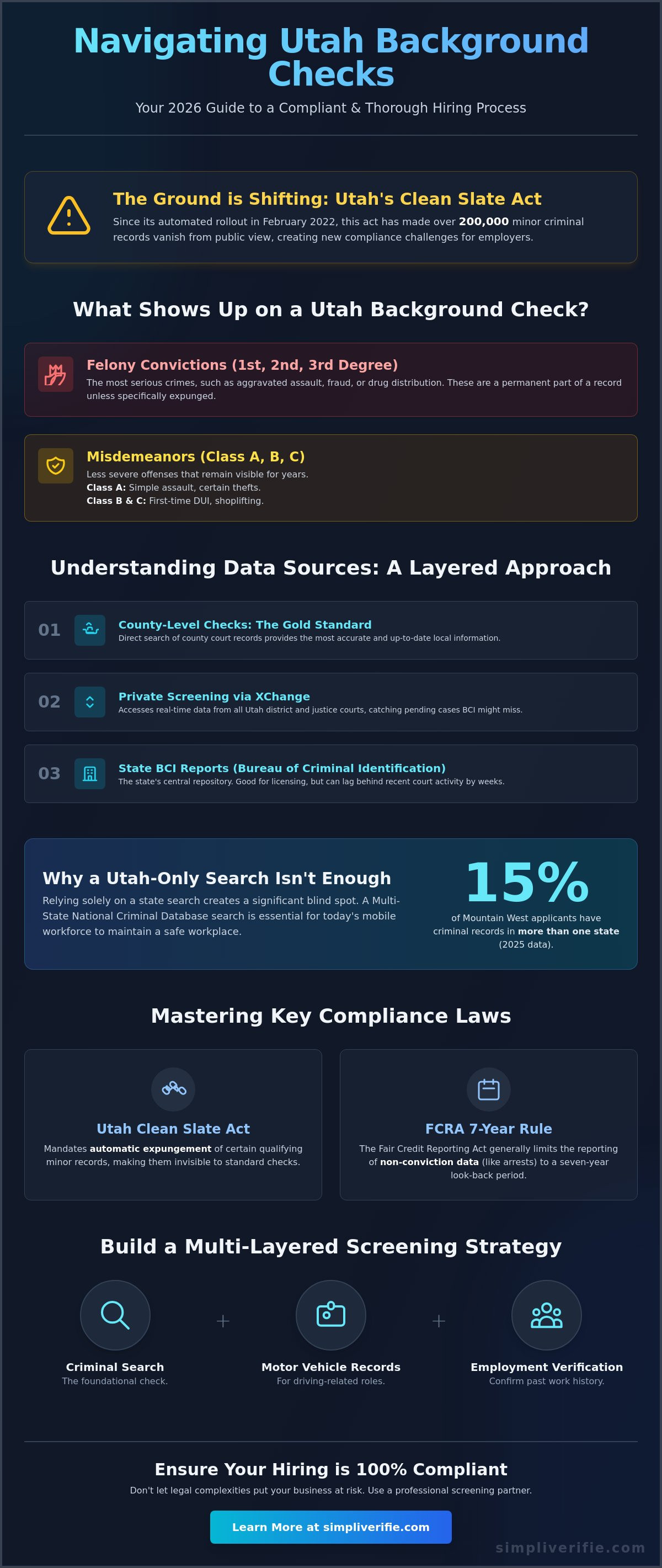
Could an automated legal process from February 2022 be the reason you're missing critical candidate data? Since the Utah Clean Slate Act began its automated rollout, over 200,000 minor records have vanished from public view, leaving many HR professionals wondering exactly what shows up on a criminal background check Utah providers deliver. You're right to feel that the ground is shifting. Managing a growing team requires a balance between speed and total legal compliance, and the fear of an FCRA lawsuit or a missed out-of-state felony is enough to keep any hiring manager up at night.
We're here to restore your tranquility of mind. This 2026 guide breaks down the complexities of Utah's reporting standards into a simple, actionable framework. You'll discover the specific offenses that remain visible, understand the strict look-back periods dictated by state law, and learn how to navigate the intersection of court data and federal regulations. By the end of this article, you'll have a clear roadmap to ensure your hiring process is both thorough and 100% compliant.
A Utah criminal background check serves as a detailed audit of an individual's legal history. It documents specific interactions with law enforcement, including arrests, formal charges, and final convictions. The Utah Bureau of Criminal Identification (BCI) acts as the state's central repository for this data. It's the primary source for state-level information, but it doesn't always tell the full story. Understanding what shows up on a criminal background check Utah requires a look at how data moves through different systems. While BCI offers name-based checks, these differ significantly from fingerprint-based FBI checks. Fingerprint checks use biometric data to prevent identity errors, while name-based searches rely on identifiers like birth dates and Social Security numbers. Professional screening firms often prioritize "The Hub" and specific county-level court searches to ensure real-time accuracy. This multi-layered approach is necessary because Criminal records in the United States are maintained across thousands of separate jurisdictions, making a single-source search insufficient for high-stakes hiring.
The BCI "Right of Access" report is a common starting point, but it has practical limitations for employers. These reports often reflect only what's been reported to the state's central file, which can lag behind recent court activity by several weeks. Professional screening firms avoid these delays by accessing the Utah District Court's XChange system. This digital gateway provides direct access to records from all Utah district and justice courts. Since 2024, many Utah businesses have shifted to XChange-based searches to catch pending cases that haven't reached the BCI database yet. Using a private firm ensures you're seeing the most current data available, providing the clarity needed for confident decision-making. It's a proactive way to manage risk rather than relying on static, potentially outdated government exports.
Relying solely on a Utah-only search creates a blind spot in your screening process. Data from 2025 indicates that approximately 15% of job applicants in the Mountain West region have criminal records in more than one state. If you only search Utah, you'll miss a felony conviction in Idaho or a recent arrest in Arizona. A Multi-State National Criminal Database search acts as a wider safety net, scanning millions of records from across the country in seconds. This broader perspective is essential for a mobile workforce where candidates frequently relocate for work. When evaluating what shows up on a criminal background check Utah, you must account for these out-of-state possibilities to maintain a safe workplace. In Utah, the standard look-back period for reporting criminal records generally follows the seven-year rule established by the Fair Credit Reporting Act for most non-conviction data.
Understanding what shows up on a criminal background check Utah requires a look at how the state categorizes and stores judicial data. Most reports pull information directly from the Utah Bureau of Criminal Identification (BCI) and the Administrative Office of the Courts. These records provide a detailed history of an individual's interactions with the law, categorized by the severity of the offense and its current legal status.
While most convictions remain visible, Utah's Clean Slate law, which began its automated rollout in early 2022, clears specific old and minor records from public view. This law helps individuals with older, non-violent misdemeanors regain their footing by removing those records from standard background checks automatically.
Standard traffic tickets and minor infractions are generally civil matters and don't appear on a criminal background check. However, if a traffic violation escalates to a criminal level, it changes the reporting. For instance, a speeding ticket is an infraction, but Reckless Driving is a Class B misdemeanor. Under 2026 reporting standards, only criminal-level driving offenses typically populate in a standard criminal history report. Partnering with a provider like SimpliVérifié ensures you receive these details in a clear, compliant format that distinguishes between minor slips and serious risks.
To ensure accuracy and prevent "false positives," Utah background checks include specific personal identifiers. These data points confirm that the record belongs to the candidate in question. A standard report includes the full legal name and any known aliases (AKAs) used in court filings. You'll also see the date of birth and a partial Social Security Number to maintain privacy while ensuring verification. Finally, the report often lists last known addresses and residency history within Utah to provide a complete picture of the individual's local footprint.
Utah's legal landscape for employment screening is designed to balance public safety with a candidate's right to move past their history. Employers must understand these specific regulations to stay compliant. The intersection of state initiatives like the Clean Slate Act and federal mandates determines exactly what shows up on a criminal background check Utah.
The Utah Clean Slate Act, which began automating expungements in February 2022, fundamentally changed how records are handled. By 2026, this program has matured to include a broader range of qualifying Class B and Class C misdemeanors, minor drug possession charges, and infractions. If a person remains crime-free for a specific period, usually five to seven years depending on the offense, the state automatically clears these records from public view.
Once a record is expunged under this initiative, it's legally erased for the purposes of most private employment screenings. You cannot see these records, and you're legally prohibited from using them to make a hiring decision. This process provides candidates with a fresh start while simplifying the screening process for HR teams. SimpliVerified's technology integrates these updates in real-time, so your team doesn't accidentally view or act upon protected data.
Federal law acts as a primary guardrail for background checks. The Fair Credit Reporting Act (FCRA) limits the reporting of non-conviction information. Arrests that didn't lead to a conviction, tax liens, and civil judgments generally won't appear on a report if they're older than seven years.
There's a specific exception to this rule. If the position you're hiring for has an annual salary of $75,000 or more, federal law allows for a more extensive look into these older records. However, SimpliVerified recommends a consistent screening policy across your organization to maintain equity. We provide the expert oversight needed to ensure that what shows up on a criminal background check Utah remains within these strict legal boundaries, protecting you from potential litigation.
Compliance also involves how you handle the information once you receive it. Utah follows specific "Adverse Action" protocols. If a report contains a record that leads you to consider a non-hire, you must follow a two-step process:
Utah's "Ban-the-Box" law, known as the Utah Employment Selection Procedures Act, currently applies to public sector employers. These agencies can't ask about criminal history on an initial application. While private employers in Utah aren't currently under a statewide mandate to remove the box, many choose to do so to ensure a more inclusive hiring culture and to align with evolving national standards.
Knowing what shows up on a criminal background check Utah provides a solid foundation for your hiring process. It isn't the complete picture. A single criminal search doesn't reveal if a candidate lied about their degree or if they have a history of dangerous driving. To truly protect your company culture, you need to layer different types of data. This multi-dimensional approach transforms a simple check into a comprehensive safety strategy.
Pairing criminal records with employment verification is the most effective way to confirm a candidate's integrity. Resume fraud remains a persistent issue, with industry data showing that 40% of applicants misrepresent their work history. Verifying past titles and dates ensures you're hiring the expert you interviewed. This synergy between criminal and professional history eliminates blind spots and builds a more reliable workforce.
If an employee operates a company vehicle or uses their personal car for business, an MVR is essential. While a DUI conviction typically appears on a criminal report, the MVR provides the granular details insurance providers require. It shows license status, medical certificate expirations for CDL holders, and accumulated points. In 2026, Utah's Driver License Division utilizes specific reporting codes like "A24" for alcohol-related reckless driving. Checking these records helps you avoid negligent entrustment lawsuits, which can cost businesses millions in liability claims.
For specialized industries, verifying credentials isn't just a best practice; it's a legal requirement. This is especially true for healthcare compliance monitoring where an unverified license can lead to immediate federal penalties. We look beyond the certificate to ensure the issuing institution is accredited. This prevents "diploma mills" from placing unqualified individuals in high-stakes roles. Confirming education directly with the registrar ensures your team has the actual skills needed to succeed.
A truly safe workplace also integrates the following components into the pre-employment workflow:
SimpliVérifié makes this complex layering process effortless. We handle the technical details so you can focus on making the right hire with total confidence. It's about more than data; it's about your peace of mind.
Contact us today to build your custom Utah screening packageCreating a robust hiring process starts with a clear, written background check policy tailored for your Draper-based business. This document serves as your roadmap. It ensures every candidate receives equal treatment while protecting your company from liability. You should define which roles require specific checks and outline the criteria for disqualification based on the nature of the job. Understanding what shows up on a criminal background check Utah allows you to set these benchmarks with precision, and many firms also incorporate deleteme into their broader security strategy to remove corporate information from the internet.
Before you run any search, you must obtain written consent from the candidate. This isn't just a courtesy; it's a legal requirement under the Fair Credit Reporting Act (FCRA). In 2026, digital signatures have made this step nearly instantaneous. Once you have the results, the focus shifts to analysis. You must distinguish between a significant red flag, such as a recent violent felony, and a minor past mistake, like a decade-old misdemeanor that doesn't impact job performance. Using an individualized assessment prevents you from losing qualified talent over irrelevant history.
Partnering with a local expert ensures you don't miss Utah-specific nuances. For instance, Utah's Clean Slate law has automated the expungement of certain records, meaning some older cases won't appear. A local partner knows how to navigate these updates, ensuring your reports are both accurate and legally compliant.
Our team brings deep expertise in Utah court systems and specific Draper local regulations. We use technology-driven results to keep your hiring process fast and functional. Our platform integrates directly with local databases to ensure accuracy that generic national providers often miss. Our expert compliance review provides the total peace of mind you need to grow your workforce with confidence.
Is your background check strategy ready for 2026? Compliance laws shift frequently, and staying ahead requires a proactive partner. You can request a custom quote tailored to your specific industry needs, whether you're in tech, healthcare, or retail. Knowing exactly what shows up on a criminal background check Utah for your specific sector helps you hire faster and safer. Contact our Draper office today for personalized support and a walkthrough of our automated platform.
Navigating Utah's 2022 Clean Slate law and federal FCRA regulations is essential for any growing organization. You must understand what shows up on a criminal background check Utah to ensure your hiring decisions remain both legal and effective. Relying on incomplete searches or outdated data exposes your business to unnecessary risks. By integrating multi-layered screening that pulls directly from the Utah Bureau of Criminal Identification, you protect your company culture while staying compliant with 2026 standards.
SimpliVerified simplifies this entire process. We're headquartered in Draper, UT, providing a local perspective that national firms often miss. Our FCRA-certified experts use advanced technology integrations to deliver fast, accurate results that keep your onboarding pipeline moving without delays. We've designed our platform to be intuitive, removing the friction and stress from background checks. You'll get the clarity needed to hire candidates securely. Let us handle the technical details so you can focus on growth with total peace of mind.
Get a Compliant Utah Criminal Background Check for Your Business Today
Your path to a safer, more efficient workplace starts with a partner who knows Utah law inside and out. We're ready to help you succeed.
Utah background checks generally report convictions indefinitely, but the Fair Credit Reporting Act (FCRA) limits the reporting of non-convictions to a 7-year window. Most employers focus on this 7-year period for standard screenings to maintain compliance. If you've successfully expunged a record under Utah Code § 77-40a, those specific details won't appear. Understanding what shows up on a criminal background check Utah helps you prepare for the hiring process with confidence.
Arrests without convictions appear on your report for up to 7 years unless they've been expunged or sealed. The FCRA prevents consumer reporting agencies from listing these non-conviction records once they exceed the 7-year limit. However, if the position you're applying for offers a salary exceeding $75,000, some reporting agencies might extend this lookback period. It's best to verify your record with the Utah Bureau of Criminal Identification to ensure everything's accurate.
The Utah Clean Slate Act, which took effect on February 10, 2022, automates the expungement process for individuals with specific low-level crimes. This law applies to Class B and C misdemeanors, minor drug possession, and cases where charges were dismissed. For employers, this means automated systems remove these records from public view entirely. It simplifies the hiring process by ensuring minor, old mistakes don't hinder a qualified candidate's progress or create unnecessary bias.
Employers generally can't access juvenile records in Utah because they're considered private and protected under Utah Code § 80-6-101. These records aren't part of the public adult criminal history that standard checks access. Only specific government agencies or law enforcement entities have the legal authority to view them. Unless you're applying for a high-security government position or a role involving vulnerable populations, your juvenile history stays confidential and won't impact your job search.
Most Utah background checks take between 1 and 3 business days to complete. This timeline depends on whether the search relies on the Utah Bureau of Criminal Identification (BCI) database or requires manual county courthouse checks. Digital systems often deliver results in under 24 hours. If a candidate has lived in multiple locations like Salt Lake or Utah County, the process might require an extra 48 hours to ensure every jurisdiction is thoroughly searched.
A DUI from another state will show up on a Utah-based check if the screening includes a national criminal database search. Most professional background checks use the National Criminal Database and the Interstate Identification Index to find records across all 50 states. Even if the incident happened in California or Nevada, the data usually links back to your Social Security number and name within 48 hours of the request being processed by the reporting agency.
It's illegal to conduct a professional background check for employment without the candidate's written consent under FCRA Section 604. Employers must provide a standalone disclosure and obtain a signature before they initiate the search. If an employer ignores this 1970 federal law, they face significant legal penalties and potential lawsuits. This requirement ensures the process remains transparent and gives you the chance to review what shows up on a criminal background check Utah before it's finalized.
You should immediately file a formal dispute with the consumer reporting agency if you find an unexpected or inaccurate record. Under the FCRA, the agency has 30 days to investigate the claim and correct or remove any disputed information. Provide documentation, such as court dismissal papers or expungement orders, to speed up the correction process. This proactive step protects your reputation and ensures your employment opportunities remain intact despite clerical errors or outdated data.