
Hiring
Drug Testing
Employment Screening


Did you know that a single fraudulent tenant can cost you an average of $7,500 in unpaid rent, legal fees, and eviction expenses? In 2026, the rental market is more competitive than ever, but it's also more dangerous for property owners who cut corners. It is tempting to save a few dollars by running your own Google searches or checking social media profiles, but the risks of DIY background checks for landlords have transformed into a significant legal and financial liability.
We understand the pressure to fill a vacancy quickly while staying compliant with shifting Fair Housing and FCRA regulations. You want a reliable tenant who respects your property, not a "professional tenant" who knows exactly how to exploit an incomplete screening process. This article explains why DIY methods often miss sophisticated AI-generated fraud and how professional verification protects your investment from litigation.
By the end of this guide, you'll understand the latest regulatory changes, the true cost of manual errors, and how SimpliVerified provides the clarity you need to move forward with confidence. We will show you how to streamline your applications while maintaining the highest standards of accuracy and security for every property in your portfolio.
Many property owners believe a quick online search is enough to vet a potential tenant. However, the risks of DIY background checks for landlords often outweigh the perceived convenience. A DIY check typically involves social media sleuthing, searching local court websites, and making informal reference calls. While these methods feel thorough, they provide a fragmented and often outdated view of an applicant. Relying on a Google search doesn't constitute legal due diligence in a modern courtroom; it leaves you vulnerable to claims of negligence or discrimination.
Public records are frequently 30 to 60 days behind the specialized databases used by professional agencies. This delay means you might miss a recent eviction or a pending criminal case. Furthermore, DIY searches usually focus on local records, meaning you could easily overlook out-of-state convictions or federal offenses. With rental application fraud rates reaching 5.1% in 2025, according to industry analysis of over 1.4 million applications, DIY methods are simply not equipped to catch sophisticated fake documents or "template farm" identities.
Understanding What is Tenant Screening? requires looking beyond surface-level data. Professional agencies like SimpliVerified are classified as Consumer Reporting Agencies (CRAs). This classification means we must follow strict accuracy standards that protect both the landlord and the applicant. Under the FCRA, a Consumer Report is any communication by a consumer reporting agency regarding an individual's credit, character, or reputation used as a factor in establishing eligibility for housing or employment.
Using these certified reports grants landlords specific legal protections that DIY searches cannot provide. If you deny an applicant based on a professional report, you have a clear, documented, and legally admissible reason for your decision. Our team serves various industries, providing tailored screening solutions that meet specific regulatory requirements and ensure you aren't making decisions based on incomplete or incorrect data.
Landlords often turn to social media to get a feel for a person. This is a dangerous path. You may inadvertently see information about a protected class, such as religion, disability, or familial status. If you deny the application after seeing this, you face a high risk of a discrimination claim under the Fair Housing Act. Unlike DIY searches, professional reports provide the legal foundation required to issue an adverse action notice without fear of litigation.
Free background sites are another common trap. These platforms often aggregate unverified data from multiple sources, leading to false positives or missing records entirely. Relying on self-reported data from the applicant is equally risky; individuals with a history of evictions or criminal behavior often know how to hide their past on a standard application form. Without professional verification, you're essentially taking the applicant's word for their history, which is a gamble your rental investment can't afford.
One of the most significant risks of DIY background checks for landlords is the assumption that "public" information is free to use for any purpose. Under the Fair Credit Reporting Act (FCRA), if you use a third party to collect information on a tenant's credit or character, you are using a Consumer Report. This triggers a specific set of legal obligations. If you deny an applicant based on a casual Facebook post or an unverified court record found online, you are often bypassing the mandatory "Adverse Action" process. This oversight doesn't just lose you a potential tenant; it opens the door to litigation that is difficult to defend in court.
Non-standardized screening methods often lead to claims of implicit bias. In 2026, many states have introduced or expanded "Fair Chance" housing laws that restrict when and how you can look at criminal history. For example, Illinois recently implemented changes effective July 1, 2026, that cap background check fees at $50 and require clear fee disclosures. DIY landlords frequently miss these nuances, inadvertently violating local "Ban the Box" ordinances. Standardizing your process through a partner like SimpliVerified ensures that every applicant is treated with the same rigorous, compliant criteria.
Statutory damages for FCRA violations can be devastating for property owners. In July 2026, the Federal Trade Commission announced a $2.25 million penalty against a screening company for failing to ensure report accuracy. While individual landlords might not face such massive sums, the cost of a single non-compliant denial can still reach thousands of dollars in fines and legal fees. A professional Adverse Action Notice provides a clear trail of compliance, documenting exactly why a decision was made. Our platform automates this documentation, allowing you to focus on managing your property instead of worrying about administrative paperwork.
The Fair Housing Act prohibits discrimination, but "disparate impact" lawsuits often arise even when there is no intent to discriminate. When you conduct DIY research, you might see photos, religious affiliations, or family details that should never influence your decision. Once you've seen that information, it's hard to prove it didn't play a role in your choice. Maintaining a consistent, documented set of screening criteria for every applicant is the only way to mitigate this risk. By using objective data points from a professional report, you shield yourself from the risks of DIY background checks for landlords and the legal headaches they cause.
If you are unsure about your local compliance requirements, consider reviewing how we support various industries with tailored screening solutions designed to keep you on the right side of the law.
"Instant" background checks promise speed, but they often deliver a false sense of security. One of the primary risks of DIY background checks for landlords involves the sheer fragmentation of public records. There are over 3,000 counties in the United States, each with its own filing system and update schedule. A DIY search on a single court website or a "free" aggregator often misses out-of-state convictions or federal offenses that haven't been digitized or indexed correctly. If your applicant moved from another state, a local search is essentially blind to their previous history.
The Consumer Financial Protection Bureau has highlighted significant concerns regarding Data Accuracy in Background Checks, noting that errors in these reports can lead to unfair denials or missed red flags. Identity mismatches are particularly common in DIY data. Without professional verification, you might encounter a "false positive," where a record belonging to someone with a similar name is wrongly attributed to your applicant. Conversely, "false negatives" occur when a criminal history exists but remains hidden because the DIY tool didn't search the right jurisdiction. SimpliVerified bridges this gap by using human-in-the-loop verification to ensure every record belongs to the person standing in front of you.
Many landlords don't realize that standard credit reports often exclude local eviction filings unless they've resulted in a monetary judgment. Serial evictees often understand how to vacate a property before a judgment is finalized, leaving their credit score intact while their rental history remains checkered. Identifying these patterns requires a deep dive into civil record searches. For those managing properties in specific regions, our Draper Landlord's Guide to Tenant Screenings provides localized insights into how these gaps can impact your investment.
In 2026, rental application fraud has become more sophisticated. We've seen a rise in "template farms" and fake employer websites designed to fool manual checks. A DIY landlord might call a phone number provided by the applicant, only to speak with a friend or a paid service posing as a manager. Our rigorous employment verification process involves contacting institutions directly through verified channels, ensuring that income and history are factual rather than fabricated. This level of scrutiny is the only way to combat the increasing prevalence of AI-generated fraudulent documents.
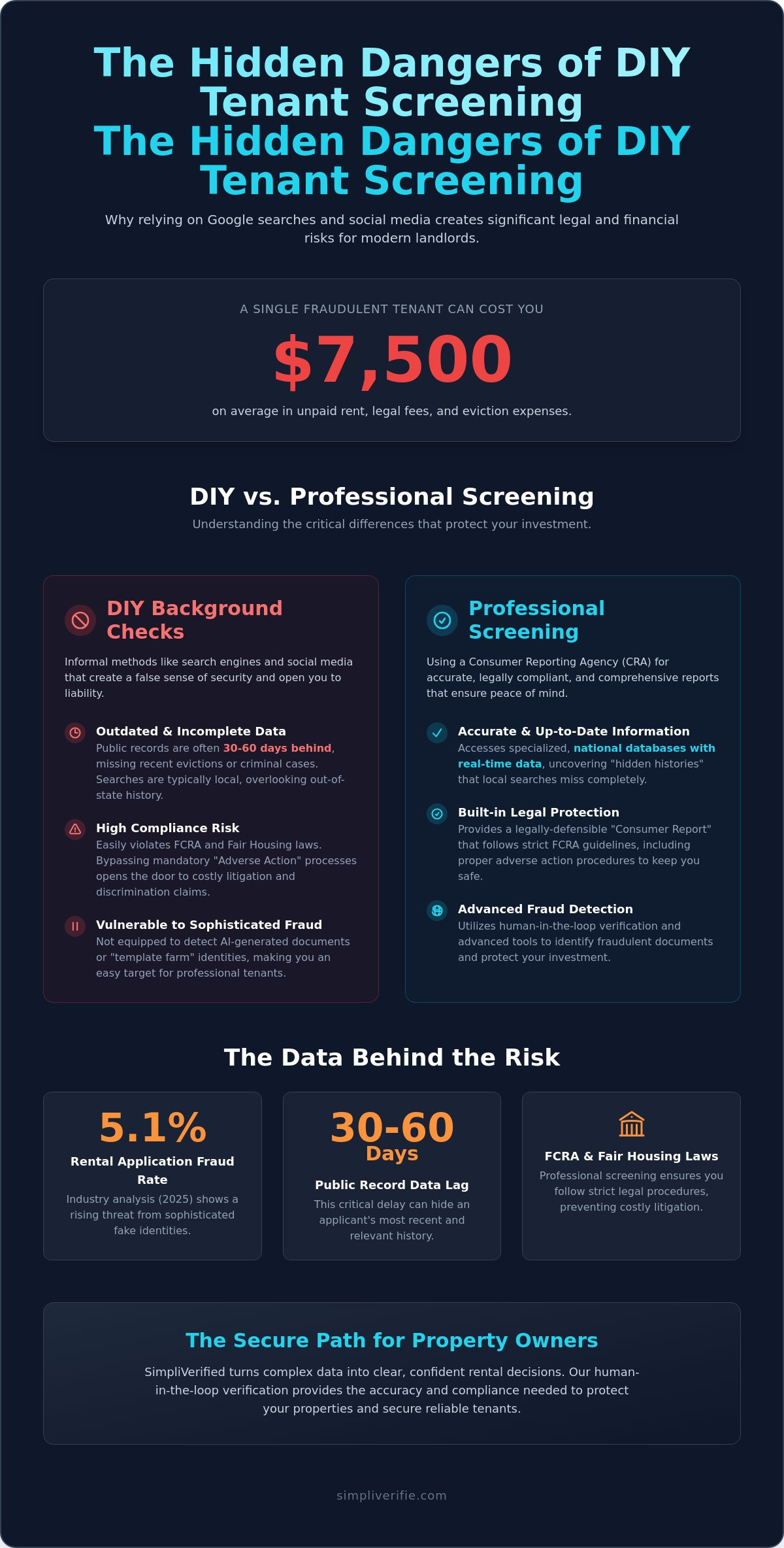
The financial consequences of a bad placement extend far beyond a missed rent check. In 2026, the average cost of a fraudulent tenancy, including unpaid rent, legal fees, and eviction expenses, ranges between $5,000 and $10,000. Most property owners report a typical loss of $7,500 per incident. This "Bad Tenant" multiplier quickly compounds when you factor in property damage and the months of lost income while the unit sits vacant during legal proceedings. These risks of DIY background checks for landlords turn a small savings on screening fees into a massive financial sinkhole.
Liability risks present an even greater threat to your rental investment. If a DIY search misses a history of violent behavior and that tenant later harms a neighbor or another resident, you could face a "Negligent Credentialing" lawsuit. This growing legal trend holds property managers and owners responsible for failing to exercise due diligence during the vetting process. Without a professional screening trail, proving you took reasonable steps to protect the community becomes nearly impossible in a courtroom.
Compare the modest cost of a professional report to the five-figure price tag of a lawsuit. A professional screening report from SimpliVerified serves as your "Exhibit A" in any legal defense. It demonstrates a commitment to a standardized, non-discriminatory process that manual searches cannot replicate. This documentation provides peace of mind that no manual Google search can match. You aren't just buying data; you're investing in a defensible shield for your business assets.
Your time has a specific dollar value. Spending hours "cyber-sleuthing" through social media and local court sites is an inefficient use of your resources. Professional screening services dramatically speed up the vacancy-to-occupancy cycle by delivering verified results in a fraction of the time it takes to do it yourself. Leveraging technology allows you to focus on high-level property management and growth rather than acting as a private investigator. Every day a unit remains empty while you manually verify references is a day of lost revenue that you cannot recover.
Protect your assets today by choosing a partner who understands the high stakes of modern property management. Explore our tenant screening solutions to ensure your next placement is a safe and profitable one.
Earlier sections detailed how "instant" results often fail to provide a complete picture of an applicant. SimpliVerified bridges the gap between raw data and informed decisions. We don't just dump a list of records on your desk. We provide context and clarity. This human-in-the-loop approach ensures that complex records are accurately interpreted, reducing the risks of DIY background checks for landlords who might otherwise misread a court filing or miss a critical identity mismatch.
Every rental property has unique requirements. A single-family home in a quiet suburb might need a different screening depth than a high-density urban apartment complex. We allow you to customize your screening package, ensuring you get the exact criminal, eviction, and credit insights you need without paying for irrelevant data. Implementing a compliant screening policy starts with choosing a partner that prioritizes accuracy and legal adherence over speed alone.
Efficiency shouldn't come at the expense of accuracy. We offer fast turnaround times because we've optimized our technology, not because we cut corners. Our dedicated support team is available to help you understand the nuances of a report, providing a level of service that generic automated platforms can't match. We serve a wide range of industries and property types, bringing specialized expertise to every screening request to ensure you remain fully compliant with local and federal laws.
Successful property management requires moving from a reactive mindset to proactive risk management. Instead of dealing with the fallout of a bad tenant, you can prevent the issue entirely. High-quality, verified tenants provide long-term value through consistent rent payments and lower maintenance costs. By avoiding the risks of DIY background checks for landlords, you build a reputation for safety and professionalism that attracts better applicants.
The legal and financial environment of 2026 demands a higher standard of due diligence. Don't leave your investment to chance or a basic search engine query. Contact SimpliVerified to secure your rental property today and experience the confidence that comes with professional-grade screening. We make the complex process of tenant verification fluid, positive, and friction-free for everyone involved.
Managing a rental property shouldn't feel like a legal gamble. We've explored how "instant" searches miss critical data and how failing to follow FCRA protocols leads to thousands in statutory damages. The risks of DIY background checks for landlords are simply too high when a single bad placement results in an average loss of $7,500. Shifting to a professional screening model moves you from reactive crisis management to proactive asset protection.
Reliable tenant selection requires more than a gut feeling or a simple Google search. It demands access to national criminal and eviction databases that manual efforts often overlook. SimpliVerified provides the expert support and FCRA-compliant reports needed to navigate complex housing laws with ease. Whether you manage one unit or one hundred, our team ensures your process is fast, accurate, and fully defensible.
Protect your investment with professional tenant screening from SimpliVerified. Let us handle the complexities of verification so you can focus on growing your portfolio with complete peace of mind.
You cannot legally deny a tenant based solely on social media findings without risking a discrimination lawsuit. Social platforms often reveal "protected class" information like religion or familial status that you aren't allowed to consider under the Fair Housing Act. If you see this data and then reject the applicant, proving that the decision was based on other factors is difficult. Stick to standardized, objective criteria to avoid legal pitfalls.
It's common practice to have the applicant pay the screening fee, though state laws vary significantly in 2026. For example, Illinois caps these fees at $50 as of July 1, 2026, unless third-party costs are higher. California's cap is $65.86 for the same period. Always check your local regulations before charging a fee to ensure you aren't violating state-specific application laws.
If a DIY search misses a record that leads to property damage or injury, you may be held liable for "negligent credentialing." This is one of the primary risks of DIY background checks for landlords because manual searches often miss out-of-state or federal offenses. A professional report provides a documented trail of due diligence that serves as a legal shield in a courtroom.
A professional screening typically takes 24 to 72 hours, whereas a DIY search might seem "instant" but lacks depth. SimpliVerified uses this time to verify data directly with courts and employers rather than relying on stale or aggregated databases. This small delay prevents the long-term friction of placing a fraudulent tenant who could take months to evict later.
You must follow a three-step process: provide a pre-adverse action notice, allow a waiting period for the applicant to dispute findings, and then issue a final adverse action notice. Skipping these steps is a direct violation of the FCRA. Professional agencies automate this documentation, ensuring you have a clear record of compliance if the applicant challenges your decision in the future.
Yes, a tenant can sue you for damages if you make a housing decision based on inaccurate or incomplete DIY data. Under the FCRA, landlords are responsible for the accuracy of the information they use to deny housing. If your manual search leads to a wrongful denial, you could face statutory damages and legal fees that far exceed the cost of a professional report.
You must obtain written consent before performing any background check, regardless of whether you do it yourself or use a professional service. The FCRA requires a clear, standalone disclosure that a report will be obtained for housing purposes. Failing to get this signature is a major compliance failure that leaves you defenseless against privacy and consumer rights lawsuits.
The most common mistake is relying on "gut feelings" or incomplete data rather than a standardized screening policy. Many property owners overlook the risks of DIY background checks for landlords and assume a friendly conversation replaces a criminal history search. Without a consistent, documented process for every applicant, you're vulnerable to both fraudulent tenants and expensive discrimination claims.