Hiring
Drug Testing
Employment Screening


With over $700 billion in federal contracts awarded annually, a single oversight during a GSA SAM exclusion check isn't just a minor administrative error. It's a direct threat to your organization's revenue and standing. You've likely felt the pressure of manual searches or the confusion of distinguishing between SAM and OIG databases. It's frustrating when compliance feels like a bottleneck that slows down your hiring process rather than a safety net that protects it.
At SimpliVerified, we understand that you need clarity and speed to keep your projects moving. This guide will help you master federal compliance by showing you how to effectively navigate and automate your exclusion searches. We'll break down the 2026 regulatory shifts, clarify the latest system consolidations, and provide a clear roadmap for faster onboarding. You'll gain a bulletproof workflow that replaces compliance anxiety with total operational serenity.
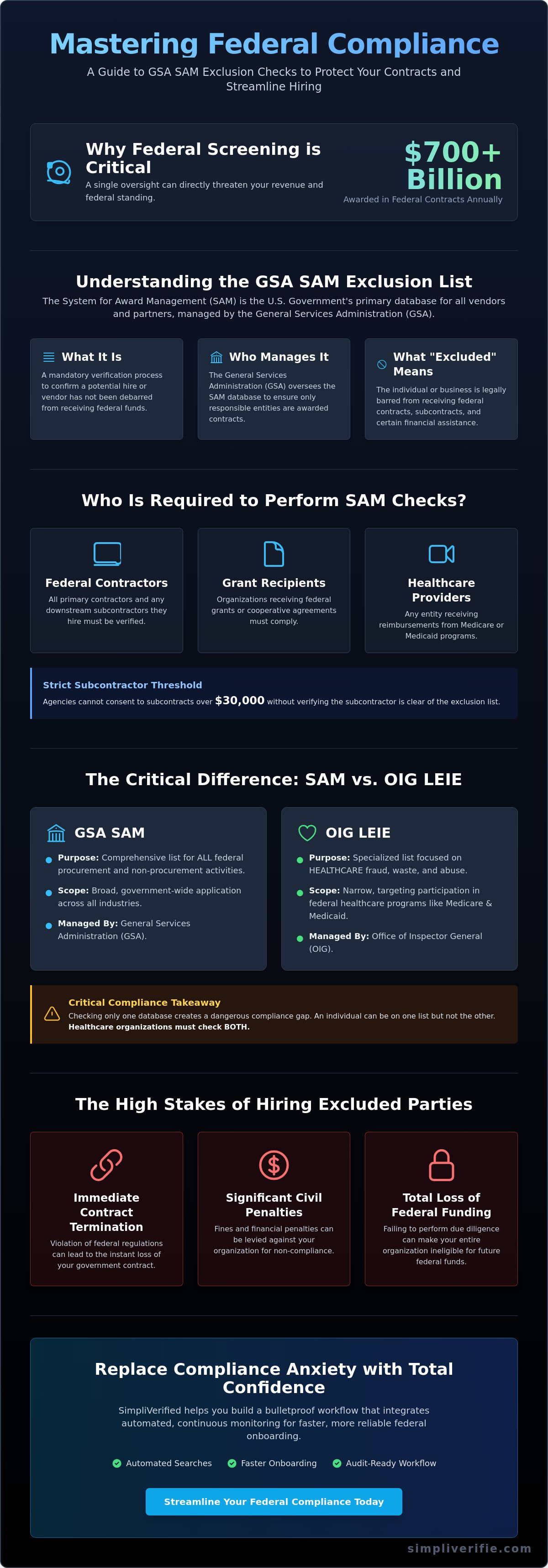
The System for Award Management (SAM) serves as the primary database for the U.S. government to manage its massive ecosystem of vendors and partners. With the federal government awarding over $700 billion in contracts every year, maintaining a transparent and secure record of eligible partners is a top priority. The General Services Administration (GSA) oversees this platform, ensuring that only responsible entities and individuals receive taxpayer funds.
A GSA SAM exclusion check is a mandatory verification process. It confirms that a potential hire or vendor hasn't been "excluded" from federal procurement. Being on the exclusion list means an individual or business is barred from receiving federal contracts, subcontracts, or certain types of financial assistance. This isn't just a recommendation; it's a legal requirement rooted in the Federal Acquisition Regulation (FAR). Failing to perform this check can lead to the immediate loss of federal funding.
Before 2012, federal agencies used the Excluded Parties List System (EPLS) to track debarments. The consolidation into SAM streamlined this by merging several legacy portals into one centralized hub. In 2026, the GSA continues to modernize this infrastructure. For example, the system underwent significant maintenance on June 20, 2026, to enhance data accuracy and system reliability. These updates ensure that reporting frequency remains high. They've also replaced old "Cause and Treatment" codes with more descriptive exclusion types, making it easier for compliance officers to understand why an entity was barred.
Compliance isn't just for massive defense firms. If your organization touches federal money, you likely need a screening process. Organizations across various industries must integrate these checks to remain compliant. This requirement specifically applies to:
The federal government enforces a strict threshold for subcontractors. Agencies can't consent to subcontracts exceeding $30,000 without verifying the subcontractor isn't on the exclusion list, unless a compelling reason is provided in writing. This rule ensures that every link in the supply chain meets federal standards. SimpliVerified helps organizations manage this burden by providing fast, accurate results that satisfy even the most rigorous federal audits.
One common mistake federal contractors make is assuming that a single database covers every regulatory requirement. This "false sense of security" can lead to devastating consequences. While a GSA SAM exclusion check is foundational, it doesn't always provide the full picture of an individual's eligibility. The System for Award Management (SAM) is the comprehensive repository for all federal procurement and non-procurement exclusions. However, other agencies maintain specialized lists that target specific risks like healthcare fraud or international sanctions.
Understanding the nuances between these lists is vital for maintaining a bulletproof compliance workflow. For instance, Federal Acquisition Regulation 9.404 mandates that the GSA maintain the list of parties excluded from federal procurement. But if your organization operates in specific sectors like healthcare or international trade, you'll need to look beyond SAM. Checking only one list leaves you vulnerable to overlooked hires who might be cleared in one system but barred in another.
The Office of Inspector General (OIG) maintains the List of Excluded Individuals/Entities (LEIE). This database focuses specifically on healthcare fraud, waste, and abuse. If a hire is on the LEIE, they're barred from participating in any federal healthcare program. Healthcare entities must check both SAM and OIG LEIE because an individual might be debarred from federal contracts (SAM) but not yet excluded from healthcare programs, or vice versa. Integrating this into your healthcare compliance monitoring strategy ensures you don't overlook these critical overlaps. It's a necessary step for any provider receiving Medicare or Medicaid reimbursements.
Compliance requirements often extend into national security and international trade. The Department of State's Directorate of Defense Trade Controls (DDTC) maintains its own debarment lists for arms export violations. Similarly, the Treasury Department's Office of Foreign Assets Control (OFAC) manages the Specially Designated Nationals (SDN) list. This list includes individuals and entities sanctioned for terrorism, narcotics trafficking, or other threats to national security. Hiring someone on the SDN list can result in severe legal penalties and the immediate termination of federal agreements.
Manually searching these disparate databases is time consuming and prone to error. SimpliVerified eliminates this friction by aggregating these sources into a single, easy to read report. This proactive approach protects your organization across all industries you serve. If you want to ensure your compliance is airtight, our team can help you automate these essential checks today.
The stakes for federal compliance have never been higher. Hiring an excluded individual or entity isn't just a minor administrative slip; it's a legal and financial catastrophe. When you fail to perform a proper GSA SAM exclusion check, you expose your organization to severe enforcement actions. The federal government views these oversights as a breach of trust, and the penalties reflect that. Civil Monetary Penalties can reach staggering amounts, but the real threat often lies in treble damages. Under the False Claims Act, the government can seek three times the amount of the damages sustained because of the non-compliant hire.
Beyond the immediate fines, the contractual impact is often final. If an auditor discovers an excluded person on your payroll, the federal government can terminate your agreements immediately. This leads to a "de-listing" effect. Your company becomes effectively barred from future bidding opportunities, which can be a death sentence for firms reliant on federal revenue. Executives and compliance officers also face growing personal liability. Federal agencies are increasingly holding individuals accountable for failing to maintain a rigorous and verifiable screening process.
Contractors must realize their responsibility doesn't end at their own front door. You're legally responsible for the compliance of every subcontractor you bring onto a project. This creates a significant risk of "passive debarment" by association. For example, if a subcontractor fails a check on the official SAM.gov exclusions portal, the prime contractor often bears the brunt of the investigation. We've seen companies lose multi-million dollar agreements simply because they didn't verify a small vendor's status. It's a chain of trust where one weak link can pull down the entire operation.
A common mistake is treating the exclusion check as a "one and done" task. Exclusion lists are dynamic and change frequently. For instance, a specific entity like Acronis AG was added to the list as recently as March 10, 2026. If an employee is added to an exclusion list mid-contract, your initial screening won't protect you. For multi-year federal projects, this creates a massive blind spot that manual searches can't fill. Implementing continuous criminal monitoring is the only way to ensure that a clean hire on day one stays clean throughout the project. This proactive approach at SimpliVerified transforms compliance from a reactive hurdle into a steady, reliable shield for your organization.
Performing a compliant GSA SAM exclusion check requires more than a casual name search. Accuracy starts with the data you collect. You must gather full legal names and any known aliases, as many individuals on debarment lists may operate under different names to avoid detection. While a name search provides a starting point, a Social Security Number (SSN) is essential for positive identification. Without a verified SSN, you risk misidentifying a clean hire or, worse, missing a barred individual who shares a common name with a compliant candidate.
Documenting your process is just as important as the search itself. Federal auditors expect a clear trail that proves you verified every hire before they touched a federal project. This documentation should include the date of the search, the specific database queried, and the final result. If you rely on manual processes, you'll need to save screenshots or PDF exports of every "no match" result to satisfy future audit requirements.
If you choose to conduct searches manually, navigate to the "Exclusions" section of the SAM portal. Use the "Advanced Search" feature to filter results by entity or individual. This tool allows you to narrow down results by state or exclusion type, which helps manage the volume of data. However, be prepared to handle "False Positives." These occur when a name matches a record, but the identity does not. Verifying these matches manually is a time consuming task that requires cross referencing additional personal data to ensure you don't unfairly disqualify a candidate.
Professional firms like SimpliVerified eliminate the manual labor and high error rates associated with self-service searches. While the SAM.gov API is free, it has strict rate limits. Non-federal users without a specific role are limited to just 10 requests per day, and even those with a role are capped at 1,000. For high-volume staffing needs, these limits create a significant bottleneck. Partnering with a specialist ensures your background check process remains compliant with the Fair Credit Reporting Act (FCRA) while delivering audit-ready reports in a fraction of the time.
We provide clear, documented results that integrate seamlessly into your existing hiring workflow. This approach removes the stress of manual verification and ensures your compliance is always up to date. To see how we can protect your federal contracts, explore our specialized industry solutions today.
Managing federal compliance doesn't have to be a source of constant stress for your HR team. While manual searches on the government portal are technically free, the hidden costs of human error and lost time are often staggering. At SimpliVerified, we've designed our platform to turn the GSA SAM exclusion check from a bureaucratic hurdle into a seamless part of your onboarding process. By automating these essential verifications, we allow you to focus on your organization's growth while we handle the technical rigors of federal data validation.
Speed is critical in the competitive world of federal contracting. When you're staffing for high volume projects, you can't afford to wait for manual database queries that might be delayed by scheduled maintenance, such as the SAM.gov downtime on June 20, 2026. Our technology bypasses these bottlenecks, providing fast turnaround times that keep your projects on schedule. We don't just provide a snapshot in time; we offer the scalability needed to manage hundreds of hires without sacrificing the accuracy that federal auditors demand.
True compliance requires a holistic view of every candidate. We integrate SAM checks with comprehensive employment verification to ensure every hire is exactly who they claim to be. This unified approach eliminates the need to juggle multiple vendors or disparate databases. All your results are stored in a centralized reporting system, providing easy access during government audits. This organization reduces friction for HR teams, allowing for a more proactive and organized hiring culture.
Data integrity is the foundation of our partnership. We understand that federal law requires specific "No Match" documentation to prove a search was conducted properly. SimpliVerified automates the generation of these records, ensuring you always have a verifiable audit trail ready. Our expert support team is also available to help you interpret complex exclusion records, removing the guesswork from difficult hiring decisions. This commitment to precision provides the psychological comfort you need to operate with total confidence.
Don't leave your federal funding to chance. A robust compliance strategy is your best defense against the risks of debarment and financial penalties. Our team is ready to help you modernize your screening process with tools that are as agile as they are rigorous. Contact SimpliVerified to secure your federal compliance strategy today.
Mastering federal compliance in 2026 requires more than a basic understanding of the GSA SAM exclusion check. It demands a proactive approach that combines technical accuracy with continuous monitoring. By distinguishing between various federal databases and documenting every search, you protect your organization from the devastating financial and contractual risks of non-compliance. You've learned that a single oversight can lead to contract termination, making a bulletproof workflow essential for your team's success.
Ready to streamline your process? Secure Your Federal Contracts with SimpliVerified SAM Screening. Our platform offers fast turnaround times for federal compliance and advanced enterprise integrations that fit your existing workflow. You'll also have access to expert human support to help you interpret complex results, ensuring you never make a hiring decision in the dark. We handle the heavy lifting of data validation so you can focus on winning and executing your next big project.
Building a culture of compliance doesn't have to be a burden. With the right partner, you can transform these regulatory requirements into a steady foundation for your organization's growth. We're here to ensure your path forward is clear, compliant, and completely stress free.
The GSA SAM exclusion list is the official registry of parties barred from receiving federal contracts or certain types of financial assistance. It's the consolidated database that replaced the old EPLS. The GSA maintains this list to ensure that only responsible entities handle taxpayer dollars. Performing a thorough search helps you identify individuals or businesses excluded for reasons like fraud, theft, or bribery. It's a critical component of any federal contractor's risk management strategy.
You should ideally monitor your staff on a continuous basis. While an initial check is required at hire, the list updates frequently. For instance, new entities like Acronis AG were added as recently as March 10, 2026. Monthly or quarterly re-screens prevent you from accidentally keeping an excluded person on a multi-year project. Regular checks ensure you don't lose federal funding due to an overlooked status change mid-contract.
Both organizations and individuals can appear on the list. The registry includes corporations, non-profits, and specific individuals who have committed violations. A GSA SAM exclusion check should verify the legal name of a vendor and its executive leadership. This dual-layered approach protects you from passive debarment by association. It ensures that neither the company you hire nor the people running it are barred from federal work.
You must act immediately to remove the individual from any work related to federal contracts. Hiring or retaining an excluded person can lead to contract termination and civil penalties. You'll also need to notify your contracting officer as required by the Federal Acquisition Regulation. It's vital to have a clear policy in place for these situations. Acting quickly helps protect your organization's reputation and its future bidding eligibility.
No, they are separate processes with different goals. A criminal check identifies law violations at the local or state level. A GSA SAM exclusion check specifically looks for administrative actions taken by federal agencies. While a person might have a clean criminal record, they could still be debarred for administrative reasons like tax delinquency or contract fraud. You need both types of screening to build a truly bulletproof compliance workflow.
Document every search with a dated, verifiable record. You should save a PDF or screenshot of the search results, even when no match is found. This provides proof to federal auditors that you performed your due diligence. SimpliVerified streamlines this by generating permanent, audit-ready reports for every search. Having these records organized and accessible is the best way to handle a sudden government compliance review.
Yes, prime contractors must verify their subcontractors. Federal agencies generally won't consent to subcontracts over $30,000 without proof that the subcontractor isn't excluded. You are responsible for the compliance of your entire supply chain. Failing to check a vendor can result in flow-down liability. This means the prime contractor often pays the price for a subcontractor's exclusion, leading to significant financial and legal risks.
Debarment is a final action that bars an entity for a set time, typically three years. Suspension is a temporary action used when an agency is investigating a potential violation. Both actions appearing in SAM prevent an entity from receiving new federal contracts or subcontracts. While the duration differs, the impact on your project is the same. You cannot use a suspended or debarred party on any federally funded work.