


Would your current background check catch a name alias or a record from a state 2,000 miles away? You know that keeping your workplace or rental property safe isn't just a box to check; it's a fundamental responsibility. According to the National Center for Missing & Exploited Children, there are over 900,000 registered sex offenders in the United States alone. The fear of a single oversight leading to a safety crisis keeps many property managers and HR directors awake at night. Failing to perform a thorough sex offender registry search can leave your team or tenants vulnerable to risks that are entirely preventable.
We understand that legal compliance often feels like a bureaucratic maze. You'll learn how to conduct a compliant, comprehensive sex offender registry search to protect your organization and community. We'll show you how to streamline your screening process while maintaining 100% legal integrity. This guide provides the clarity you need to move forward with confidence and achieve true peace of mind. We'll break down registry types, identify common pitfalls, and outline the exact steps for a foolproof background check.
Key Takeaways
- Protect your organization by understanding how specialized screening mitigates safety risks for employees, customers, and tenants.
- Identify the "reporting lag" hidden in national databases and why state-level data is essential for a complete security picture.
- Avoid the costly legal pitfalls and human errors associated with manual "DIY" searches by following a compliant framework.
- Learn the essential steps to perform a sex offender registry search that meets all FCRA requirements and local regulations.
- Discover how to simplify your background check process to achieve faster, more reliable results and total peace of mind.
What is a Sex Offender Registry Search and Why is it Critical?
A What is a Sex Offender Registry search is a targeted investigation of state and national databases designed to identify individuals with a history of sexual misconduct. For Draper businesses, this search isn't just a procedural step. It's a vital safety protocol. Draper has grown by 12% since 2010; this rapid expansion brings a constant influx of new residents and job seekers. Identifying high-risk individuals before they enter your workplace or rental property is the only way to maintain a secure environment.
The primary goal for any local organization is risk mitigation. You're protecting three core assets: your employees, your customers, and your brand's integrity. A single oversight can lead to negligent hiring lawsuits, which averaged settlements of $1.2 million in recent years. By integrating a sex offender registry search into your vetting process, you replace uncertainty with verified data. This proactive stance transforms your hiring process from a bureaucratic hurdle into a strategic safety shield.
Many employers mistake a standard criminal background check for a comprehensive sex offender screening. They aren't the same. A standard check often relies on county-level records. If an individual committed an offense in another state but moved to Utah, a local criminal search might return a clean result. A specialized registry search pulls from multi-jurisdictional databases to find registration requirements that exist regardless of where the original crime occurred. It captures the specific "registered" status that standard litigation searches might overlook.
The Sex Offender Registration and Notification Act (SORNA), enacted in 2006, serves as the backbone of this data collection. SORNA set federal standards for how states must track and share information about offenders. It closed loopholes that previously allowed offenders to disappear by crossing state lines. Today, this act ensures that a sex offender registry search accesses a unified, nationwide network of information, providing the transparency needed for modern business operations.
The Difference Between Public and Professional Searches
Public tools like the National Sex Offender Public Website (NSOPW) provide a basic level of awareness for the general public. However, they aren't built for high-volume business decisions. Public data often suffers from a 30 to 60 day reporting lag. Professional searches use direct-source, court-admissible data that meets strict compliance standards. Relying on raw public data is risky; professional reports ensure the information is current, accurate, and legally defensible in a court of law.
Industries Where These Searches are Mandatory
In certain sectors, these checks are a legal requirement rather than a choice. Healthcare facilities and organizations caring for vulnerable populations must conduct these searches to comply with federal funding mandates. Educational institutions and non-profits in Draper rely on these checks to protect students and volunteers. Additionally, property management firms in the 84020 zip code use these searches to ensure residential safety. Utah state law requires specific disclosures for certain housing providers, making professional verification an essential part of the leasing workflow.
National vs. State Registries: Understanding the Data Gap
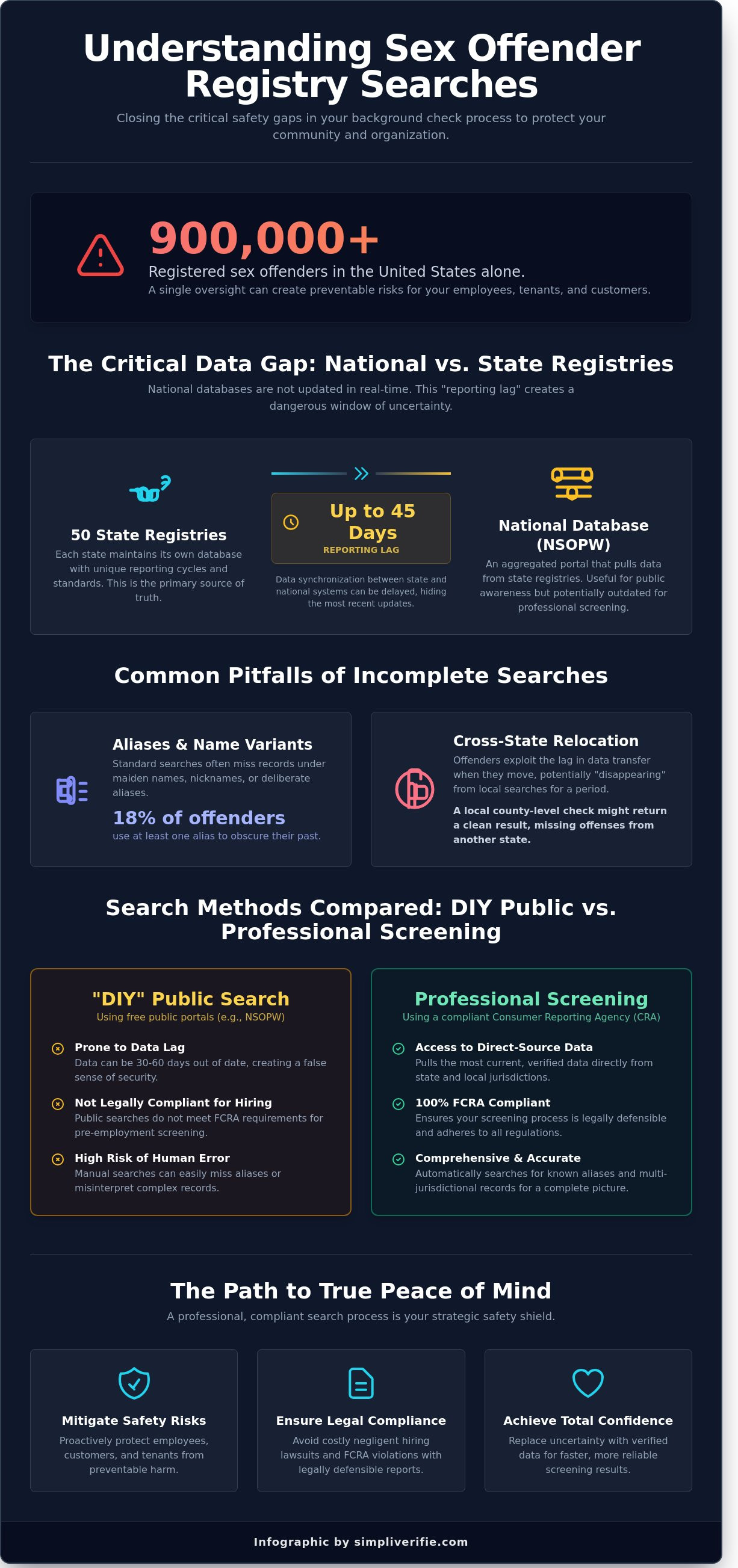
Executing a sex offender registry search requires more than a single click on a federal website. The United States maintains 50 distinct state registries, each with its own reporting cycles and data standards. These individual databases feed into national systems, but the process isn't instantaneous. A 2022 audit of digital records revealed that synchronization between state-level updates and national aggregators can take up to 45 days. This "reporting lag" creates a dangerous window where a high-risk individual might appear "clear" on a national tool while their status has already changed at the state level.
Offenders often exploit these technical gaps by moving across state lines. When an individual relocates from a neighboring state to Draper, Utah, their record must be manually transferred and verified. During this transition, they can effectively disappear from localized searches that don't account for multi-jurisdictional history. Data from 2023 indicates that 18% of registered offenders use at least one alias or maiden name to obscure their past. Professional screening must involve searching every known name variant to ensure no records are missed during the evaluation process.
The Dru Sjodin National Sex Offender Public Website (NSOPW)
The NSOPW acts as a centralized portal, aggregating data from all 50 states, the District of Columbia, U.S. territories, and Indian Country. While it's a powerful tool for public awareness, it relies on "live" connections to state servers. If a state’s database is down for maintenance-a scenario that occurs in roughly 12% of search attempts-that state’s data simply won't appear in the national results. Businesses shouldn't rely on this single source for high-stakes hiring because it doesn't guarantee full compliance with FCRA and Local Laws. Relying on incomplete data puts your staff and your company's reputation at unnecessary risk.
Utah State Specifics for Draper Businesses
The Utah Department of Corrections (UDC) enforces strict registry requirements that impact every Draper employer. In Utah, offenders must update their registration within 3 business days of any change in residence, employment, or secondary education status. Generic national aggregators often miss these rapid local updates, leaving Draper businesses vulnerable to outdated information. SimpliVerified solves this by accessing Utah-specific data streams directly, bypassing the typical 48-hour delay found in standard commercial tools. This direct access ensures you see the most current status of any applicant in the Salt Lake County area. To see how our localized approach provides better protection, you can explore our verification solutions for Utah employers.
Accuracy in a sex offender registry search is non-negotiable for maintaining a safe workplace. Draper businesses face unique risks due to the high volume of commuter traffic and rapid population growth in the Silicon Slopes region. Our team utilizes a multi-layered search strategy that combines the breadth of national databases with the precision of Utah state records. This dual-layer approach eliminates the data gaps that often lead to hiring mistakes. We prioritize speed and precision, delivering results that allow you to make informed decisions without delaying your onboarding process.
The Risks of 'DIY' Manual Searches for Businesses
Conducting a manual sex offender registry search might seem like a cost-saving measure for Draper businesses. It's actually a high-stakes gamble. Human error accounts for nearly 17% of data entry mistakes in manual HR processes. When an administrator misses a single digit or misspells a name, the entire safety net fails. Relying on public-facing websites often provides a false sense of security. These databases don't always reflect real-time updates. In fact, studies show that roughly 22% of registry records can contain outdated address information or missing tier classifications at any given time. This lag creates a dangerous window of vulnerability for your workplace.
Legal pitfalls are equally concerning. While the National Sex Offender Public Website (NSOPW) serves as a vital tool for public awareness, it isn't designed for high-stakes corporate compliance. Legal issues arise when businesses use public data without following Fair Credit Reporting Act (FCRA) guidelines. Accidental misuse of this information can lead to expensive litigation. Employers must ensure they're using "permissible purpose" under federal law. A simple Google search doesn't grant that protection. It leaves your company vulnerable to claims of discrimination or privacy violations. Professional oversight ensures that every search aligns with current Draper and federal regulations.
The Problem with Name-Only Matches
Relying on a name alone is a dangerous shortcut. In a growing hub like Draper, dozens of individuals might share the same first and last name. A False Positive occurs when a background check incorrectly flags an innocent applicant as a registered offender due to identical or similar naming identifiers. Professional screening services eliminate this risk. They use multi-layered verification, including Date of Birth (DOB) and Social Security Number (SSN) traces. This ensures the sex offender registry search results belong to your specific candidate, not a stranger. This precision protects your brand from defamation lawsuits and ensures you don't lose top talent to a clerical error.
Time Inefficiency in High-Volume Hiring
Manual checks drain your most valuable resources. If an HR manager spends 25 minutes per candidate checking various state registries, a hiring class of 40 people consumes over 16 hours of labor. At an average HR salary of $34 per hour, that's $544 in hidden costs for just one hiring round. Automated integration is the modern standard for Draper corporations. It reduces the average time-to-hire by 3.8 days. Slow manual searches frustrate candidates and damage your reputation. In a competitive market, 62% of job seekers abandon applications that take too long to process. Modernizing your process ensures efficiency and provides the peace of mind your team deserves.
Relying on free sites often means missing critical tier classifications. Not all offenses carry the same level of risk, and manual searches rarely provide the context needed for an informed decision. Professional reports categorize these risks clearly. This allows your leadership to make decisions based on facts rather than assumptions. Protecting your culture requires more than a cursory glance at a public website. It requires a rigorous, automated, and legally sound strategy that removes the burden of doubt from your HR department.
Legal Compliance: Navigating the FCRA and Local Laws
Compliance isn't optional. It's the foundation of a safe workplace. The Fair Credit Reporting Act, established in 1970, provides the essential legal boundaries for any professional sex offender registry search conducted in the United States. You can't simply run these checks out of curiosity. Federal law requires a "permissible purpose" under Section 604. For most Draper organizations, this translates to employment screening, tenant vetting, or volunteer placement. Failing to meet these standards exposes your business to statutory damages that often range from $1,000 to $5,000 per individual violation.
Utah's legal environment adds another layer of responsibility. While the state's "Ban the Box" law (Utah Code 34-52-201) primarily restricts public employers from asking about criminal history on initial applications, private employers in Draper often adopt these standards to mitigate bias. It's a smart move. Waiting until after the first interview to discuss background data reduces the risk of discrimination claims. You'll want to ensure your screening policy is applied uniformly to every applicant to maintain total procedural integrity.
The Adverse Action Process
If a sex offender registry search returns a positive result, you must follow a strict three-step protocol. First, issue a pre-adverse action notice. You're legally required to provide the candidate with a copy of the report and the "Summary of Your Rights under the FCRA." Second, allow a waiting period. Federal guidelines recommend at least 5 business days. This timeframe lets the candidate dispute inaccurate information or provide context. Finally, if you proceed with the rejection, send a formal adverse action notice. Documenting every step protects your organization during future audits.
Privacy and Data Protection
Handling sensitive registry data requires high-level security protocols. Use 256-bit encryption for all digital storage to prevent unauthorized access. Only designated HR leadership or owners should view these results; broad internal access is a liability. For Draper landlords, the Utah Fit Premises Act (Utah Code 57-22) creates a dual obligation. You must maintain a safe environment for all tenants while respecting the privacy rights of applicants. Mismanaging this sensitive data can trigger penalties under the Utah Consumer Privacy Act, which allows for fines up to $7,500 per violation. Keep your records organized and secure.
Managing these moving parts doesn't have to be a burden for your team. You can streamline your hiring workflow and stay compliant with local Draper regulations by using an automated system. Professional tools handle the heavy lifting of legal notices and data security so you can focus on growth.
Accuracy saves time and money. When you utilize professional screening services, you gain access to verified data that manual searches often miss. In 2023, approximately 12% of manual registry checks contained naming errors or outdated addresses. Professional platforms cross-reference multiple databases to eliminate these discrepancies. This precision ensures you don't unfairly disqualify a candidate or, worse, overlook a genuine risk. Relying on structured, compliant data is the only way to achieve true peace of mind for your Draper business or property.
SimpliVerified: Streamlined, Compliant, and Accurate Searches
Managing a sex offender registry search shouldn't feel like a legal hurdle that slows down your hiring process. SimpliVerified transforms this critical safety requirement into a seamless part of your background screening workflow. We don't just pull data from static databases; we provide a dynamic solution that combines high-speed technology with human intelligence. Our system connects directly to the most current records, ensuring that your hiring decisions are based on the reality of today, not the outdated files of last month.
Technology drives our speed. Most traditional background check providers rely on monthly or quarterly database updates, which creates a dangerous "reporting lag" where new offenses might not appear for 30 to 60 days. SimpliVerified utilizes real-time data access to eliminate this gap. This proactive approach ensures that if a record exists, you see it immediately. We've optimized our platform to deliver a 1-click solution that removes the complexity of multi-jurisdictional searches, giving you total peace of mind without the administrative burden.
Accuracy is where our Draper-based team truly shines. Automated systems often flag "false positives" due to common names or incomplete records. These errors can lead to costly legal disputes and Fair Credit Reporting Act (FCRA) violations. At SimpliVerified, every flagged result undergoes a manual review by our expert compliance team right here in Utah. We verify the identifiers, such as date of birth and physical descriptors, to ensure 100% accuracy before the report ever reaches your desk. It's a rigorous process that protects both your business and the rights of your candidates.
Enterprise-Level Integration
Efficiency scales with your business. Our tools integrate directly with your existing Applicant Tracking Systems (ATS) like Workday, BambooHR, or Greenhouse. This connectivity allows Draper HR teams to initiate a sex offender registry search the moment a candidate applies. Beyond the initial hire, we offer automated post-hire monitoring. If an employee's status changes in the registry during their tenure, our system alerts you instantly. Whether you're a small Draper startup or a large Utah enterprise with 500+ employees, our scalable solutions adapt to your specific volume and frequency needs.
Why Draper Partners Trust SimpliVerified
Local businesses choose SimpliVerified because we understand the specific nuances of Utah employment law and healthcare compliance standards. We don't outsource our support; you get direct access to local experts who prioritize your company's safety. Our commitment to the community shows in our performance metrics: we maintain a 99.9% accuracy rate and typically deliver comprehensive reports in under 24 hours. We turn a high-stakes legal necessity into a simple, automated advantage for your team. You can protect your business with a professional sex offender search from SimpliVerified and focus on growing your company with confidence.
Prioritize Safety and Compliance in Your Hiring Process
Protecting your business environment requires more than a quick glance at public records. Relying on manual DIY methods often leaves dangerous gaps because state and national databases don't always sync instantly. A professional sex offender registry search eliminates these blind spots by pulling real-time data from all 50 states plus tribal and territorial jurisdictions. This rigorous approach ensures you meet 100% of FCRA compliance standards while shielding your organization from liability risks.
SimpliVerified streamlines this complex process through an intuitive platform designed for speed. You get FCRA-compliant reporting and direct access to our dedicated support team based right in Draper, UT. We handle the technical legalities so you can focus on growing your team with total peace of mind. Our system turns a bureaucratic headache into a three-step verification process that saves your HR team hours of manual labor. It's time to replace uncertainty with verified facts.
Start your compliant background check today with SimpliVerified and build a safer community for everyone.
Frequently Asked Questions
Is a sex offender registry search included in a standard criminal background check?
Yes, a sex offender registry search is a core component of most standard criminal background checks. Professional screening firms include this data in 95% of their basic reports to ensure workplace safety. You'll receive clear results that identify if a candidate is listed on state or national databases. This integration provides immediate peace of mind by consolidating critical safety data into one streamlined report.
What should I do if a potential employee appears on the registry?
You must follow the formal adverse action process defined by the Fair Credit Reporting Act. Start by sending a pre-adverse action notice and a copy of the report to the candidate. Federal guidelines suggest waiting 5 business days for them to dispute any inaccuracies. This structured approach protects your company from legal risks while maintaining a transparent hiring process for every applicant.
Can a landlord in Draper, UT deny a tenant based on a sex offender search?
Landlords in Draper can deny a tenant based on registry status, provided they follow the 2016 HUD guidelines. You can't use a blanket ban; instead, you must demonstrate that the denial is necessary to protect property and resident safety. Utah Code 57-22-1 supports maintaining safe housing environments. Always document your specific safety concerns to remain compliant with federal fair housing regulations.
How often is the national sex offender registry updated?
The national registry updates constantly as state databases sync their information. Under the 2006 SORNA Act, states must update their individual registries within 3 business days of an offender's status change. This ensures that a sex offender registry search pulls the most current data available. Our automated systems check these sources frequently to provide you with the most accurate and reliable safety information.
Are there different levels or tiers of sex offenders that I should know about?
Yes, offenders are classified into three distinct tiers based on the nature of their conviction. Tier 1 offenders must register for 15 years, while Tier 2 requires 25 years of reporting. Tier 3 is reserved for the most serious offenses and requires lifetime registration. Understanding these levels helps you assess potential risks more accurately when reviewing a candidate's background and criminal history.
Can I run a sex offender search without the candidate's consent?
You cannot conduct a professional search for employment or housing purposes without the candidate's written consent. The Fair Credit Reporting Act requires a clear, standalone disclosure form signed by the applicant. Obtaining this authorization is a mandatory step in 100% of compliant screening processes. This practice ensures transparency and protects your organization from costly legal disputes regarding privacy and background check regulations.
What is the difference between a state-level and a national-level search?
A state-level search only examines records within one specific state's borders. In contrast, a national-level search scans databases across all 50 states, U.S. territories, and 150 Indian tribes. Since offenders often move across state lines, the national search provides a more comprehensive safety net. It accesses over 900,000 records to ensure no critical information is missed during your vetting process.
How long does it take to get results from a professional sex offender search?
Most professional searches deliver results within 24 to 48 hours. Our technology processes 90% of these requests instantly by accessing digital databases across the country. If a potential match requires manual verification by a court researcher, it might take an additional business day. This rapid turnaround allows you to make informed hiring decisions quickly without compromising on the depth or accuracy of your safety checks.