
Hiring
Drug Testing
Employment Screening


Imagine discovering a $5,000 repair bill and four months of unpaid rent because you missed one inconsistent date on a rental application. In 2024, data showed that the average cost of a single eviction climbed above $3,500, excluding the heavy mental toll of legal battles. You've likely felt that familiar anxiety when a candidate seems perfect but your gut says otherwise. It's a constant challenge to fill vacancies quickly while avoiding high-risk renters who might ignore your property rules or default on their payments.
Identifying tenant screening red flags early is the most effective way to protect your investment and ensure long-term rental stability. We'll show you how to look past the surface to find reliable tenants who truly respect your property. This guide offers a clear, actionable checklist of dealbreakers and modern verification strategies tailored for the 2026 market. You'll gain the confidence to make faster, smarter decisions that lead to total tranquillity of mind and significantly lower turnover rates for your portfolio.
In the competitive Draper rental market, a red flag is a specific, verifiable data point that signals a heightened risk to your property or your monthly cash flow. These aren't vague intuitions. They are objective markers discovered during the tenant screening process that suggest an applicant may fail to uphold the lease agreement. Identifying tenant screening red flags early allows you to filter out high-risk individuals before they sign a contract, protecting your investment from predictable failures.
The financial stakes are high. As of August 2024, the average cost of an eviction in the United States ranges from $3,500 to $10,000. This total includes court filing fees, legal representation, and the total loss of rent during the legal proceedings. Compare this to the cost of a vacancy. In Draper, where the median rent sits near $2,100, a property sitting empty for 30 days costs significantly less than a single botched tenancy. Professional landlords understand that a vacant unit is a controlled cost, while a bad tenant is an unpredictable liability.
Relying on a "gut feeling" is a dangerous strategy for modern property owners. Intuition is often a mask for unconscious bias, which can lead to unintentional violations of the Fair Housing Act of 1968. This federal law prohibits discrimination based on race, religion, sex, and other protected classes. By shifting to a data-driven screening model, you remove emotion from the equation. You aren't judging a person's character; you're evaluating their documented history of financial and behavioral reliability. This objective approach ensures you stay compliant while securing the most stable occupants for your units.
High-risk applicants frequently use psychological pressure to bypass standard verification steps. You'll often see an artificial sense of urgency. They might claim they need to move in "tomorrow" or offer to pay three months of rent in cash to skip the background check. These tactics are designed to make you rush and overlook tenant screening red flags. They may also engage in "over-sharing," providing elaborate stories about past hardships or "difficult" former landlords to trigger your empathy. Your job is to distinguish between a one-time life event, such as a medical emergency in 2022, and a chronic pattern of instability. A single late payment from three years ago is a mistake. Three late payments in the last six months is a lifestyle.
Consistency is your strongest legal shield. You must document your minimum qualification standards before you ever list a property for rent. Set clear, non-negotiable thresholds. For example, you might require a minimum credit score of 620, a monthly income of at least 3 times the rent, and a clean eviction record for the past 7 years. When you apply these rules to every applicant without exception, you eliminate the risk of discrimination claims. If you reject one applicant for a 590 credit score but accept another with the same score, you create a legal vulnerability. Digital screening tools make this process seamless by automatically flagging any data that falls below your pre-set benchmarks, ensuring your decisions remain fast, fair, and focused on your bottom line.
The rental process in Draper begins the moment a prospect reaches out. Your first interaction often reveals more than a credit score ever could. One of the most common tenant screening red flags is extreme urgency. If a candidate insists on moving in within 24 to 48 hours, it's a warning. This rush frequently signals a pending eviction or a sudden fallout with a current landlord. While a legitimate job transfer might explain a quick move, 85% of stable tenants plan their transitions at least 30 days in advance. A desperate timeline often means they're running away from a legal or financial problem.
Another subtle tactic involves offering to pay the entire six-month or one-year lease upfront. This seems attractive to property owners looking for immediate cash flow. However, this move often masks untraceable income or a desire to bypass the standard tenant screening reports that verify long-term financial stability. High-quality applicants understand that a consistent payment history is more valuable than a lump sum. Accepting a large cash payment without verification can lead to legal complications or illegal activities on your property.
Watch for incomplete or inconsistent information on the written application. If lines for previous addresses or employer contact info are blank, the applicant is likely hiding a gap. Professional property management requires 100% transparency to ensure compliance. Hostile or overly demanding behavior during a showing is also a non-negotiable red flag. If a prospect is rude to you now, they'll likely be difficult to manage once they've signed the lease. Trust your instincts; a tenant who lacks respect during the honeymoon phase of a showing will rarely improve once they have the keys.
Erratic communication creates friction and uncertainty. If a prospect changes their story about move-in dates or who's actually living in the unit, the foundation of trust is broken. Reluctance to provide a Social Security Number or government ID is a massive barrier to a professional background check. Some applicants try to negotiate the screening fee or security deposit immediately. This suggests they lack the liquid assets required for the lease. Consistency is the foundation of a secure rental agreement, and any deviation from the facts is a signal to stop the process.
Fake references are a growing challenge for landlords in the current market. You can spot a "friend as landlord" by asking specific, technical questions that only a professional would know. Ask for the square footage of the previous unit or the exact date the lease ended. A real professional landlord has these records at their fingertips; a friend will hesitate or provide vague answers. Be wary if the only contact for a large 150-unit complex is a personal cell phone number. Legitimate property managers use business lines and official email domains. Verifying these details ensures tranquillité d'esprit during your selection process and protects your investment from professional "rent skippers."
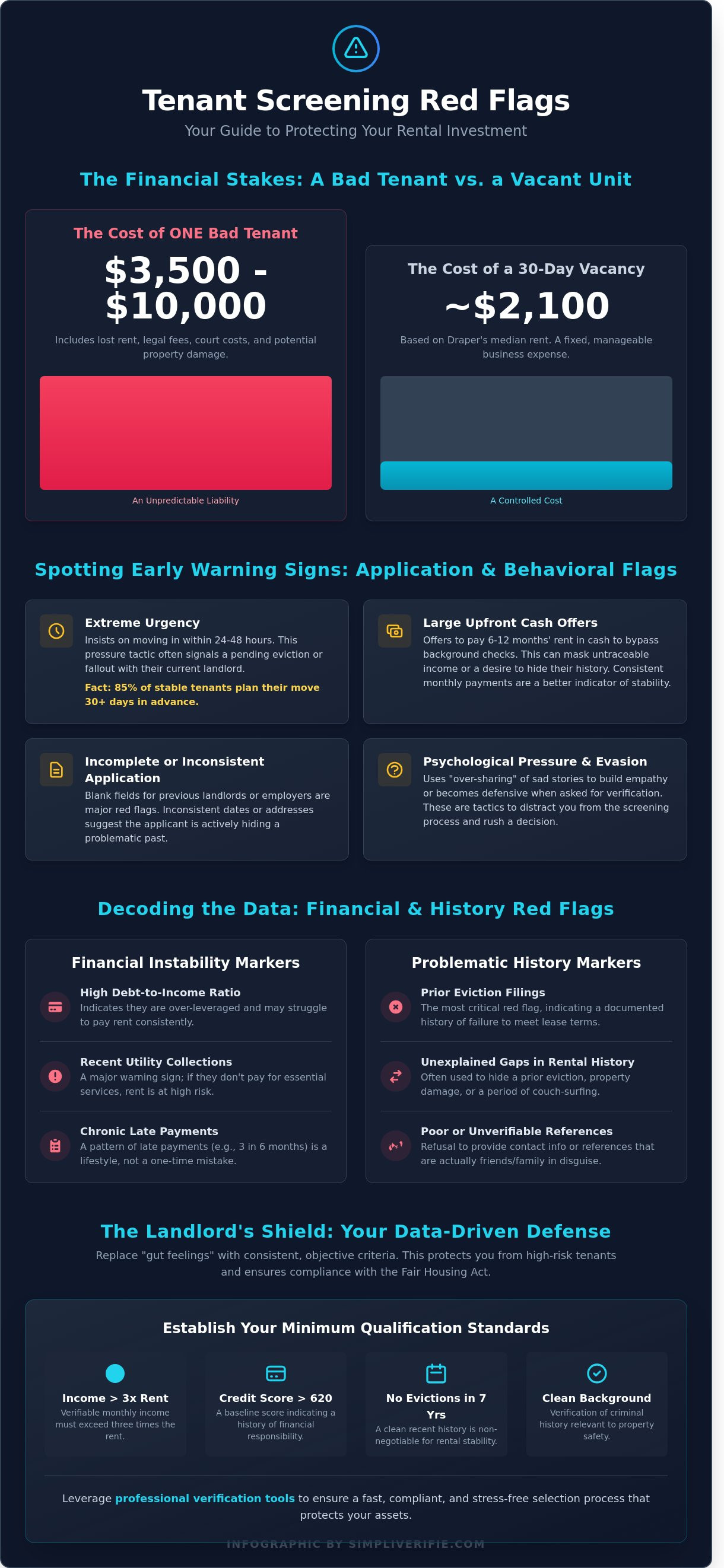
A credit score of 680 might look acceptable on the surface. However, professional property managers in Draper know that the number alone often hides critical risks. One of the most telling tenant screening red flags is a high debt-to-income (DTI) ratio. If a candidate's monthly debt obligations, including car payments and student loans, exceed 45% of their gross income, their ability to pay rent becomes fragile. Even a minor financial emergency can lead to a default when margins are this thin.
Pay close attention to collections from the last 18 months. Specifically, unpaid utility bills or balances owed to previous property managers are immediate disqualifiers. These records indicate that the applicant may prioritize lifestyle spending over basic housing necessities. A history of late payments in the last 24 months follows a similar logic. If you see more than two 30-day or 60-day delinquencies since 2022, you're looking at a pattern of financial instability rather than a one-time misfortune. High-performing landlords don't ignore these trends; they use them to predict future behavior.
Distinguishing between types of debt is vital for modern landlords. Medical debt often stems from unpredictable crises and doesn't always reflect a tenant's reliability. In contrast, consumer lifestyle debt, like maxed-out credit cards for retail purchases, suggests poor financial discipline. A "thin file" means the applicant lacks history, which is common with younger renters. It's often less risky than a "bad file" filled with active defaults. Watch for a 50-point drop in credit score over a 90-day period. This sudden decline often signals a recent job loss or a new, unmanageable debt load that hasn't yet stabilized.
Verifying income requires more than a quick glance at a PDF. It's a critical step in identifying tenant screening red flags before they become costly evictions. Use the 3x rent-to-income rule as your baseline. If the monthly rent is $2,000, the applicant needs $6,000 in verifiable monthly gross income. Spotting fake pay stubs is easier when you check for perfectly rounded numbers or inconsistent tax withholdings that don't match local Draper tax rates.
If an applicant claims $5,000 a month in "cash" income, ask for 12 months of bank statements to see consistent deposits. If the numbers don't align, you must act to protect your investment. In these cases, require a co-signer with a 700+ credit score or an additional security deposit equal to 2 months of rent. This proactive approach ensures your rental process remains fluid and secure. Modern tools make this verification fast and automated, removing the guesswork from your decision-making process. Accuracy here leads to long-term tranquility for your property portfolio.
Stability serves as the foundation of a successful lease. When you review a Draper rental application, look for patterns rather than isolated incidents. A candidate who changes jobs every 4 months without an increase in salary or responsibility suggests financial instability. Data from the Bureau of Labor Statistics indicates the median tenure for workers aged 25 to 34 is 2.8 years; anything significantly lower across multiple roles is a concern. Frequent job hopping often leads to inconsistent income, which directly impacts a tenant's ability to meet monthly obligations.
Rental history requires even closer scrutiny. Gaps longer than 90 days in a housing timeline are significant tenant screening red flags. If a candidate cannot explain where they lived between January 2022 and June 2022, they might be hiding a period of couch-surfing or an undisclosed eviction. You should also watch for "landlord-hopping." This occurs when a tenant stays less than 12 months at multiple properties. High turnover suggests the tenant is either difficult to manage or fails to maintain the property, causing the landlord to decline lease renewals.
Watch for these specific indicators during your review:
Approximately 15% of the workforce is self-employed, but this status shouldn't be a blank check for ambiguity. If an applicant claims self-employment, ask for the last 2 years of tax returns or 6 months of bank statements to confirm a steady cash flow. It's a major red flag if the listed employer is a family member or a company that doesn't appear in official business registries. Always verify employment through official HR channels or corporate headquarters. Don't rely on the mobile number provided on the application; it's too easy for a friend to pose as a supervisor. Professional tenant screening red flags often emerge when you insist on third-party verification that the applicant cannot provide.
Standard credit reports often miss evictions because they only record the resulting debt if it's sent to collections. To get the full picture, you must conduct a national civil records search. This reveals filings that never reached a final judgment. Pay close attention to "dismissed" eviction cases. In many jurisdictions, a dismissal occurs because the tenant paid the overdue rent at the last minute or agreed to move out quietly. While the case didn't end in a formal eviction, the initial filing proves the tenant struggled with payments or lease compliance. A history of multiple filings, even if dismissed, indicates a high-risk pattern that will likely repeat in your property.
Protect your investment by ensuring every applicant meets your rigorous standards for stability and transparency. You can achieve total tranquillity of spirit with our automated verification tools that catch the details humans often miss.
Manual vetting is often prone to human error. A 2023 industry study revealed that independent landlords miss nearly 22% of critical data points when verifying history themselves. Professional services like SimpliVerified use direct API access to court records and credit bureaus to eliminate this guesswork. Identifying tenant screening red flags becomes a data-driven process rather than a subjective gut feeling. This shift from manual to digital verification ensures you don't overlook a 2021 eviction or a hidden criminal record from another state.
SimpliVerified provides fast, accurate, and fully compliant reports. Speed matters in the competitive Draper rental market where high-quality tenants often apply for multiple properties simultaneously. Our platform delivers comprehensive background checks in hours, not days. We prioritize accuracy by cross-referencing multiple databases to confirm that the person applying is exactly who they claim to be. This level of scrutiny protects your property from sophisticated identity fraud schemes that manual checks often miss.
Compliance is a major hurdle for many property owners. If you reject a candidate based on a background report, the Fair Credit Reporting Act (FCRA), established in 1970, requires you to issue an Adverse Action notice. Failure to follow this specific legal protocol can lead to lawsuits costing over $1,000 per violation plus attorney fees. SimpliVerified automates the generation of these notices. It ensures your process stays within the law while you focus on managing your portfolio.
Automation also removes unconscious bias from your selection process. By setting standardized criteria for every applicant, you treat everyone against the same 10-point scale. This consistency is your best defense against Fair Housing Act claims. It saves you roughly 4 to 6 hours of administrative work per application by flagging tenant screening red flags automatically, allowing you to make decisions based on facts rather than fatigue.
Integrated screening platforms remove the burden of manual data entry. You won't spend hours typing names into public record searches or calling previous landlords who may not return your calls. SimpliVerified offers real-time criminal and driver monitoring even after the lease is signed. If a tenant is arrested 8 months into their residency, you'll receive an alert. This proactive approach gives you the legal documentation needed to address lease violations before they escalate into costly evictions.
To secure your investment, you need a standardized screening workflow. Start by defining your minimum credit score and income-to-rent ratio. Once your criteria are set, you can initiate your first report with SimpliVerified in under five minutes. Our platform guides you through each step, from applicant consent to the final report delivery. This structured approach ensures every tenant you place meets your high standards for reliability and financial stability.
Protecting your real estate investment requires more than a simple gut feeling. Identifying tenant screening red flags early helps you avoid the average $3,500 expense associated with modern residential evictions. You've seen how inconsistent rental histories and unexplained employment gaps serve as reliable indicators of long-term risk. Landlords who prioritize verified financial data over intuition typically reduce their turnover rates by 25% within the first year. By focusing on these behavioral patterns during the initial application phase, you'll eliminate the majority of potential tenancy issues before they ever begin.
Professional expertise makes the difference between a stressful vacancy and a reliable revenue stream. SimpliVerified delivers the clarity and peace of mind you need to move forward with total confidence. We provide FCRA-compliant reporting and instant access to criminal and eviction databases across all 50 states. Our specialists support property managers with precise, actionable data that simplifies every leasing decision. It's time to stop worrying. Take control of your property's future with a system designed for speed and accuracy.
Get Started with Comprehensive Tenant Screening
You're now equipped to build a more secure and profitable rental business today.
Inconsistencies between an application and verified reports represent the most critical red flag during the vetting process. If a candidate claims a $75,000 salary but their pay stubs show $40,000, it signals a lack of integrity. Industry data suggests that 30% of application fraud involves falsified income documents. Trusting your data helps you avoid future legal headaches and ensures long term stability for your property.
You can legally deny an applicant based on a low credit score provided you apply the same minimum threshold to every candidate. Most landlords set a baseline score of 620 to 650 to mitigate financial risk. Under the Fair Credit Reporting Act, you must provide a written notice if the credit report influenced your decision. This practice maintains compliance while protecting your monthly cash flow from potential defaults.
Spotting a fake reference requires cross-referencing the contact's name with public property records or tax assessments. Call the provided number and ask specific questions, such as the exact monthly rent or the unit's square footage, rather than just asking if they're a good tenant. Fake references often stumble on these 3 specific details. Identifying these tenant screening red flags early saves you from professional tenants who use friends as proxies.
Large upfront payments often serve as a distraction from poor credit or a history of evictions. While 6 months of cash seems attractive, it doesn't guarantee the tenant'll respect the lease terms or maintain the property. You should still perform a full background check to ensure the funds aren't coming from illegal activities. Ensure your local Draper ordinances don't cap the amount of prepaid rent you can legally accept.
Urgent move-in requests are a significant warning sign because they often hide a pending eviction or a skipped lease elsewhere. Legitimate tenants typically plan their move 30 to 60 days in advance to accommodate notice periods. An applicant rushing the process might be trying to bypass your thorough tenant screening red flags check. Always stick to your standard 48-hour processing window to verify every detail properly.
Criminal background checks generally cover the last 7 years of an applicant's history, though some jurisdictions allow reporting for up to 10 years. Credit reports typically show late payments and bankruptcies for 7 years; however, Chapter 7 bankruptcies can stay for 10 years. Modern automated systems pull this data in seconds, providing a clear window into a candidate's long term financial behavior. This timeframe offers enough data to predict future performance.
An Adverse Action notice is a formal document you've got to send if you deny an application or require a higher deposit based on a consumer report. This notice is a requirement under the FCRA and must include the contact information of the screening agency used. Failing to send this within 10 days of your decision can lead to legal penalties. It ensures transparency and gives the applicant a chance to dispute errors.
You can screen a tenant using just their name and date of birth, but the results won't be as precise as an SSN-based search. Social Security Numbers are the only way to accurately link credit files and multi-state criminal records to a specific individual. Without it, you risk matching with the wrong person or missing 50% of relevant records. For maximum security and peace of mind, always require a verified identification number.