
Hiring
Drug Testing
Employment Screening


Did you know that in 2025, the FMCSA reported over 100,000 violations, with individual penalties sometimes exceeding $125,000? It's a sobering figure for any fleet manager or HR leader trying to stay ahead of the curve. You likely feel the weight of managing multiple state portals and the constant worry that a single oversight in your Driver Qualification files could trigger a costly audit. At SimpliVerified, we believe that maintaining a safe, compliant fleet should be a smooth and predictable process rather than a source of administrative stress.
This guide will help you master the MVR check for commercial drivers while protecting your business from regulatory risk. You'll gain a clear understanding of the latest 2026 standards, including the mandatory shift to digital medical certifications and the essential 12-month renewal rule. We'll explore how a streamlined screening process can help you hire faster, stay audit-ready, and potentially lower your insurance premiums through proactive risk management. By the end of this article, you'll have a roadmap to transform compliance from a burden into a strategic advantage for your organization.
A Motor Vehicle Record (MVR) is a comprehensive document issued by a state licensing agency that details a driver's history over a specific period. For those operating heavy machinery or freight, an MVR check for commercial drivers serves as more than just a routine background check; it's a critical safety audit. It provides a real-time look at license status, medical certifications, and specific endorsements required for specialized hauling. SimpliVerified pulls these records directly from state databases to ensure the data you receive is 100% accurate and up to date.
This document acts as the primary evidence of a driver's safety record for DOT compliance. It isn't just about finding past mistakes; it's about verifying that a driver is currently legally allowed to be on the road. By checking these records, you confirm that your team meets the rigorous standards set by federal regulators, which protects your company from liability and keeps the public safe.
Think of the MVR as the heart of your Driver Qualification (DQ) file. The Federal Motor Carrier Safety Administration (FMCSA) requires you to maintain a complete history for every driver behind the wheel. When you hire a new driver, you must obtain an MVR from every state where they held a Commercial Driver's License (CDL) or permit in the previous three years.
Compliance doesn't stop at the hiring stage. You're also required to conduct an annual review of each driver's MVR to ensure they remain qualified to operate. This ongoing vigilance helps you identify potential risks before they lead to accidents or legal liabilities. For a deeper look at how this fits into your broader safety strategy, explore our article on The Comprehensive Guide to Professional Background Checks in 2026.
Relying on a standard MVR or a basic criminal background check is a common mistake that can lead to FMCSA violations. A standard record often misses the nuances required for commercial transport. A commercial-grade report includes data from the Commercial Driver’s License Information System (CDLIS). This nationwide database ensures that drivers don't hide violations by holding licenses in multiple states.
CDLIS checks are essential because they track a driver's primary "pointer" state. If a driver has a history of reckless driving in another jurisdiction, the CDLIS report will flag it. SimpliVerified handles these multi-jurisdictional searches seamlessly. We bridge the gap between different state DMVs, providing a unified view of a driver's eligibility regardless of where they've lived or worked. This level of detail is non-negotiable for maintaining a high-performing and compliant fleet.
When you run an MVR check for commercial drivers, you're looking for a comprehensive snapshot of professional reliability. The report provides a real-time status of their license, clearly indicating if it is active, suspended, revoked, or expired. It also lists traffic violations such as speeding, reckless driving, and DUIs. Depending on specific state reporting rules, the document will also include accident history. This data is essential for meeting FMCSA Driver Qualification File requirements, which mandate a thorough review of a driver's safety record to ensure they remain qualified to operate.
Since January 10, 2026, federal regulations have required motor carriers to verify medical certifications exclusively through the MVR. This update means paper Medical Examiner's Certificates (MECs) are no longer a compliant form of verification for CDL holders. Your MVR report now displays the medical examiner’s results and the certificate expiration date directly. This transition to digital verification helps you maintain accurate, audit-ready records while reducing the administrative burden of tracking physical paperwork.
It isn't enough to know a driver holds a valid CDL; you must ensure they're qualified for the specific cargo they're hauling. The MVR details critical endorsements for Hazmat, Tanker, or Passenger transport. Conversely, it lists restrictions that might prohibit certain activities, such as a restriction against driving a vehicle with air brakes. Verifying these details ensures your drivers are legally permitted to handle the specific vehicle types and routes your business requires.
Managing an MVR check for commercial drivers across multiple jurisdictions requires an eye for detail. State lines create significant differences in reporting; some states provide a 3-year lookback, while others offer 7 or 10 years of history. For example, Utah businesses must navigate specific Driver's Privacy Protection Act (DPPA) regulations to access certain driver data. These variations often make it difficult for HR teams to maintain a consistent standard. SimpliVerified standardizes these disparate reports into a clear, functional format, allowing you to make confident hiring decisions regardless of the state. If you're looking to simplify your screening workflow, our tailored industry solutions provide the clarity you need to stay compliant.
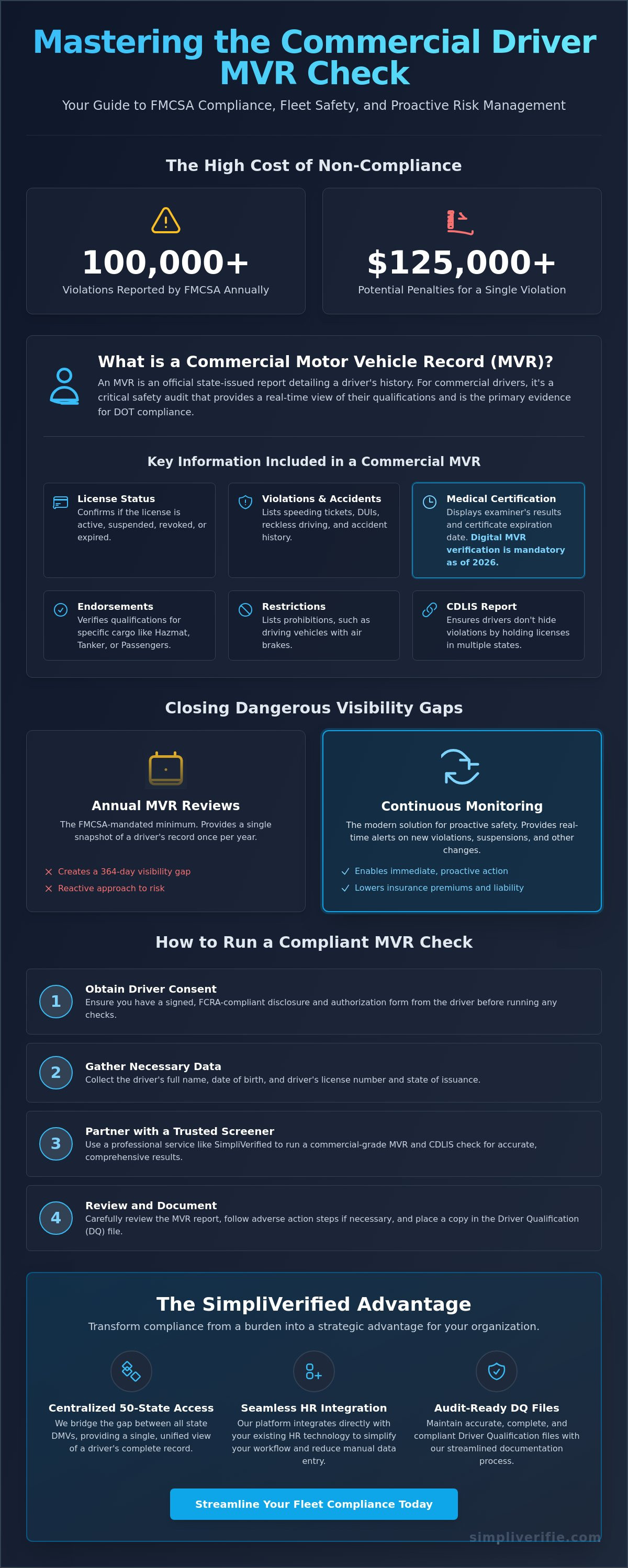
Federal regulation 49 CFR §391.25 is very clear: motor carriers must obtain and review a Motor Vehicle Record for each driver at least once every 12 months. This "12-month rule" forms the foundation of most safety programs. However, relying exclusively on a yearly MVR check for commercial drivers leaves your organization vulnerable to a dangerous compliance gap. If a driver incurs a major violation or a license suspension shortly after their annual review, they could continue operating your equipment for months without detection. This lack of visibility is a massive legal liability that can jeopardize your entire operation.
Continuous monitoring has emerged as the modern gold standard for fleet safety. Instead of a single snapshot taken once a year, this system provides a persistent look at driver behavior. SimpliVerified delivers real-time alerts whenever a driver's status changes in a state database. This ensures you're never the last to know about a suspension or a serious traffic ticket. With over 190,000 drivers currently in prohibited status within the Drug and Alcohol Clearinghouse as of late 2025, the need for constant vigilance has never been higher.
The primary benefit of real-time alerts is the immediate prevention of "driving while suspended" incidents. When a driver's license is revoked, every mile they drive under your DOT number increases your exposure to catastrophic legal claims. Proactive monitoring allows you to pull a driver off the road the same day a disqualifying event occurs. This level of oversight is highly valued by insurers. Many providers now offer more favorable rates to fleets that move beyond the minimum industry requirements for driver files and adopt automated monitoring. It transforms a reactive administrative task into a proactive risk management strategy that protects your brand.
Fleet managers often weigh the upfront cost of annual report pulls against the ongoing investment of a monitoring subscription. While a one-time MVR check for commercial drivers might seem cheaper on paper, it fails to account for the hidden costs of manual labor or FMCSA fines. In 2025, significant penalties for compliance failures often exceeded $125,000. Subscription monitoring removes the burden of tracking renewal dates and managing individual state portal logins. For fleets with more than 10 drivers, the ROI is simple: the cost of the service is a fraction of the expense associated with a single out-of-service violation or a high-stakes lawsuit resulting from an unmonitored driver's accident.
Running a compliant MVR check for commercial drivers is a structured legal process that goes far beyond simply logging into a state portal. To protect your organization from litigation and regulatory fines, you must follow a specific sequence of actions. This ensures you respect driver privacy while gathering the data necessary to maintain a safe fleet. Most state-run portals focus only on their own records, but a professional screening partner allows you to look across state lines without managing dozens of different accounts.
Compliance hinges on two major federal laws: the FCRA and the Driver’s Privacy Protection Act (DPPA). Under the DPPA, you must have a "Permissible Purpose" to access a driver's records. For motor carriers, this purpose is typically related to verify the driver’s qualifications. It's vital to use specific disclosure and authorization forms tailored for commercial hires rather than generic background check forms. For a broader look at how these legalities affect your hiring process, see our Employment Verification: The Complete 2026 Employer Guide.
If an MVR check for commercial drivers reveals a disqualifying offense, you can't simply rescind a job offer or terminate employment immediately. You must follow the two-step adverse action process. First, send a pre-adverse action notice along with a copy of the report and a summary of the driver's rights. This gives the driver a chance to dispute any inaccuracies. If you decide to move forward with the disqualification after a waiting period, you must then send a final adverse action notice. SimpliVerified’s platform simplifies this by automating these compliance workflows, ensuring you never miss a required step. Ready to streamline your safety program? Start your compliant screening process today.
Managing driver records across state lines often feels like a full time job. Between different portal requirements and varying reporting standards, the administrative load can quickly become overwhelming. SimpliVerified solves this by providing centralized access to all 50 state DMVs through a single, intuitive dashboard. You no longer need to manage dozens of individual state accounts or navigate confusing government websites to secure a compliant MVR check for commercial drivers. Our technology aggregates this data into a consistent format, giving you the clarity needed to make fast, informed decisions.
Efficiency is built into our platform through seamless integration with your existing HR and fleet management software. We understand that your tech stack should work together to reduce manual data entry and minimize the risk of human error. By syncing our screening results directly with your internal systems, we help you maintain an organized and audit-ready environment. Our team of compliance experts, based in Draper, UT, provides dedicated support to ensure your screening program remains robust and reliable. We prioritize fast turnaround times because we know that in the transportation industry, a delayed hire is a lost opportunity.
A truly safe fleet requires more than just a look at driving records. SimpliVerified offers a comprehensive suite of services that allows you to combine motor vehicle reports with drug testing, criminal background checks, and employment verifications. This single-source approach ensures that every aspect of a driver's history is vetted with the same level of rigor and professionalism. For businesses operating in specialized sectors, our sector-specific solutions provide tailored screening packages that meet unique regulatory demands. Consolidation leads to better data oversight and a more cohesive safety strategy for your entire organization.
SimpliVerified is designed to remove the bureaucratic friction that often stalls the hiring process. We transform a complex regulatory requirement into a fluid, positive experience for both your HR team and your drivers. By automating the most tedious parts of compliance, we allow your leaders to focus on building a culture of safety that attracts and retains top-tier talent. Reliability and transparency are the cornerpoints of our partnership; we provide the tools you need to grow your fleet with total confidence. If you are ready to modernize your compliance program, contact SimpliVerified today for a custom fleet screening quote.
Staying ahead of DOT requirements in 2026 means moving beyond basic annual reviews. By adopting a proactive safety strategy, you protect your drivers and your bottom line from unnecessary risk. We've explored how digital medical verification is now the only compliant path and why continuous monitoring provides the real-time visibility needed to prevent "driving while suspended" incidents. These shifts represent a move toward a more transparent and efficient transportation industry where data drives safety.
Implementing a robust MVR check for commercial drivers doesn't have to be a bureaucratic struggle for your HR team. SimpliVerified offers a streamlined solution with nationwide DMV access and full FCRA and DOT compliance. Our real-time continuous monitoring keeps you informed of status changes instantly, allowing you to focus on operational growth while we handle the rigorous technical details of your screening program. We provide the modern tools necessary to maintain a pristine safety record without the traditional administrative friction.
Streamline Your Fleet Compliance with SimpliVerified MVR Checks
We're here to help you navigate these complex regulations with ease and confidence. Your team deserves a partner that prioritizes accuracy, speed, and professional integrity. Let's work together to build a safer, more reliable fleet for the road ahead.
At least once every 12 months is the mandatory federal requirement for motor carriers. Per 49 CFR §391.25, you must request an MVR check for commercial drivers annually and document the review in their file. Many safety-conscious fleets choose to run these checks more frequently or use continuous monitoring to avoid the risks associated with a year-long gap in visibility.
A certified MVR contains an official state seal or signature and is typically used for court proceedings or legal evidence. For standard employment screening and DQ file maintenance, a non-certified electronic record is generally sufficient. SimpliVerified provides the high-quality, official data you need for compliance without the extra cost or processing time often associated with certified paper documents.
No, federal regulations require the motor carrier to obtain the motor vehicle record directly from the state agency or an authorized third-party provider. You cannot accept a copy provided by the driver for your official DQ files. This rule ensures the integrity of the data and prevents any potential tampering or omission of violations that might impact a driver's qualification status.
Employers must maintain the MVR in the Driver Qualification file for three years from the date of the report. This includes both the initial hire record and the subsequent annual reviews. Keeping these records organized ensures you're prepared for FMCSA audits, which often focus on the last three years of your fleet's compliance history and safety documentation.
If an MVR check for commercial drivers indicates an expired medical certificate, the driver is immediately disqualified from operating a commercial motor vehicle. As of January 10, 2026, you must rely on the MVR as the sole source of medical certification truth. You should remove the driver from safety-sensitive duties until they complete a new physical and the state licensing agency updates their electronic record.
Yes, a comprehensive MVR check will show out-of-state violations if it includes a search of the Commercial Driver’s License Information System (CDLIS). This system tracks a driver's history across all 50 states, ensuring that tickets or suspensions in one jurisdiction follow the driver's record to their current license. SimpliVerified utilizes these nationwide databases to provide you with a complete picture of a driver's safety history.
The "Annual Review of Driving Record" is a formal process where the motor carrier evaluates a driver's MVR to determine if they still meet safety requirements. You must review the record for disqualifying offenses, such as DUIs or reckless driving, and sign a statement confirming the review. This documentation is a mandatory component of the DQ file and is frequently scrutinized during federal safety audits.
Most MVR reports through SimpliVerified are delivered instantly or within minutes of the request. While some states have specific processing requirements that can lead to slight delays, our direct connections to state DMVs ensure the fastest possible turnaround. This speed helps you keep your hiring pipeline moving while maintaining the highest standards of accuracy and regulatory compliance for your fleet.