Hiring
Drug Testing
Employment Screening


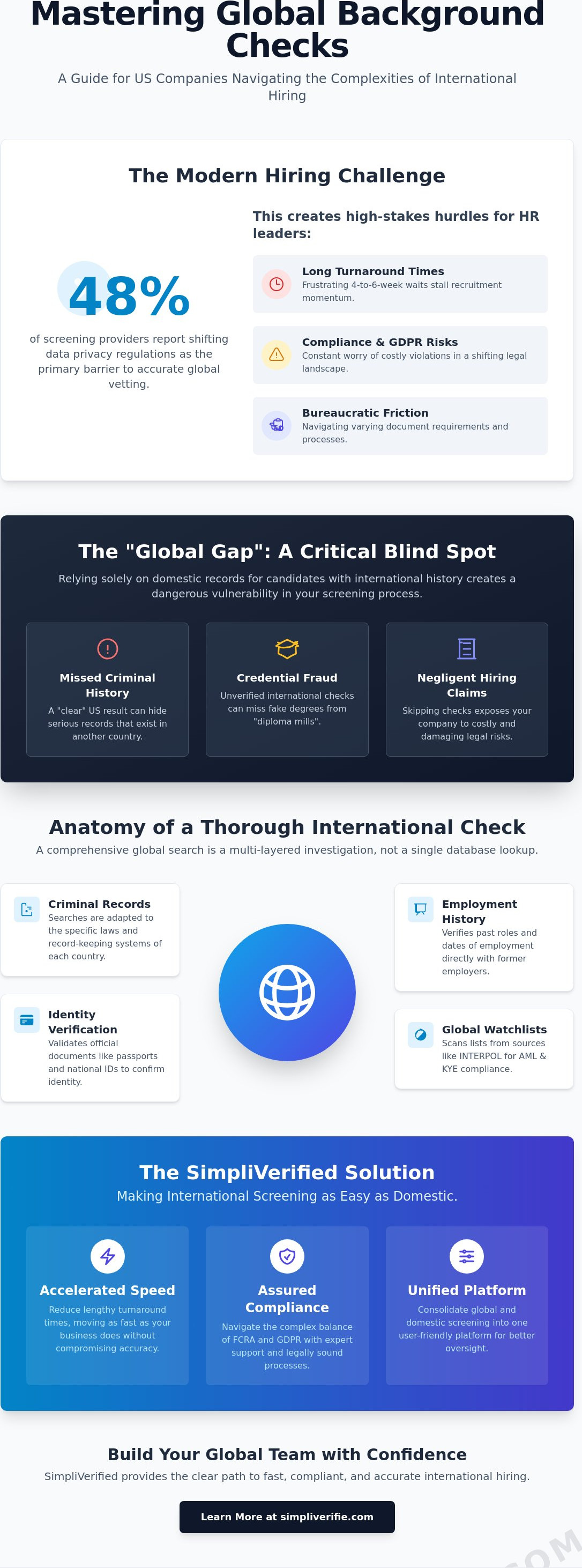
Nearly 48% of screening providers now report that shifting data privacy regulations are the primary barrier to accurate global vetting. For HR leaders, this creates a high-stakes environment where hiring a talented candidate from overseas often feels like a legal gamble. If you are managing international background checks for US companies, you've likely felt the frustration of 4-to-6-week turnaround times and the constant worry of a GDPR violation. You need a process that moves as fast as your business does, without the bureaucratic friction that often stalls global recruitment.
We agree that expanding your talent search shouldn't mean compromising your compliance standards or slowing your momentum. At SimpliVerified, we believe that global screening should be as seamless and transparent as your domestic US process. This 2026 guide provides the roadmap you need to master international screening with speed and absolute precision. You'll learn how to navigate varying document requirements, maintain strict FCRA compliance, and integrate international checks directly into your existing hiring workflow for total peace of mind.
US firms aren't confined to local talent pools anymore. In 2026, accessing global expertise is a necessity for staying competitive in a digital-first economy. This shift means that international background checks for US companies have moved from being an occasional requirement to a core part of the recruitment workflow. These checks involve the verification of criminal, educational, and professional records outside the US. Whether you're hiring a remote developer based in Brazil or vetting a local candidate who completed their MBA in London, the goal remains the same: ensuring the person you hire is exactly who they claim to be. Reliable data is the foundation of every successful hire, especially when that data crosses international borders.
Most organizations face two primary scenarios when expanding their search. You might be hiring foreign nationals who have never lived in the States, or you're vetting US residents who have significant international history. In both cases, a standard domestic search won't provide a complete picture of a candidate's background. Skipping these steps exposes your organization to credential fraud and negligent hiring claims that can be costly and damaging to your culture. Understanding the anatomy of an international background check is the first step toward building a secure, global team that you can trust from day one.
Relying solely on domestic records creates a dangerous blind spot in your screening process. If a candidate lived, worked, or studied abroad for six months or more, a US-based criminal search will likely return a "clear" result, even if serious records exist in another country. This isn't just about criminal history; "diploma mills" are a growing concern in several international regions. These unaccredited institutions sell fake degrees that look remarkably authentic to the untrained eye. Without a verified international check, these discrepancies often go unnoticed until it's too late. The "Global Gap" is the vulnerability created when US companies ignore a candidate’s international history.
A consistent screening policy protects your brand and streamlines your operations. When you apply the same rigorous standards to every hire regardless of their origin, you demonstrate a commitment to safety and excellence that resonates with stakeholders. This consistency builds trust with your current employees and ensures that everyone on the team has been held to the same high bar. By utilizing SimpliVerified’s industry-specific solutions, you can ensure that your global screening process is as fast and accurate as your domestic one. Implementing international background checks for US companies shouldn't be a hurdle; it's a strategic move to safeguard your company's reputation and future growth in an interconnected world.
International background checks for US companies aren't a "one size fits all" solution. There is no single global database that stores every criminal record or employment history. Instead, a thorough check is a multi-layered investigation that adapts to the specific laws and record-keeping habits of the candidate's home country. This process typically includes criminal record searches, global watchlist screenings, and the direct validation of identity documents like passports or national IDs. Accuracy here depends on knowing which sources to trust in each specific region.
Global watchlists and sanctions are particularly vital for maintaining anti-money laundering (AML) and "Know Your Employee" (KYE) standards. These searches scan thousands of lists from organizations like INTERPOL and various government agencies to ensure your candidate isn't a high-risk individual. While these technical steps are essential, they are only part of the equation. Balancing these international requirements with domestic obligations like Compliance Hurdles: The FCRA remains a top priority for US-based hiring teams.
Criminal record searches vary wildly across the globe. Some jurisdictions, like certain provinces in Canada or states in Australia, offer national-level searches. However, many other countries have decentralized systems where records are only available at the regional or local court level. In these cases, a "National" search simply doesn't exist. You have to know where the data lives to get a clear result.
Methods of retrieval differ too. You'll find that some countries require digital fingerprints for a search to even begin. In many European and Asian jurisdictions, candidates must provide a "letter of good conduct" from their local police department. This adds a layer of candidate cooperation that isn't typically seen in domestic US checks. If you need help managing these moving parts, you can partner with a dedicated screening expert to simplify the process.
Validating an international degree or past job title involves more than just a quick phone call. It requires navigating different time zones, language barriers, and varied academic calendars. Our team reaches out directly to foreign institutions to confirm that a candidate's credentials are legitimate and not the product of a diploma mill. This direct outreach is the only way to ensure the data is current and accurate.
For specialized roles in healthcare or finance, professional license verification is non-negotiable. This ensures that any certifications earned abroad meet the rigorous standards required by your industry. If you want to see how these checks fit into your specific field, explore SimpliVerified’s industry-specific solutions for a tailored approach to international background checks for US companies.
Hiring globally requires a delicate balance between two distinct legal frameworks. You must adhere to the US Fair Credit Reporting Act (FCRA) while simultaneously respecting the stringent data privacy laws of the candidate's home country. This dual-compliance requirement is often the biggest roadblock for HR teams. When conducting international background checks for US companies, you aren't just following one set of rules. You're navigating a patchwork of regulations that change the moment a search crosses a border. Navigating these rules is often the most stressful part of global hiring. Overcoming Compliance Hurdles: GDPR and Privacy Laws requires a proactive approach to data sovereignty and candidate rights.
In Europe, the General Data Protection Regulation (GDPR) remains the gold standard for privacy. It mandates a clear "Legal Basis for Processing" for every piece of data you collect. While US law often emphasizes the employer's right to know, GDPR prioritizes the individual's right to privacy. By 2026, cross-border data transfer agreements between the US and key global regions have become even more nuanced. New adequacy decisions and updated standard contractual clauses mean that how you move data from a server in Berlin to an office in Chicago is under more scrutiny than ever before. You need a process that respects these boundaries without stalling your hiring timeline.
Consent is the cornerstone of a compliant global screening program. A standard US consent form is often insufficient for international searches because it lacks the specific language required by foreign data protection authorities. Many jurisdictions require country-specific authorization forms written in the local language. These forms must clearly explain what data is being collected and how it will be used. SimpliVerified manages these disclosures automatically. We provide the correct, legally vetted documents for each region, ensuring your candidates are informed and your company stays protected.
Modern privacy laws emphasize the principle of data minimization. This means you should only collect data that is strictly necessary for the specific job role. If a criminal record isn't relevant to a position, collecting that information could lead to a compliance violation in certain countries. Additionally, international candidates often have the "Right to be Forgotten," allowing them to request the deletion of their personal data after the hiring process ends. Your screening workflow must be able to handle these requests quickly and securely. Compliance is a moving target that requires a dedicated screening partner to stay ahead of changing regulations.
Efficiency in international background checks for US companies depends on a structured, logical workflow. It begins with determining the scope of the search. You should look at the candidate's residency history over the last 7 to 10 years to identify which jurisdictions require a deep dive. Once the scope is clear, you can initiate the request through an integrated employment verification platform. This centralized approach ensures that your domestic and global data live in one secure place, allowing for better oversight and faster decision-making.
The process then shifts to the candidate. They receive a link to a mobile-friendly portal where they can upload identity documents and provide digital consent. This step is critical. Any delay here ripples through the entire timeline. After consent is secured, local in-country researchers access primary source records directly from courts or government agencies. These "boots on the ground" are essential for navigating manual filing systems that digital tools can't reach. Finally, a quality assurance review filters the raw data into a clear, actionable report that highlights any discrepancies without the clutter of irrelevant data.
A non-US resident faces unique hurdles when providing information. They might be using a smartphone as their primary device or speaking a language other than English. A multilingual, mobile-first portal isn't just a luxury; it's a necessity for reducing friction. Clear communication about why the check is happening helps build trust and encourages participation. When candidates can snap a photo of their ID and upload it instantly, you shave days off the total turnaround time. This positive experience reflects well on your brand before the candidate even starts their first day.
Expectations must be grounded in reality. In 2026, digital infrastructure varies significantly by region. A criminal search in the UK might take 2 to 3 business days because of their highly digitized systems. In contrast, searches in India or Brazil can take 10 to 15 days due to manual record retrieval or local government holidays. While some providers still struggle with 4 to 6 week delays, SimpliVerified provides real-time status updates so your HR team always knows exactly where a report stands. Managing international background checks for US companies requires this level of transparency to keep your hiring pipeline moving. Learn more about our streamlined screening process here.
Managing international background checks for US companies often feels like juggling multiple vendors, conflicting time zones, and varying legal standards. It shouldn't be that way. SimpliVerified removes this friction by providing a single, unified platform where your domestic and global screenings coexist. This "Simpli" approach means you have one dashboard, one dedicated support team, and one high standard of excellence across the board. You don't need to learn different systems for different countries. The interface remains consistent whether you're vetting a candidate in Ohio or Oslo.
Integration is key to a smooth hiring process. We've designed our system to slide naturally into your existing workflow. This ensures that international checks aren't a secondary hurdle but a seamless part of your standard operating procedure. Our dedicated US-based support team understands the pressures HR leaders face. When you have a question about a specific document requirement in India or a privacy law update in the UK, you get an answer from an expert who speaks your language and operates in your time zone. This proactive support is a cornerstone of our partnership model.
SimpliVerified acts as a direct extension of your HR and compliance departments. We know that accuracy isn't just a metric; it's the foundation of your organizational culture. The peace of mind that comes from our service isn't based on vague promises. It's built on a rigorous vetting process where every international check is reviewed for compliance with both local laws and US standards. Many vendors focus on volume, leading to robotic interactions and missed details. We prefer a business-quality partnership where we provide the dependable guidance you need to make confident, informed hiring decisions.
Global hiring is no longer an optional strategy. In 2026, it's a competitive necessity. As you expand your search for the best talent, your screening process serves as the essential safety net that protects your team and your reputation. You've seen the complexities of GDPR, the nuances of international criminal records, and the importance of a mobile-first candidate experience. Now, it's time to professionalize your program with a partner who understands the high stakes of global recruitment. Get started with SimpliVerified for your international background checks today.
Expanding your reach into international talent pools is a strategic move that defines growth in 2026. While the complexities of GDPR and varying regional record-keeping can seem daunting, they shouldn't stop your momentum. By centralizing your workflow, you ensure that every hire meets the same high standards of integrity and safety that your domestic team does. Implementing international background checks for US companies is about more than just risk mitigation; it's about building a foundation of trust that spans continents.
SimpliVerified is here to remove the friction from your global recruitment. Our FCRA-compliant global screening process, supported by a dedicated US-based support team, ensures that you never have to navigate these hurdles alone. With our mobile-friendly candidate portal, your international hires enjoy a smooth, professional experience that reflects your company's modern values. You deserve a partner that prioritizes accuracy and speed as much as you do.
Simplify your global hiring today with SimpliVerified. We're ready to help you hire the world's best talent with total peace of mind.
Turnaround times in 2026 generally range from 2 to 15 business days depending on the digital infrastructure of the target country. Highly digitized nations like the United Kingdom often return results within 48 to 72 hours. In contrast, regions that require manual record retrieval from local courts, such as parts of India or Brazil, can take two weeks or longer. SimpliVerified provides real-time status updates so you can manage your hiring timeline with precision.
Yes, international background checks for US companies are compliant with the FCRA provided the employer follows standard disclosure and authorization procedures. Your screening partner must also ensure that gathering data abroad respects the host country's specific privacy laws. This dual-layer compliance protects your organization from domestic legal challenges while ensuring you meet international data protection standards like GDPR.
Candidates typically need to provide a valid passport or national ID, a detailed residency history, and signed authorization forms. Some jurisdictions require additional items, such as digital fingerprints or a "letter of good conduct" issued by local police authorities. Our mobile-friendly portal allows candidates to upload these documents instantly, which significantly reduces the friction often associated with global document collection.
The cost of a global check depends on the specific country being searched and the depth of the verification required. Factors that influence the price include local court access fees, the need for in-country researchers, and the complexity of verifying international education or employment. SimpliVerified focuses on delivering high-quality, verified data and transparent reporting to ensure you get the best value for your compliance budget.
You can and should run an international check on any US citizen who has lived or worked abroad for six months or more. A domestic search only accesses US-based records, leaving a significant gap in the candidate's history. Performing international background checks for US companies ensures that you close this "Global Gap" and maintain a consistent, high standard of vetting for your entire workforce regardless of their citizenship.
A global watchlist search scans international databases, such as INTERPOL and government sanctions lists, to identify high-risk individuals or those involved in financial crimes. A criminal check is a more focused search of national or regional court records for specific local convictions. While watchlists are essential for anti-money laundering (AML) compliance, they are not a substitute for a thorough criminal record search at the local level.
Explicit candidate consent is a legal requirement in almost every jurisdiction worldwide. Most international privacy laws, including GDPR, mandate that candidates receive a clear explanation of what data is being collected and how it will be used. These authorization forms often must be provided in the candidate's local language to ensure they fully understand their rights before the screening process begins.
In countries with strict privacy laws, the screening process must adapt to prioritize data minimization and individual rights. This involves only collecting information that is strictly necessary for the job role and ensuring a clear "Legal Basis for Processing" exists. SimpliVerified manages these nuances by utilizing legally vetted, country-specific forms and workflows that respect local regulations without compromising the accuracy of your final report.