Hiring
Drug Testing
Employment Screening


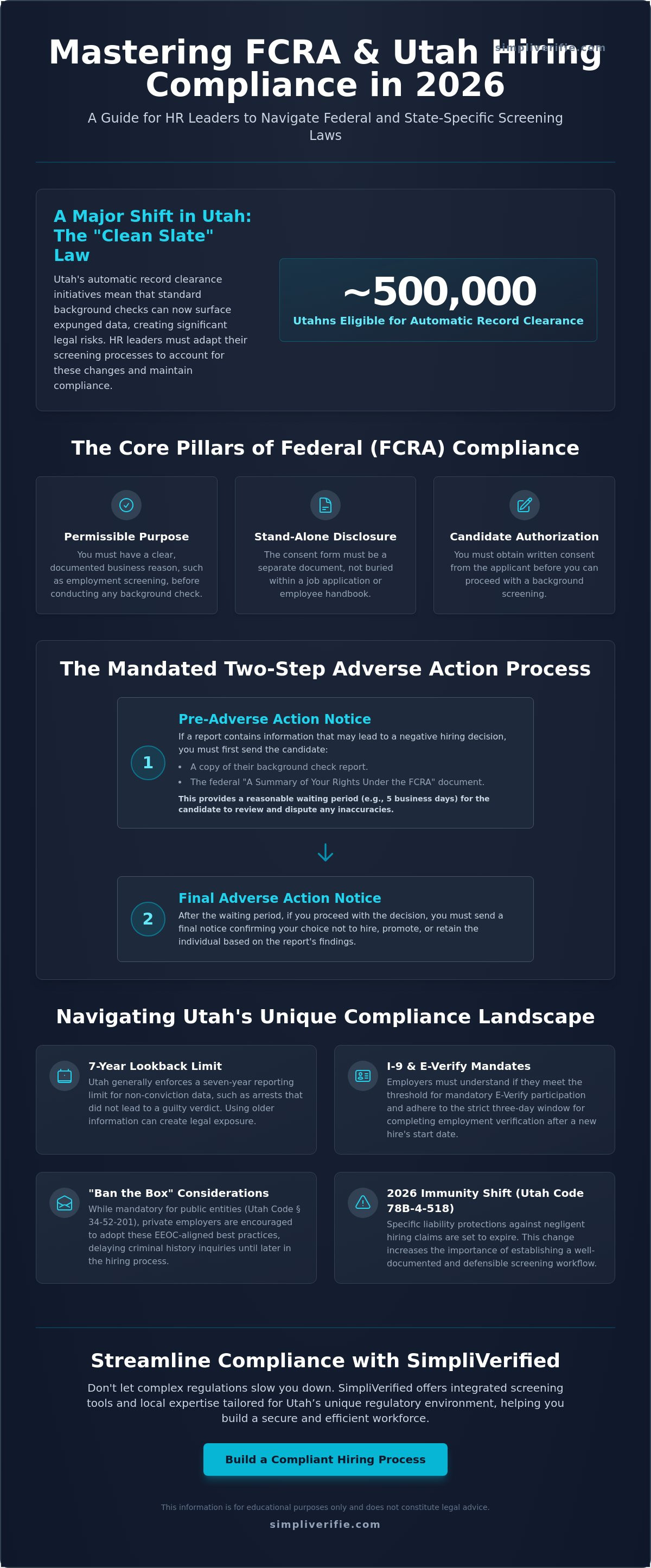
Did you know that nearly 500,000 Utahns became eligible for automatic record clearance as the state's Clean Slate initiatives reached full implementation? For HR leaders, this shift means that a standard background check could accidentally surface expunged data, leading to significant legal risks. Maintaining FCRA compliance for Utah employers in 2026 requires more than just following federal rules; it demands a precise understanding of how state-level privacy laws and E-Verify mandates intersect with your hiring funnel.
We understand that balancing these local requirements with federal standards can feel like an administrative burden that slows down your onboarding. You want a process that's both legally airtight and fast enough to secure top talent. This guide provides the clarity you need to master the dual requirements of the FCRA and Utah-specific hiring laws, helping you build a secure and efficient workforce without the guesswork. We'll explore the 2026 E-Verify thresholds for private companies, the impact of automatic expungement on criminal searches, and how SimpliVerified helps you consolidate these steps into one seamless, compliant workflow.
The Fair Credit Reporting Act (FCRA) serves as the foundational legal floor for every background check you conduct. While Utah has its own specific hiring statutes, federal law remains the primary driver for how you handle applicant data. In 2026, the Federal Trade Commission (FTC) and the Consumer Financial Protection Bureau (CFPB) continue to share enforcement duties, ensuring that employers maintain high standards of accuracy and privacy. For local businesses, achieving total FCRA compliance for Utah employers begins with recognizing that any background check performed by a third party is legally a "consumer report." This definition includes criminal history, employment verifications, and even motor vehicle records. You must treat these documents with the same level of security as a financial credit file.
Compliance isn't a suggestion; it's a requirement to protect your organization from litigation. First, you must have a "permissible purpose," which for your HR team is employment screening. You can't run a check on anyone without a clear, documented business reason. Second, you must provide a stand-alone disclosure. This is a common pitfall where companies bury the consent language inside a long job application or an employee handbook. Federal law requires this document to be separate from other application materials so the candidate clearly understands what they're signing. Finally, you must certify to your screening partner, such as SimpliVerified, that you've followed these steps and will use the information legally. SimpliVerified provides tailored solutions across various industries to keep your workflow compliant and efficient.
If a background check reveals information that makes you reconsider a hire, you must follow a strict two-step process. The Pre-Adverse Action stage requires you to send the candidate a copy of their report along with a document called "A Summary of Your Rights Under the FCRA." This gives them a chance to dispute inaccuracies. In Utah, courts generally look for a "reasonable" waiting period between this notice and your final decision. While five business days is a common industry standard, some situations may require more time if the candidate is actively disputing a record. Once that period passes and you've considered any feedback, you can issue the Final Adverse Action notice. This formal letter confirms your decision not to hire based on the report. Skipping these steps is one of the fastest ways to trigger a lawsuit. By following this structured workflow, you protect your company's reputation and ensure a fair experience for every applicant.
Mastering FCRA compliance for Utah employers means looking beyond federal mandates to understand how state-specific statutes alter your hiring obligations. Utah law provides unique protections that often go further than the baseline federal rules, particularly regarding how far back you can look into an applicant's history. For non-conviction data, such as arrests that didn't lead to a guilty verdict or cases that were dismissed, Utah generally enforces a seven-year lookback limit. Using information older than this can expose your company to legal challenges. While you're likely familiar with the standard FCRA compliance guidance for employers, local nuances like "Ban the Box" rules for public entities (Utah Code § 34-52-201) require a more specialized approach. Even if you're a private employer not strictly bound by "Ban the Box," adopting these standards is a smart way to align with EEOC best practices across various industries.
A significant change arriving in 2026 is the expiration of specific liability protections under Utah Code 78B-4-518. Previously, this statute offered a degree of immunity to employers against negligent hiring claims if they met certain screening criteria. With these legal shields evolving, you can't rely on outdated "safe harbor" assumptions. You must maintain a defensible process by establishing clear, written screening policies that apply to every candidate. This shift makes it vital to document why specific criminal records are relevant to a particular role. If your process isn't consistent, you're much more vulnerable to lawsuits if a hire's past behavior becomes a legal issue for your business.
The Utah Clean Slate Act has fundamentally changed the background screening landscape. As of January 1, 2026, Utah courts have fully transitioned to automatically identifying and clearing eligible criminal cases. This includes Class C misdemeanors after five years, Class B after six years, and Class A misdemeanors after a seven-year waiting period. Many "instant" national databases fail to update these records in real-time, meaning they might still show "cleared" records that are legally expunged. If your HR team makes a hiring decision based on an expunged record, you've likely violated state law. SimpliVerified solves this problem by using live, court-level data to ensure that expunged records never improperly influence your hiring decisions. To protect your organization, it's best to partner with a specialized screening provider that understands Utah’s specific data privacy rules.
Hiring in Utah involves more than just verifying a candidate's past; it requires confirming their legal right to work in the United States. While the Fair Credit Reporting Act governs the background check process, state law adds another layer of responsibility through E-Verify mandates. Maintaining FCRA compliance for Utah employers means integrating these verification steps into a single, cohesive workflow. This prevents the administrative friction that often occurs when HR teams treat background checks and work authorization as separate, disconnected tasks.
The timeline for these checks is strict. You must complete the E-Verify process within three business days of the employee's start date. This digital system works in tandem with the physical Form I-9, which every employer must maintain. Failing to meet these deadlines or neglecting the mandate altogether carries heavy consequences. In Utah, non-compliant businesses risk the suspension of their business licenses, a penalty that can halt operations entirely. Managing these requirements proactively protects your organization's standing and ensures you stay ahead of state-level enforcement.
Utah law requires private employers with 150 or more employees to use a status verification system like E-Verify for all new hires. The Utah Department of Commerce oversees this mandate and ensures that organizations remain in good standing. Even if your company hasn't reached the 150-employee threshold yet, adopting E-Verify is a best practice that signals a commitment to legal hiring standards. Conducting regular audits of your existing I-9 forms is a smart way to prepare for the 2026 regulatory environment. These audits help you identify missing signatures or expired documents before they become a liability during a state review.
Using separate platforms for criminal background checks and E-Verify often leads to data entry errors and lost time. SimpliVerified eliminates this complexity by offering an integrated portal where you can manage every aspect of the hiring process. This unified approach is especially beneficial for Utah’s remote and hybrid workforces, as digital I-9 storage keeps your records organized and accessible. By automating the data flow between your Applicant Tracking System (ATS) and the E-Verify system, you reduce the risk of human error. This efficiency allows your team to focus on growth across various industries while SimpliVerified handles the technical details of your compliance strategy.
Establishing a structured workflow is the most effective way to ensure long-term FCRA compliance for Utah employers. A defensible process doesn't just protect you from lawsuits; it creates a consistent experience for every candidate. By following a logical sequence, your HR team can eliminate the friction often associated with complex hiring mandates. This five-step framework integrates federal requirements with Utah's specific 2026 standards to keep your organization secure.
Your screening needs change based on the role and industry. For positions involving transportation, you should include motor vehicle records (mvr) to verify driving history and license status. If safety is a top priority, integrating pre employment drug test results directly into the candidate file ensures all data is in one place. Additionally, healthcare compliance monitoring is essential for Utah medical facilities to track ongoing license status and exclusions.
When a report contains disqualifying information, you must follow the adverse action cycle precisely. Automating the delivery of Pre-Adverse Action notices ensures you never skip this legal requirement. This step gives candidates a clear path to dispute inaccurate data, which is vital if an expunged record accidentally surfaces. Finalize the process with professional communication that reflects your brand's values. If you're ready to build a faster, more reliable hiring funnel, partner with SimpliVerified today to automate your compliance workflow.
Choosing a screening partner involves more than comparing turnaround times. It's about finding a strategic ally that understands your specific market. Headquartered in Draper, SimpliVerified provides the local accountability and expertise required for FCRA compliance for Utah employers in 2026. We've built our reputation on removing the friction from complex regulatory requirements, transforming a bureaucratic burden into a smooth, automated experience. Our "Simpli" philosophy means we handle the administrative heavy lifting, from court-level data verification to electronic work authorization. Whether you're a growing tech startup in Silicon Slopes or an enterprise organization with thousands of employees, our solutions scale to meet your specific volume and complexity.
Our commitment to accuracy helps you avoid the legal pitfalls associated with outdated data. We prioritize a proactive approach, identifying potential issues before they slow down your onboarding process. By integrating background checks with E-Verify and drug testing, we provide a single source of truth for your HR department. This consolidation reduces the risk of data entry errors and ensures that every hire meets your high standards for safety and integrity. You can trust that your compliance is in expert hands, allowing you to focus on your organization's core mission.
Our team understands the nuances of Utah’s county court systems and the latest state legislation better than generic national providers. This local insight ensures that your searches are accurate and reflect the most current "Clean Slate" updates discussed earlier in this guide. While our roots are in Utah, our reach remains nationwide. You gain access to a network of over 15,000 drug testing collection sites across the country, making it easy to manage remote hires or satellite offices. You'll work with compliance experts who know the Utah market, providing a level of personalized support that distant competitors simply can't match. This blend of local presence and national capability gives you the confidence to hire anywhere while staying grounded in local compliance.
Efficiency drives our technology. We offer seamless integration with the top ATS platforms, allowing you to trigger checks and view results without leaving your existing workflow. Our real-time dashboards provide instant visibility into every background check status and E-Verify result. This transparency eliminates the "black box" feeling of traditional screening services. We've designed our platform to be intuitive, so your recruiters spend less time troubleshooting and more time interviewing. We also believe in clear, upfront pricing with no hidden fees, ensuring Utah business owners can budget with confidence. By combining advanced automation with human expertise, SimpliVerified ensures your FCRA compliance for Utah employers remains airtight while you focus on your organization's growth.
Staying ahead of hiring regulations in 2026 requires a proactive approach that balances federal standards with Utah's unique legal shifts. You've seen how the Clean Slate initiative changes record reporting and why the E-Verify mandate is a critical hurdle for larger private organizations. Achieving total FCRA compliance for Utah employers isn't just about following a checklist; it's about building a culture of security and transparency that protects both your company and your candidates. By implementing a defensible workflow that integrates criminal searches with work authorization, you remove the administrative friction that slows down top-tier hiring.
SimpliVerified is here to simplify this complexity. As a Draper, UT headquartered partner, we offer local expertise backed by an FCRA certified compliance team. Our integrated E-Verify and I-9 solutions ensure your onboarding remains fast, accurate, and legally sound. Don't leave your organization's reputation to chance with generic, automated platforms. Instead, gain the peace of mind that comes from working with a dedicated screening partner that understands the Utah market inside and out. Request a Utah Compliance Consultation with SimpliVerified today to secure your workforce with confidence.
No, E-Verify is only mandatory for private employers in Utah that have 150 or more employees. This threshold ensures that larger organizations confirm the work eligibility of every new hire through the federal electronic system. While smaller businesses aren't legally required to participate, many choose to do so to maintain a secure and compliant hiring process.
Non-conviction data like arrests or dismissed cases are limited to a seven-year lookback period in Utah. While federal law technically allows convictions to be reported indefinitely, Utah's Clean Slate law automatically expunges many records after five to seven years. SimpliVerified focuses on providing only legally reportable data, ensuring your team doesn't accidentally consider records that the state has cleared.
Utah's Clean Slate law automatically expunges certain criminal records once a candidate has remained crime-free for a specific period. As of January 1, 2026, the courts automatically clear eligible Class C, B, and A misdemeanors after five, six, or seven years respectively. Employers can't legally see or use these expunged records, which helps protect applicant privacy and promotes fair hiring practices across the state.
Yes, private employers in Utah can conduct background checks at any point during the recruitment process. While public sector agencies must follow "ban the box" rules that delay criminal inquiries, private companies have more flexibility. Many organizations still wait until after a conditional offer to ensure FCRA compliance for Utah employers and to align with federal anti-discrimination guidelines.
Utah employers who meet the 150-employee threshold and fail to use E-Verify risk the suspension of their business licenses. The state monitors compliance through the Department of Commerce to ensure all large organizations are verifying employment eligibility. Using an integrated screening partner helps you avoid these penalties by automating the verification process within the required three-day window.
Digital applications must present the disclosure as a separate, standalone document that isn't bundled with other application text. The candidate must provide clear, electronic consent before you can initiate any search. SimpliVerified uses intuitive, mobile-friendly digital forms that meet these federal standards, making it easy for candidates to sign off without the need for physical paperwork.
Drug tests aren't a legal requirement for FCRA compliance, but they're a standard safety practice for many Utah businesses. If you use a third-party lab for testing, the results are considered part of the consumer report and must follow FCRA privacy rules. SimpliVerified integrates these results directly into your compliance workflow, helping you manage all safety screenings from a single dashboard.
A national search is a database sweep that identifies potential records across multiple states, while a county search involves checking live court records for the most current information. Relying only on national databases is risky because they may not reflect recent expungements. For FCRA compliance for Utah employers, SimpliVerified recommends combining both to ensure every report is accurate and legally reportable.