Hiring
Drug Testing
Employment Screening


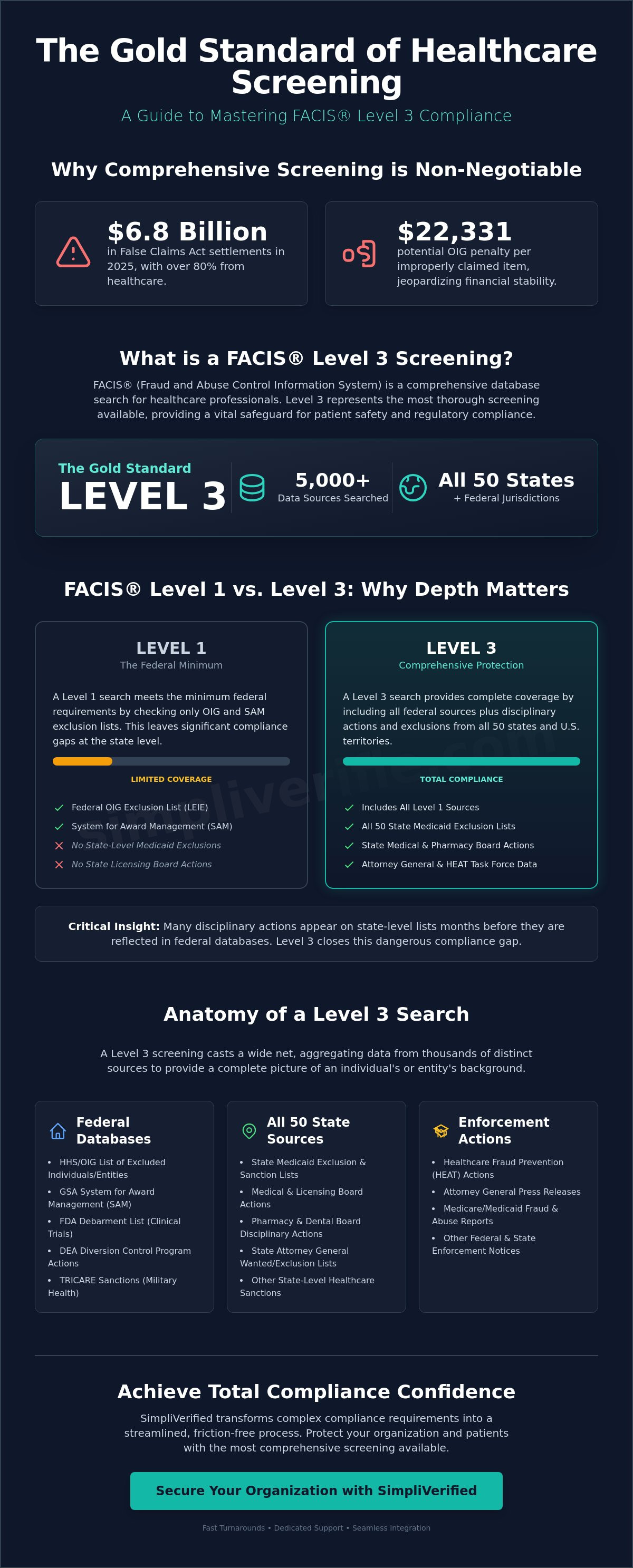
In 2025, False Claims Act settlements reached a record $6.8 billion, and healthcare organizations were responsible for over 80% of that figure. With the Office of Inspector General now issuing penalties of up to $22,331 per item claimed, the stakes for your credentialing process have never been higher. You likely feel the pressure of an increasingly complex regulatory landscape and the constant worry that a single oversight could lead to devastating sanctions. Implementing a robust FACIS level 3 screening for healthcare is no longer just a best practice; it's a vital safeguard for your organization's reputation and financial health.
At SimpliVerified, we believe compliance shouldn't be a source of stress. You deserve total peace of mind during audits and a fast turnaround for new hires. This 2026 compliance guide will help you master the complexities of Level 3 screenings to ensure bulletproof patient safety protocols. We'll explore the critical differences between screening levels, analyze the latest OIG guidance, and provide a clear roadmap for modernizing your compliance strategy for the year ahead. By the end of this guide, you'll have the tools to transform a bureaucratic hurdle into a streamlined, friction-free process.
FACIS stands for the Fraud and Abuse Control Information System. It's a vast database used to verify the backgrounds of healthcare professionals and entities. A FACIS level 3 screening for healthcare represents the most comprehensive version of this search. While lower levels might only check federal data or a single state, Level 3 scans over 5,000 sources across all 50 states and federal jurisdictions. This depth makes it the gold standard for organizations that prioritize patient safety and absolute regulatory compliance. Implementing a FACIS level 3 screening for healthcare ensures you aren't just meeting the bare minimum requirements; you're protecting your entire organizational culture.
Historically, HR teams had to manually check the OIG's List of Excluded Individuals/Entities (LEIE). This was a slow, error-prone process. Data aggregation has transformed this workflow. Modern FACIS databases compile information from state medical boards, pharmacy boards, and attorney general offices into one accessible report. This historical record is vital. Some exclusions date back to the 1980s. Missing these could lead to hiring a debarred individual who still poses a risk to your facility. For organizations operating across various healthcare sectors, this level of scrutiny is non-negotiable.
Several government bodies contribute the data that makes these screenings effective. The HHS Office of Inspector General (OIG) is the most critical. They maintain the LEIE, which lists individuals barred from participating in Medicare and other federal programs. Additionally, the System for Award Management (SAM) tracks debarments across the entire federal government. Level 3 also pulls from Federal Healthcare Entitlement Program (FHEP) sources at the state level. This ensures that a provider sanctioned in one state can't simply move across borders to find work elsewhere. A Level 3 search typically includes:
Real-time updates are essential in the 2026 regulatory environment. Sanctions are added daily. Relying on outdated data creates a window of liability that your organization simply can't afford. A proactive approach identifies excluded, sanctioned, or debarred individuals before they ever interact with a patient. This transforms a bureaucratic hurdle into a streamlined, friction-free experience for your hiring team.
A FACIS level 3 screening for healthcare isn't just a deeper search; it's a multi-layered net designed to catch risks that standard checks miss. While basic screenings look at the surface, Level 3 dives into over 5,000 distinct data sources. This includes critical federal databases like the FDA for clinical trial debarments and the DEA for controlled substance registration issues. It also incorporates TRICARE data, ensuring that any provider sanctioned within the military health system is flagged immediately. By monitoring these diverse channels, your organization maintains a defense against individuals who have a history of fraud or abuse at the highest levels of government.
The search also extends into specific law enforcement actions. It aggregates news from the Healthcare Fraud Prevention and Enforcement Action Team (HEAT) and Attorney General press releases. These sources often reveal ongoing investigations or recent settlements that haven't yet been reflected in official exclusion lists. This proactive approach allows you to identify potential risks before they become a liability for your facility.
Federal-only checks are a common starting point, but they often leave a significant gap in your compliance profile. Many disciplinary actions start at the state level. A provider might lose their license or be sanctioned by a state Medicaid program months before that information reaches the OIG Exclusions list. Level 3 closes this window by aggregating data from Medicaid exclusion lists and contractor disqualification files in all 50 states and the District of Columbia. It captures state-level medical board sanctions that federal databases simply don't track, providing a 360-degree view of a candidate's professional history.
It's a mistake to think these screenings only apply to physicians. A robust FACIS level 3 screening for healthcare covers everyone in your ecosystem. This includes nurses, therapists, and technicians who have direct patient contact. It also reaches non-clinical staff in billing or administrative roles where financial fraud remains a high risk. Even your vendors and contractors fall under this umbrella. Entity-level screening ensures that the companies you do business with aren't debarred from receiving federal funds. If you're managing a diverse team across multiple healthcare environments, you need this level of breadth to ensure total safety. Many organizations find that they can streamline their credentialing workflow by centralizing these complex data points into a single, easy-to-read report.
Choosing the right screening depth often comes down to balancing risk against operational efficiency. A Level 1 search meets the basic federal requirements by checking the OIG Exclusions List (LEIE) and the System for Award Management (SAM). While this fulfills the floor of federal compliance, it leaves your organization vulnerable to state-level risks. Level 1M adds state Medicaid lists, which is a step up, but it still misses the broader professional disciplinary actions that only a FACIS level 3 screening for healthcare can capture. Level 3 provides the total picture, aggregating data from all state medical boards and thousands of additional sources to ensure no prior sanction goes unnoticed.
The cost-benefit analysis for upgrading to Level 3 is clear when you consider the price of failure. With the OIG now issuing penalties of up to $22,331 per item or service claimed for excluded individuals, a single hiring mistake can result in million-dollar fines. Investing in the highest tier of screening isn't just about checking a box; it's a strategic move to prevent catastrophic financial and reputational damage. It transforms a potential liability into a verified asset for your team.
A significant risk in healthcare recruitment is the "multi-state bad actor." A provider might face disciplinary action or license revocation from a state board in one jurisdiction and simply move across state lines to seek new employment. Because federal databases often experience a lag in reporting these state-level actions, a Level 1 search might return a "clear" result for someone who is actually unfit for duty. Missing a state board sanction can lead to malpractice claims and a total loss of Medicare reimbursement eligibility. A FACIS level 3 screening for healthcare closes this gap by searching all 50 states simultaneously, ensuring that past behavior in one region doesn't become your facility's future crisis.
For organizations seeking or maintaining accreditation, the depth of your screening process is a primary focus for auditors. Level 3 screenings are generally required to meet the rigorous standards set by the National Committee for Quality Assurance (NCQA) and URAC. Similarly, JACHO compliance for hospital staffing often hinges on the ability to prove that every individual in the facility has been thoroughly vetted against all available state and federal records. SimpliVerified understands these high-stakes requirements. We provide executive-quality reports that align with these specific accreditation benchmarks across various healthcare sectors. This level of precision ensures that your organization remains audit-ready and fully compliant with the industry's most demanding safety protocols.
Establishing a baseline begins with a thorough pre-employment FACIS level 3 screening for healthcare. This initial step ensures every hire enters your facility with a clean professional record. However, compliance isn't a one-time event. The OIG recommends monthly monitoring rather than annual checks to close the "gap of risk" that occurs between yearly reviews. Monthly updates allow you to identify new exclusions or sanctions as soon as they are reported, significantly reducing the window for potential fines. This cadence is particularly important for organizations operating in high-compliance healthcare environments.
If a screening returns a "hit," you must act with precision. First, verify the identity to ensure it isn't a false positive. Once confirmed, you should immediately suspend the individual's access to federal healthcare programs and follow your internal disciplinary protocols. Maintaining a clear audit trail of these actions is essential for demonstrating your commitment to compliance during regulatory reviews. This documentation proves you've taken proactive steps to protect your organization and its patients.
The industry is shifting away from traditional "point-in-time" checks toward real-time alerts. Automated systems provide immediate notification when a staff member's status changes. Leveraging continuous criminal monitoring adds an extra layer of protection by tracking new arrests or convictions between scheduled screenings. This proactive approach reduces the administrative burden on your HR team while keeping your patient safety protocols bulletproof. It transforms a reactive process into a steady, reliable shield for your organizational culture.
A compliant FACIS report must be clear, detailed, and easily accessible. You should store these records in a centralized digital system that federal and state investigators can review upon request. Audit-readiness is the ability to produce verified primary source data within 24 hours. Having this information at your fingertips transforms the stress of an unexpected audit into a routine confirmation of your high standards. This level of organization ensures that you're always prepared for scrutiny from any regulatory body. If you're ready to modernize your process, you can partner with SimpliVerified for automated monitoring today.
Managing a FACIS level 3 screening for healthcare shouldn't feel like a bureaucratic burden. Many organizations struggle with fragmented data from multiple vendors, which leads to slow hiring and increased risk. SimpliVerified centralizes these complex requirements into a single, intuitive platform. We don't just provide data; we deliver executive-quality insights that allow HR leaders to make confident decisions quickly. By integrating Level 3 screenings with our broader suite of services, such as criminal background checks and drug testing, we create a unified compliance profile for every candidate. This holistic approach ensures that your FACIS results aren't siloed but function as part of a comprehensive safety strategy.
Our technology is built to handle the rigorous demands of the 2026 regulatory landscape. We understand that your team needs more than a list of names; you need a partner who understands the nuances of OIG guidance and state-level mandates. Our platform integrates seamlessly with enterprise hiring systems, allowing you to trigger screenings and receive results without leaving your existing workflow. This efficiency transforms a traditionally friction-filled process into a smooth, positive experience for both your recruiters and your candidates.
Speed matters in the competitive healthcare talent market. We've optimized our workflows to provide fast turnaround times without compromising on data accuracy. Our reports are polished and professional, designed specifically for busy decision-makers who need clear, actionable information. We also handle professional license verification alongside FACIS checks. This ensures that every credential is valid and every sanction is identified before a provider ever begins patient care. Our team provides dedicated support for complex compliance questions, acting as a reliable extension of your own HR department.
We view our relationship with clients as a strategic partnership rather than a transactional service. Our goal is to protect your organization's culture by ensuring every hire aligns with your high safety standards. Whether you operate in hospitals, telehealth, or long-term care, we offer customized screening packages for various healthcare industries. This tailored approach ensures you aren't paying for unnecessary checks while still maintaining a bulletproof defense against debarred individuals. Total peace of mind comes from knowing your screening partner is as committed to patient safety as you are. If you're ready to modernize your credentialing process, your next step is to request a custom compliance review from our expert team.
The landscape of healthcare compliance is shifting toward greater transparency and stricter enforcement. As we've explored, the depth of your screening process directly impacts your facility's safety and financial stability. By moving beyond basic federal checks and embracing the comprehensive data found in a FACIS level 3 screening for healthcare, you eliminate the state-level blind spots that lead to costly sanctions. Transitioning to a monthly monitoring schedule further ensures you're always ahead of regulatory changes and potential risks. This proactive approach doesn't just check a box; it actively protects your patients and your reputation.
SimpliVerified is here to transform this complex process into a seamless part of your hiring workflow. Our team provides NCQA-compliant data sources and fast, audit-ready reporting to keep your organization protected. With a dedicated US-based support team at your side, you can focus on growth while we handle the technical rigors of validation. We're committed to making your compliance journey fluid and friction-free.
Secure your healthcare compliance with SimpliVerified Level 3 screening today
You've built a culture of care; let's work together to keep it safe and compliant for years to come.
Level 1 focuses on minimum federal requirements by searching OIG and SAM databases. In contrast, a FACIS level 3 screening for healthcare searches over 5,000 sources across all 50 states. This includes state medical boards, pharmacy boards, and Medicaid exclusion lists. While Level 1 checks the surface, Level 3 provides the deep visibility needed to identify individuals who move between jurisdictions to avoid detection.
Federal law only mandates checking the OIG and SAM lists, which corresponds to Level 1 compliance. However, many state Medicaid programs require broader state-level searches to remain eligible for reimbursement. Additionally, accrediting bodies like NCQA or URAC often set Level 3 as their internal standard. Most organizations choose Level 3 to avoid the massive civil monetary penalties associated with hiring sanctioned individuals.
The OIG recommends monthly monitoring to ensure you identify excluded individuals as soon as they're reported. Annual checks leave an 11-month window where an excluded employee could trigger significant fines for your organization. Monthly screening keeps your facility audit-ready. It ensures you aren't billing federal programs for services provided by ineligible staff who were sanctioned mid-year.
No, FACIS reports focus specifically on administrative sanctions, debarments, and exclusions from healthcare programs. They don't include standard criminal history from local or state courts. To get a complete picture of a candidate, you should combine a FACIS level 3 screening for healthcare with criminal background checks. SimpliVerified offers these as integrated packages to help you streamline your entire credentialing workflow.
Results are typically available within 24 to 48 hours. Modern technology allows for rapid data aggregation from thousands of sources, so you don't have to wait weeks for a clear report. Speed's essential in the current hiring market. Partnering with a professional provider like SimpliVerified ensures you get executive-quality results quickly without sacrificing the accuracy of the underlying data.
You must immediately stop the individual from providing services billed to federal healthcare programs. Failure to remove an excluded provider can lead to civil monetary penalties of over $22,000 per item claimed. You should verify the "hit" with primary sources, document every finding, and follow your organization's legal protocols. Taking swift action protects your facility from losing its Medicare and Medicaid eligibility.
Yes, Level 3 is an excellent tool for vetting your vendors and contractors. Federal regulations prohibit healthcare organizations from using federal funds to pay debarred entities. Screening your business partners ensures that your supply chain remains compliant and that you aren't inadvertently violating OIG guidelines. This protective measure shields your facility from third-party risks that could jeopardize your financial standing.
NCQA certification ensures that a data provider meets rigorous standards for primary source verification and data integrity. Using an NCQA-compliant source means the information in your report is accurate and defensible during a regulatory audit. It gives HR leaders confidence that their screening process aligns with the highest industry benchmarks. This certification's a hallmark of a reliable and modern screening partner.