
Hiring
Drug Testing
Employment Screening


Your most trusted employee today could become your greatest liability by 2026 if your screening process stops at the front door. According to the 2024 ACFE Report to the Nations, organizations lose 5% of their annual revenue to internal fraud, proving that risks often emerge long after the initial hire. You've worked hard to build a solid team, but you likely feel the weight of protecting that culture from insider threats while worrying about the legal maze of FCRA requirements. Implementing a formal post-hire background check policy shouldn't feel like a bureaucratic burden or a breach of trust.
At SimpliVerified, we believe that transparency is the key to balancing security with employee morale. You'll learn how to build a compliant, transparent post-hire screening policy that protects your workplace and reduces long-term risk without creating a culture of fear. This guide provides a clear roadmap for policy creation, explains the tangible ROI of continuous monitoring, and shows you how to maintain a safe, modern workplace that your team can rely on.
A post-hire background check policy is a proactive risk management strategy that extends safety protocols beyond the initial job offer. By 2026, the industry has moved away from the "one and done" pre-employment check. This old model is no longer the standard because it leaves the entirety of an employee's subsequent history unmonitored. A modern background check framework ensures that the integrity you verified on day one remains intact on day one thousand. This shift replaces reactive "for cause" checks with a systematic, policy-driven approach. A written policy is your best defense against claims of unfair treatment. It ensures you apply the same rules to every person in a specific role, regardless of their seniority or performance.
The primary goal is identifying new criminal convictions that might conflict with job responsibilities. Research from 2025 shows that 15% of employees in sensitive sectors experience a change in their legal status during their first five years of employment. Ongoing screenings also verify that professional licenses and certifications remain active. This is especially critical for clients in high-stakes industries like finance or medical services. By staying ahead of these changes, you protect your company’s reputation. You also reduce the risk of negligent retention lawsuits, which can cost businesses millions in legal fees and settlements. It's about maintaining a culture of safety and transparency.
HR professionals must master specific terms to maintain compliance. "Continuous Monitoring" refers to technology that provides near real-time updates on new arrests or convictions. In contrast, "Recurring Rescreening" involves conducting a full check at fixed intervals, like every 24 months. When these checks return negative results, the "Adverse Action" process becomes mandatory. You can't simply terminate an employee based on a report without providing them a copy and a chance to dispute the findings. Finally, you must establish a "Permissible Purpose" under the FCRA. This means you have a legitimate business need to conduct the search. SimpliVerified helps you navigate these legal nuances to keep your post-hire background check policy simple and effective.
A robust post-hire background check policy isn't a one-size-fits-all document. It requires a strategic framework that balances workplace safety with employee rights. First, you must define the scope. Will you screen every employee or only those in high-risk roles? Data from 2024 indicates that 48% of organizations now implement some form of ongoing monitoring for their entire workforce to mitigate long-term risk. This proactive approach helps maintain a safe culture long after the initial hire date.
Frequency is the next pillar. You might choose annual re-screens or trigger-based checks. Common triggers include promotions, transfers to sensitive departments, or following a workplace accident. Clear adjudication standards are vital for success. You need a consistent rubric to evaluate new findings. This ensures that a minor traffic violation doesn't lead to an unnecessary termination while serious offenses are addressed immediately. Consistency protects your organization from claims of discrimination or bias. Establishing a clear post-hire background check policy helps your team stay ahead of potential issues before they escalate.
Different sectors face unique risks. In healthcare, your policy should prioritize OIG/SAM sanctions and continuous license monitoring. This protects patients and ensures you meet federal funding requirements. Transportation companies often require real-time Motor Vehicle Record (MVR) alerts. This allows managers to react instantly if a driver's license is suspended. For financial services, the focus shifts toward credit reports and civil record searches to protect against internal fraud. You can explore SimpliVerified industry solutions to see how these specific requirements vary by sector.
Transparency builds trust and ensures legal safety. Your policy must include "evergreen" consent forms. These documents allow for searches throughout the duration of employment without needing a new signature for every check. However, state laws vary. Some jurisdictions require a fresh notice every time you initiate a new search. Managing FCRA compliance is essential here to avoid costly litigation and maintain federal standards.
If an employee refuses to sign a post-hire disclosure, your policy should clearly state the consequences. Usually, this includes ineligibility for certain roles or potential disciplinary action. SimpliVerified helps you automate these notifications, making the process feel like a natural part of your workflow rather than a bureaucratic hurdle. This creates peace of mind for both the HR team and the staff. If you're ready to modernize your screening process, you can view our specialized solutions to get started.
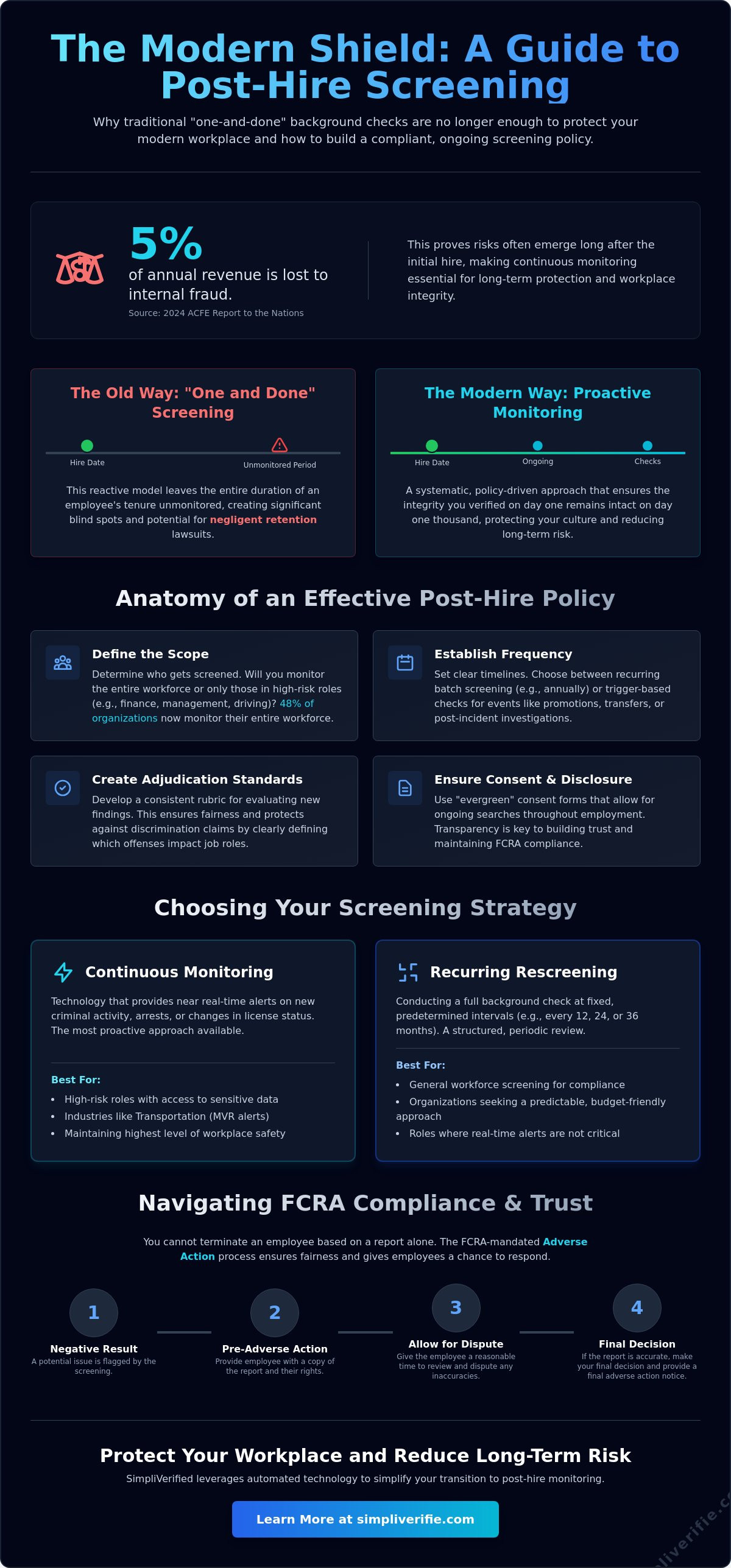
By 2026, the choice between real-time alerts and batch rescreening has become a central pillar of any robust post-hire background check policy. You're no longer limited by manual court searches or slow data processing. Technology now allows for instant notifications. This shift helps you manage risk without drowning in paperwork. Decisions today are driven by a clear analysis of cost versus immediate awareness.
The primary difference lies in the frequency and depth of data. Batch screening is a snapshot in time. Continuous monitoring is a live feed. For many organizations, the 2026 landscape offers API-driven solutions that make real-time updates more affordable than they were just two years ago. Choosing the right path depends on your specific industry risks and the sensitivity of the roles you fill. You can explore how different sectors balance these needs by reviewing specialized industry screening standards.
Continuous monitoring removes the dangerous visibility gap. If an employee is arrested on a Friday, you shouldn't wait until next year's annual check to find out. This method provides real-time alerts for arrests or convictions that could threaten workplace safety. It's about proactive protection rather than reactive discovery.
Integration is the key to making this work. Modern tools sync directly with your HRIS platforms. This automation has reduced HR administrative workloads by approximately 35% compared to the manual tracking methods common in 2023. It ensures you stay aligned with EEOC guidance on background checks by applying consistent, automated standards to all employees. It's a seamless way to maintain a safe environment while respecting legal boundaries.
Batch screening still serves a vital purpose for many business models. It's often the preferred choice for the 28% of companies that rely on large seasonal workforces or low-risk administrative roles. This method allows for predictable, interval-based budgeting. You know exactly when the costs will hit and what to expect.
Integrating this into your post-hire background check policy ensures that no employee goes years without a refresh. While it doesn't offer the "live" protection of monitoring, it provides a reliable safety net. SimpliVerified helps you determine which frequency matches your risk tolerance, ensuring your team stays protected without unnecessary complexity.
Implementing a post-hire background check policy requires more than just technical setup; it demands a commitment to fairness and clear communication. When you transition from screening candidates to screening active employees, the stakes for workplace morale increase. Your team needs to understand that these checks aren't a sign of suspicion, but a standard protocol designed to ensure everyone's continued safety. Maintaining this balance involves strict adherence to the Fair Credit Reporting Act (FCRA) and a proactive approach to internal relations.
Consistency is your best defense against legal challenges. If your policy only targets specific groups or departments without a clear business necessity, you risk "disparate impact" claims under EEOC guidelines. To avoid this, apply your screening criteria uniformly across protected classes. When a report returns a red flag, handle the situation with empathy and professionalism. These conversations are sensitive; focus on the facts and give the employee a private space to discuss the findings before any final decisions are made.
If a background report reveals information that might lead to termination or demotion, you must follow the formal adverse action process. It's a two-step legal requirement that protects the employee's rights. First, issue a pre-adverse action notice. This package must include a copy of the background report and a summary of their rights under the FCRA. You can't take immediate action at this stage. You must provide a mandatory waiting period, typically at least 5 business days, to allow the employee to dispute inaccuracies or provide context.
During this window, perform an "Individualized Assessment" as recommended by the EEOC. Rather than relying on a blanket "no-felony" rule, evaluate the nature of the offense, how much time has passed, and its direct relevance to the employee's current duties. Documenting this assessment proves that your decision was based on business necessity rather than bias. This rigorous documentation is vital for defending your 2026 compliance posture if a decision is later challenged.
The way you frame your post-hire background check policy determines whether employees feel protected or watched. Position the program as a tool for collective security. When employees understand that re-screening prevents workplace violence and fraud, they're more likely to support the initiative. Transparency serves as the foundation of a modern background check policy. Clearly explain the "why" behind the policy in your employee handbook and during town hall meetings.
By prioritizing clarity and fairness, you transform a complex compliance task into a pillar of your company culture. SimpliVerified helps organizations navigate these shifts with ease and precision. Learn how SimpliVerified supports various industries with compliant, expert-led screening solutions.
Transitioning from one-time pre-employment screenings to a robust post-hire background check policy often feels like a significant administrative hurdle. SimpliVerified removes this friction by replacing manual re-checks with intelligent, automated workflows. Instead of tracking expiration dates on static spreadsheets, your HR team receives proactive alerts only when relevant new records appear. This shift allows your staff to focus on high-value talent management rather than chasing paperwork. Internal data from 2025 suggests that companies moving to automated monitoring reduce their background-related administrative workload by approximately 35% within the first six months.
SimpliVerified acts as your strategic partner, providing the technology and expertise needed to maintain a safe workplace. We understand that 2026 brings new challenges in data privacy and employee rights. Our system is built to handle these complexities, ensuring that every check is conducted with the highest level of integrity and legal rigor. You gain the peace of mind that comes from knowing your workforce remains qualified and compliant without the need for constant manual oversight.
Our platform delivers real-time criminal and Motor Vehicle Record (MVR) monitoring that goes far beyond traditional periodic checks. SimpliVerified integrates seamlessly with enterprise-level HRIS and ATS platforms, creating a unified ecosystem for all your screening needs. You can customize reporting triggers to match your specific risk profile. For instance, a delivery firm might prioritize immediate alerts for license revocations, while a corporate office focuses on financial or criminal records. These customizable filters prevent "alert fatigue" by ensuring your team only sees the data that matters to your specific policy.
Compliance is a moving target as state and federal laws evolve. SimpliVerified provides dedicated support to help you navigate these changes, ensuring your post-hire background check policy respects the latest Fair Credit Reporting Act (FCRA) guidelines. For organizations with specialized needs, our Healthcare Compliance Monitoring guide offers a deep dive into OIG and SAM exclusion tracking.
We recommend that organizations in high-risk sectors, such as those found in our industry-specific solutions, begin with a pilot program. By testing the monitoring process with a small group of high-liability roles first, you can refine your internal communication and adjudication steps. This phased approach ensures a smooth transition and builds trust across the organization. The next step is simple: audit your current employee handbook and schedule a consultation with SimpliVerified to modernize your screening strategy for 2026 and beyond.
Adopting a proactive post-hire background check policy is a critical step for any organization focused on long-term safety and FCRA compliance. Whether you choose recurring batch screenings or sophisticated continuous monitoring, the goal is to maintain the high standards of integrity you established during the initial hiring process. By 2026, consistent workforce vetting will be the industry benchmark for risk mitigation. You'll gain peace of mind knowing your team remains qualified and your brand reputation stays protected.
SimpliVerified streamlines this complex process through seamless tech integrations and fast turnaround times for batch checks. Our dedicated US-based support team provides the expert guidance you need to navigate evolving regulations without the stress of manual oversight. We've designed our tools to be intuitive, ensuring your transition to ongoing screening is smooth for both management and staff. You don't have to manage these compliance hurdles alone.
Partner with SimpliVerified to build your compliant post-hire policy today.
We look forward to helping you foster a secure and thriving company culture.
Yes, it's legal to conduct background checks on current employees under the Fair Credit Reporting Act (FCRA) and provincial laws like the British Columbia Privacy Act. Employers must maintain a consistent post-hire background check policy to avoid discrimination claims. You'll need a clear business reason, such as a promotion or a role involving financial oversight, to ensure the check remains legally defensible.
You generally need a new consent form unless the original evergreen clause was explicitly signed and remains valid under specific state or provincial laws. In California, for example, Civil Code Section 1785.20.5 often requires fresh notice for certain reports. SimpliVerified recommends obtaining new authorization every time to guarantee compliance and maintain transparency with your workforce. This practice builds trust and ensures your records stay current.
If an employee refuses consent, your response depends on the language in your employment agreement and your internal policy. You can legally deny a promotion or even terminate employment if the check is a documented job requirement. However, you should consult your legal team first to review the 1964 Civil Rights Act implications regarding potential disparate impact. Clear communication usually resolves these concerns before they escalate.
Most organizations conduct recurring screenings every 12 to 24 months to maintain a safe workplace. A 2023 PBSA survey found that 15 percent of employers now use continuous monitoring instead of annual checks. This proactive approach allows you to receive real-time alerts about relevant criminal activity. It's a faster, more efficient way to manage risk than waiting for a scheduled audit to catch potential issues.
Yes, a post-hire background check policy can include drug testing, provided it aligns with the 1988 Drug-Free Workplace Act or local labor laws. You must apply these tests consistently to your team to avoid bias or legal challenges. SimpliVerified helps you integrate these screenings into your existing workflow, ensuring that your safety protocols remain robust and your team stays productive without unnecessary administrative friction.
For cause checks occur when specific evidence, like a workplace accident or suspicious behavior, triggers a verification. Random checks involve selecting employees without bias, often using a computer-generated sequence. Both methods require clear documentation in your employee handbook to prevent legal challenges. Random testing is especially common in safety-sensitive industries like transportation, where DOT regulations apply to ensure public safety and operational integrity.
Post-hire checks can lower morale if they feel like a surprise, but transparency fixes this issue. A 2022 HR survey showed that 72 percent of employees feel safer when they know their company performs regular screenings. When you explain that these checks protect the team and company culture, employees usually view the process as a commitment to their safety. It's about providing tranquility of mind for everyone.
You must first follow the FCRA's adverse action process, which gives the employee a chance to explain the situation. Use the EEOC's 2012 guidance to perform an individualized assessment of the findings. Consider the nature of the offense, the time passed, and the specific job duties. Don't rush to terminate; instead, evaluate if the record truly affects their ability to perform the role safely and effectively.