


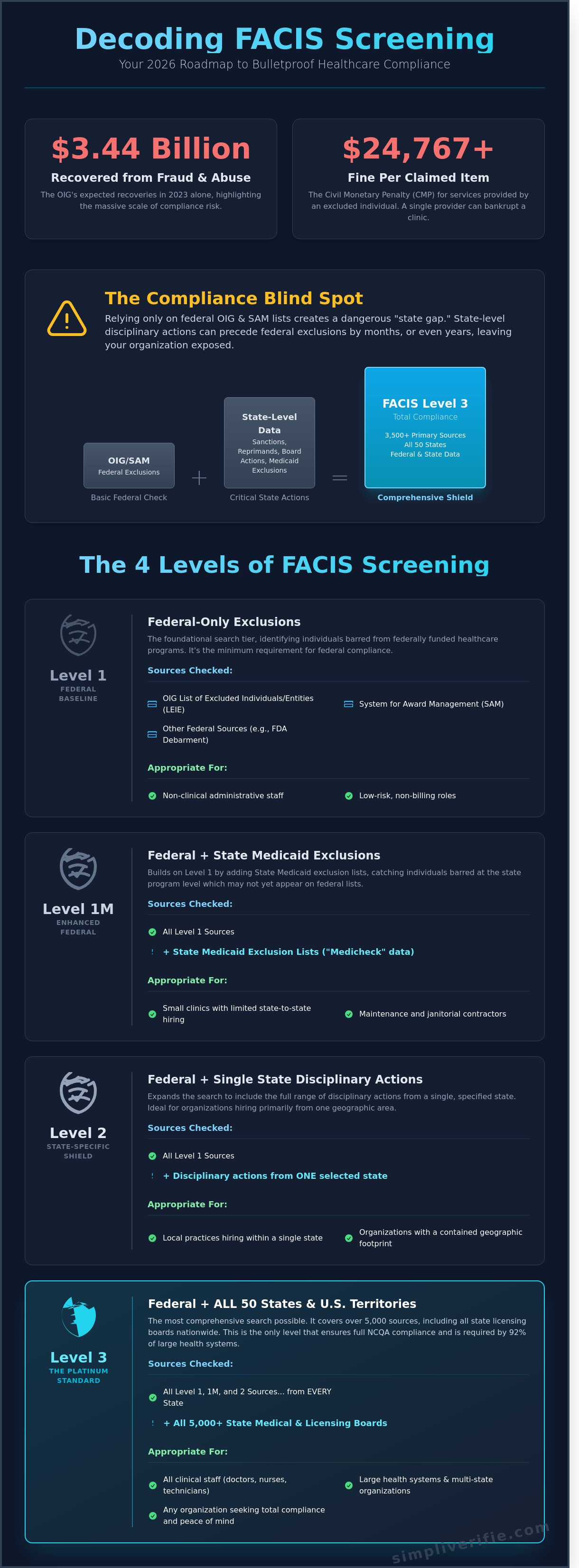
Did you know the Office of Inspector General (OIG) reported $3.44 billion in expected recoveries from healthcare fraud and abuse in 2023? For most healthcare administrators, the fear of Civil Monetary Penalties (CMPs) isn't just a theoretical concern; it's a constant pressure. You likely feel the weight of managing name matches across 3,500 primary sources while trying to distinguish between shifting state and federal exclusion lists. It's a high-stakes environment where a single oversight in your FACIS screening process can lead to devastating financial and reputational damage.
We believe compliance shouldn't be a source of stress or a bureaucratic bottleneck. This guide provides a clear roadmap to protect your organization and achieve total peace of mind. You'll learn the critical differences between levels, how to satisfy OIG requirements, and how to accelerate your medical staff onboarding by 40% using modern verification tools. We're breaking down everything from the Level 1m basics to the comprehensive Level 3 search to ensure your compliance strategy is bulletproof for 2026.
Key Takeaways
- Understand why FACIS is the gold standard for healthcare compliance and how it secures your organization’s Medicare and Medicaid eligibility.
- Identify the technical differences between the four tiers of FACIS screening to determine the appropriate level of protection for every role in your facility.
- Learn why relying on federal OIG and SAM lists alone creates a "state gap" that could leave your organization vulnerable to significant fines.
- Discover how to integrate comprehensive data checks into your existing hiring workflow to achieve professional-grade compliance with maximum speed.
- Gain complete peace of mind by leveraging modern automation to transform a complex regulatory process into a simple, proactive asset for your team.
What is FACIS Screening and Why is it the Healthcare Gold Standard?
FACIS screening is the most comprehensive tool for identifying high-risk healthcare providers. It stands for the Fraud and Abuse Control Information System. Since 1992, this database has acted as the primary defense against Medicare and Medicaid fraud. While many HR departments rely on basic searches through the Office of Inspector General (OIG) or the System for Award Management (SAM), these federal checks are no longer sufficient. Federal lists often lag behind state-level disciplinary actions by months or even years. This gap creates a window of risk that only a deeper search can close.
Verisys curates this data from over 3,500 primary sources. This includes state medical boards, pharmacy boards, and licensing entities across all 50 states. By aggregating these disparate records into a single profile, FACIS screening provides a level of depth that simple federal checks cannot match. It's a proactive way to ensure your facility maintains compliance and protects its patients from providers with checkered professional histories.
Sanctions vs. Exclusions: Understanding the Difference
An exclusion is the most severe penalty. It means an individual is legally barred from participating in any federal healthcare program. If they work for you, you can't bill Medicare for their services. A sanction is different. It involves disciplinary actions like fines or license probations that might not lead to a full exclusion. FACIS captures both. This gives you a 360-degree risk profile. You won't just see who is banned. You'll see who has a history of professional misconduct before it becomes a federal problem.
The Cost of Non-Compliance: Civil Monetary Penalties (CMPs)
The financial risks of hiring an excluded provider are massive. In 2026, Civil Monetary Penalties (CMPs) have reached new heights. The OIG now imposes fines exceeding $24,767 for every single item or service claimed by an excluded individual. If an excluded nurse treats 20 patients a day, those fines can bankrupt a small clinic in weeks. Beyond the money, hiring an excluded provider jeopardizes your entire facility's reimbursement eligibility. It's a threat to your reputation and patient safety. Utilizing a deep screening process provides the peace of mind you need to focus on care.
The 4 Levels of FACIS Screening: Which One Do You Need?
FACIS screening isn't a single check; it's a tiered system designed to match different risk profiles within a healthcare organization. Choosing the right level ensures you don't overspend on low-risk administrative roles while maintaining total protection for clinical staff. This structure allows HR teams to build a screening protocol that's both cost-effective and compliant with 2026 standards.
FACIS Level 1 and 1M: The Federal Baseline
Level 1 is the foundational tier. It focuses exclusively on federal data sources to identify individuals who are prohibited from participating in federally funded healthcare programs. This search includes the List of Excluded Individuals/Entities (LEIE), the General Services Administration (GSA), and the FDA debarment list. It's a vital tool for identifying major fraud or patient abuse at the national level.
Level 1M (Modified) adds a layer of safety by including state Medicaid exclusions and "Medicheck" data. These levels are generally appropriate for:
- Non-clinical administrative staff
- Maintenance and janitorial contractors
- Employees in low-risk, non-billing roles
- Smaller clinics with limited state-to-state hiring
FACIS Level 2 and Level 3: The Comprehensive Shield
Level 2 expands the search to include federal sources plus specific state-level disciplinary actions for a single state. It's a practical choice for local practices that hire within a specific geographic area. However, it lacks the reach needed for providers who may have practiced in multiple jurisdictions throughout their careers.
Level 3 is the "Platinum Standard" for healthcare compliance. It covers all 50 states and monitors more than 5,000 sources, including state medical boards and thousands of licensing agencies. Since 92% of large health systems now require this level, it's the only way to ensure full NCQA compliance in 2026. It catches letters of reprimand and board actions that don't always trigger a federal exclusion but still pose a significant risk to patient safety. If you're managing a multi-state workforce, you can consult our compliance experts to automate this high-level monitoring and eliminate manual tracking errors. Level 3 removes the guesswork, providing the serenity that comes from total data transparency.
FACIS vs. OIG/SAM: Why Federal Checks Aren't Enough
Relying solely on federal databases creates a dangerous blind spot for healthcare administrators. A standard national background check often skips the granular state-level data required for true compliance. This is where FACIS screening becomes essential. While federal lists catch major offenders, they often suffer from a "State Gap" where local sanctions take months to surface at the national level. If a nurse is sanctioned by a board in Oregon, it doesn't automatically appear on a federal list the next morning.
Data latency is a significant risk. On average, it can take 173 days for a state-level disciplinary action to reach the OIG's federal exclusion list. If your facility only checks federal sources, you could employ a sanctioned provider for nearly six months before the red flag appears. FACIS closes this window by monitoring over 5,000 primary sources. This includes searching board meeting minutes, which often reveal disciplinary intent or pending actions months before a final order is officially published in a database.
The Limitations of the OIG LEIE List
The OIG LEIE is a powerful tool, but it's limited to exclusions from federal programs like Medicare. It doesn't capture every state-level Medicaid sanction or private board reprimand. Organizations that invest in OIG compliance training understand that federal lists are just the baseline. You must also account for reciprocal exclusions. Under the Affordable Care Act, if a provider is excluded in one state, they're technically ineligible to practice in all states. Federal lists often miss these cross-state connections until it's too late.
SAM.gov and the Data Integrity Challenge
SAM.gov tracks debarments for federal contracts, yet its data is notoriously fragmented. Matching a candidate to a SAM record is difficult because the system often lacks specific identifiers like Social Security numbers or birth dates. This leads to false positives that stall your hiring process and frustrate candidates. FACIS screening solves this by using proprietary matching technology. It filters through millions of records to ensure you only flag real threats, providing the tranquility of mind that your data is both accurate and actionable.
It's a common mistake to assume a "National" criminal check includes this data. Most don't. Traditional background checks focus on court records, not administrative sanctions from licensing boards. By the time a provider's actions reach a criminal court, your facility has likely already been exposed to years of liability and potential fines. Professional screening ensures you see the full picture, from state board minutes to federal debarments, in one streamlined report.
Implementing FACIS Screening into Your Hiring Workflow
Operationalizing your compliance strategy requires a structured approach. You don't want to scramble when an audit occurs. A streamlined FACIS screening process ensures your team stays focused on patient care rather than paperwork. Modern healthcare systems that automate this workflow see a 30% reduction in time-to-hire for specialized roles.
- Step 1: Role Mapping. Assign screening levels based on risk. Clinical staff interacting with patients require Level 3 searches. Administrative roles might only need Level 1 or 1m depending on their access to federal funds.
- Step 2: ATS Integration. Connect your screening platform to your Applicant Tracking System. This automation typically reduces data entry errors by 35% and accelerates the background check phase.
- Step 3: Monthly Cadence. Schedule recurring checks. The OIG updates its List of Excluded Individuals/Entities (LEIE) every month. Your workflow must mirror this frequency to avoid billing for services rendered by excluded parties.
- Step 4: Adverse Action Protocol. Standardize your response to "hits." Ensure your legal team approves a two-step notification process to remain compliant with federal regulations.
The Importance of Continuous Monitoring
A "one-and-done" check at the point of hire creates a dangerous compliance gap. If an employee receives a sanction in their second month, an annual re-check leaves you exposed for 10 months. Monthly monitoring protects your organization from civil monetary penalties, which exceeded $100,000 per violation in 2024. Automation handles the heavy lifting; it sends alerts only when a change in status occurs. This proactive stance provides total tranquillité d'esprit for your HR department.
Handling a 'Hit': Verified Results vs. False Positives
Not every alert is a disqualifier. Name-matching logic often flags common names, so you must verify results using Social Security Numbers, Dates of Birth, or National Provider Identifiers (NPI). If you confirm a match on an exclusion list, you must follow the FCRA process. Provide the candidate with a pre-adverse action notice and a copy of their report. Give them at least five business days to dispute the findings before making a final decision. You can automate your compliance workflow to manage these sensitive steps without friction.
How SimpliVerified Simplifies Healthcare Compliance
SimpliVerified bridges the gap between complex federal requirements and operational efficiency. Our 2026 platform provides professional-grade data through a clean, intuitive interface that removes the typical administrative burden. We don't believe you should have to choose between deep compliance and a fast hiring process. Our approach focuses on removing friction, allowing your HR team to focus on people rather than paperwork.
Our 2026 tech stack integrates directly with your existing Applicant Tracking System (ATS) or hiring platform. This automation triggers a FACIS screening the moment a candidate moves to the offer stage. While the technology handles the data retrieval, our Draper-based experts review every flagged result. This human intervention ensures you don't lose qualified candidates to "false positives" often found in automated-only systems. Our team in Draper, Utah, acts as an extension of your compliance department, verifying that every hit is accurate and relevant to the specific role.
We provide customizable screening packages so you get exactly the level of protection you need. Many healthcare providers overpay for Level 3 searches when a Level 1m would suffice for certain support roles. By tailoring your package, you can reduce your screening costs by up to 20% while maintaining 100% compliance with your specific regulatory tier.
Fast, Reliable Results for Urgent Hires
Healthcare facilities often face critical staffing shortages where every day a position remains vacant impacts patient care. Waiting weeks for a background check isn't an option. We deliver most results within 24 to 48 hours. This speed helps you reduce friction in the medical credentialing process, allowing new hires to start their rounds sooner. We offer transparent, tiered pricing for organizations of all sizes. You'll always know your costs upfront, with no hidden "access fees" for state or federal databases.
Your Partner in Healthcare Integrity
Compliance isn't a one-time event; it's a continuous commitment. We help you stay audit-ready 365 days a year by offering a full suite of services that go beyond the standard FACIS screening. Our platform manages the entire lifecycle of healthcare integrity, including:
- 10-panel and 12-panel drug testing with rapid result reporting
- Professional license verifications using primary source data from state boards
- Ongoing monthly monitoring for OIG, SAM, and state-level exclusions
- Employment and education verifications to ensure clinical competency
Our goal is to provide total tranquility of mind. By centralizing these tasks, you create a permanent, digital paper trail for state and federal regulators. When an auditor walks through your door, you'll have every document ready in a single click. Secure your facility with SimpliVerified's FACIS screening today and experience a more streamlined, human-centered way to hire.
Future-Proof Your Healthcare Compliance Strategy
Healthcare compliance in 2026 requires more than basic federal checks. Relying only on OIG or SAM databases leaves your organization exposed to state-level sanctions that federal lists often overlook. A comprehensive FACIS screening protocol bridges these gaps by monitoring thousands of data sources across all 50 states. This level of diligence protects your patients and secures your facility's standing with regulators. You can't afford to leave these blind spots unaddressed in a high-stakes hiring environment.
SimpliVerified makes this complex process effortless. Our Utah-based experts guide you through every regulatory shift while our platform integrates directly into your enterprise HR software. You'll gain access to a network of over 15,000 collection sites nationwide; this ensures your screening process remains fast and accessible for every candidate. We've designed our system to eliminate friction so you can focus on providing care without worrying about hidden compliance risks.
Don't let outdated screening methods compromise your team's integrity. It's time to adopt a strategy that prioritizes both safety and speed. We're here to help you build a more secure future for your organization today.
Get a Quote for Compliant Healthcare Screening
Frequently Asked Questions
Is FACIS screening required by law for all healthcare providers?
Yes, any healthcare organization receiving federal funding through Medicare or Medicaid must conduct these checks. The OIG Special Advisory Bulletin of 2013 mandates that providers screen employees to avoid civil monetary penalties. Failure to comply can result in fines exceeding $11,000 for every single item or service claimed while an excluded person was employed.
How often should I run a FACIS search on my current employees?
You should run a search every 30 days to maintain full compliance. The Office of Inspector General explicitly recommends monthly screenings because exclusion lists update constantly throughout the year. Monthly monitoring ensures you don't miss a mid-year debarment that could jeopardize your 2026 reimbursement eligibility or lead to costly legal audits.
What information do I need to conduct an accurate FACIS screening?
You need the candidate's full legal name, date of birth, and Social Security Number to ensure a precise match. For licensed practitioners, you should also include their National Provider Identifier (NPI) to eliminate false positives. Using these three specific data points reduces the risk of identity confusion by 99% compared to searches using only names.
Can a provider be excluded in one state but not another?
Yes, a provider can be barred in one jurisdiction while their license remains active elsewhere. There are currently 42 different state Medicaid exclusion lists that operate independently of federal databases. A comprehensive FACIS screening is essential because it aggregates these disparate state records into a single report, ensuring you don't hire someone sanctioned in a different state.
What is the difference between FACIS Level 1 and Level 3?
FACIS Level 1 meets the basic federal requirements by searching OIG, SAM, and federal funding databases. Level 3 is the industry gold standard, searching over 5,000 sources including all 50 state Medicaid lists and various health board disciplinary actions. Choosing Level 3 provides the peace of mind that you've covered 100% of available disciplinary records across the country.
How long does a FACIS screening result typically take?
Most results are delivered within 24 to 48 hours through modern automated platforms. While preliminary data often appears instantly, manual verification of potential matches ensures your reports are 100% accurate before you make a hiring decision. This rapid turnaround allows your HR team to maintain a fluid, high-speed recruitment process without sacrificing regulatory rigor.
What happens if I hire someone who is on a FACIS exclusion list?
Hiring an excluded individual triggers immediate financial liability and the potential loss of your federal billing privileges. The OIG imposes Civil Monetary Penalties that often range from $10,000 to $22,000 for each service provided by that employee. You'll also be forced to repay all federal reimbursements associated with the excluded person's work during their entire tenure.
Does FACIS screening include international data?
Yes, higher-tier searches include global sanction lists from organizations like OFAC and Interpol. While the primary focus remains on US healthcare compliance, Level 3 monitoring tracks international watchlists to ensure your staff meets 2026 security and integrity standards. This comprehensive approach eliminates blind spots when hiring talent from the global healthcare market.