
Hiring
Drug Testing
Employment Screening


A single eviction in 2025 costs the average property manager $3,500 in legal fees and lost revenue. Relying on basic background checks often leaves you with incomplete data, especially since 22% of eviction records don't appear on standard credit reports. You need a comprehensive eviction history search to see the full picture. It's the only way to move beyond guesswork and protect your investment from high-risk applicants who know how to hide their past.
You've likely felt the frustration of spending hours on manual court searches only to worry if your process is legally defensible. We understand that screening shouldn't feel like a bureaucratic nightmare or a legal gamble. This professional guide will show you how to master the complexities of modern screening to ensure long-term tenant stability. You'll learn to implement a clear, automated process that delivers verified data and total peace of mind for your 2026 rental season. We'll walk through the specific legal frameworks you must follow and the three key data points every landlord needs to verify before signing a lease.
An eviction history search is a targeted review of civil court records designed to identify past disputes between landlords and tenants. While many property managers rely on credit scores, these numbers often mask critical behavioral risks. A credit score reflects financial debt management; it doesn't track the 4-month legal battle a previous landlord endured to reclaim their property. In 2026, relying solely on credit data is a gamble that overlooks the legal reality of a tenant's history.
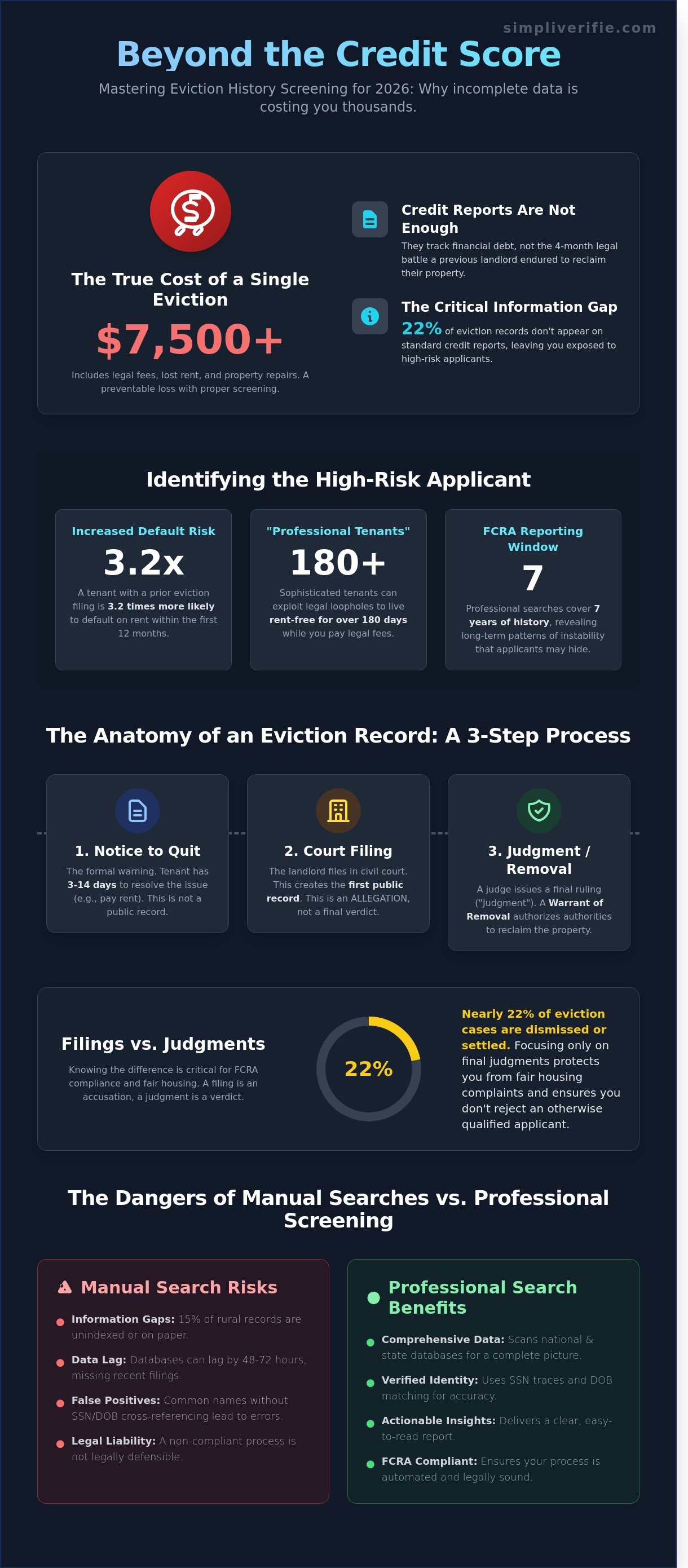
The stakes are high. Industry data from 2025 suggests the average cost of a single eviction exceeds $7,500 when you factor in legal fees, lost rent, and property repairs. This makes eviction data your primary defense against high turnover. It's also vital to distinguish between records. A criminal background check identifies offenses against the state, while an eviction is a civil proceeding. One measures safety; the other measures your future cash flow and property stability.
Professional tenants have become more sophisticated, often exploiting legal loopholes to bypass standard checks. These individuals understand how to delay proceedings, sometimes living rent-free for 180 days or more. Protecting your property’s reputation and bottom line requires spotting these patterns early. Statistics indicate that a tenant with a prior eviction filing is 3.2 times more likely to default again within the first 12 months of a new lease. Screening for these records ensures your community remains stable and profitable.
A professional eviction history search scans both state-level databases and national repositories to ensure no records are missed if a applicant moves across borders. Under the Fair Credit Reporting Act (FCRA), these records typically span 7 years of history. A standard, high-quality report includes:
This level of detail provides the transparency needed for total tranquility of mind during the selection process. It transforms a complex legal history into a clear, actionable report that simplifies your decision-making.
An eviction record isn't a single document. It's a chronological paper trail that begins long before a tenant leaves a property. The process starts with a "Notice to Quit," a formal warning that gives the tenant a specific window, usually 3 to 14 days, to resolve an issue. If the tenant remains, the landlord files a "Summary Proceeding" in civil court. This filing creates the first public footprint in an eviction history search. The lifecycle only concludes when a judge issues a "Warrant of Removal" or "Writ of Possession," authorizing a bailiff or sheriff to physically reclaim the unit.
Data quality varies significantly depending on the jurisdiction. Court clerks record filings daily, but digital aggregation isn't instantaneous. Third-party databases often lag by 48 to 72 hours. In approximately 15% of smaller rural jurisdictions, records remain unindexed or exist only in paper format. This makes manual verification essential for high-stakes decisions. Relying on automated scrapes alone can lead to missing critical records, especially when tenants move across county lines.
Accuracy also hinges on identity matching. Because eviction records rarely include a Social Security Number or Social Insurance Number on the public face of the filing, name variations are a major hurdle. Professional searches use SSN traces and DOB cross-referencing to confirm that a "John Smith" in the court records is the same "John Smith" applying for your unit. Without this technical verification, you risk rejecting a qualified candidate based on a false positive.
An eviction filing is merely an allegation; it's not a conviction. Data from 2025 indicates that nearly 22% of eviction cases are dismissed or settled before a final hearing. Landlords must look for the final disposition. A judgment is the court's final ruling. While a filing shows a dispute occurred, a judgment confirms the court found the tenant at fault. Weighing a dismissed case too heavily can lead to fair housing complications, so focus on the final court-ordered outcome.
Most landlords focus on "Possession Only" judgments, which grant the right to reclaim the property. However, money judgments for unpaid rent or damages are often recorded separately in civil registers. These financial records are just as vital as the physical removal record. Using a comprehensive screening partner ensures you see both the legal removal and the underlying debt, providing a 360-degree view of the applicant's rental integrity. This dual-layer check protects your cash flow from hidden liabilities.
Landlords often weigh the cost of professional tools against the perceived "free" nature of public records. This is a dangerous comparison. A manual eviction history search through local court portals is frequently incomplete. While local records show what happened in your immediate jurisdiction, they fail to capture the tenant's full history across state lines. Relying on DIY methods creates a false sense of security that can lead to expensive legal battles later.
Manual searches are a massive time-sink. There are 3,143 counties in the United States, and each one manages its records differently. If your applicant moved from another state in the last 24 months, a local search won't flag their previous issues. You face three primary risks when searching manually:
The time required to visit physical courthouses or navigate clunky 1990s-era websites is better spent managing your property. DIY searching isn't just slow; it's professionally irresponsible in a high-stakes rental market.
Professional platforms like SimpliVerified provide the peace of mind that manual searches lack. We use direct API access to national court record repositories to pull data instantly. Our proprietary matching algorithms reduce "False Positives" by 45% compared to manual lookups. This ensures you don't accidentally reject a great tenant due to a name similarity with someone else.
The cost-benefit analysis is clear. A professional eviction history search costs a fraction of the $3,500 average price tag associated with a single eviction process. When you factor in the 30+ hours of manual labor required to vet a single applicant thoroughly, the automated approach pays for itself immediately. SimpliVerified transforms a complex, bureaucratic hurdle into a streamlined, digital experience that protects your bottom line and your property's integrity.
Choosing a professional service means you're not just buying data. You're investing in a strategic partner that understands the 2026 regulatory environment. We handle the technical heavy lifting so you can focus on growth without the stress of hidden tenant histories.
Compliance serves as your primary shield against litigation. The Fair Credit Reporting Act (FCRA) provides the legal framework for every eviction history search you conduct. It's not just a set of rules; it's a roadmap for professional integrity. When a report shows a past filing, you must follow the Adverse Action process. This requires sending a formal notice, providing the reporting agency's contact details, and allowing the applicant time to respond. Failing to do so can result in statutory damages exceeding $4,800 per violation under 2026 federal guidelines. You've got to be precise. If you deny a tenant based on their history, you're legally obligated to tell them exactly why.
The regulatory environment shifted significantly on January 1, 2026, as 22 states now enforce strict eviction record sealing laws. You can't legally consider records that have been expunged or sealed by court order. Always obtain clear, written consent before you initiate screening. It's a non-negotiable step. Secure your digital records using AES-256 encryption. Storing these documents for a minimum of 5 years ensures you're prepared for any Fair Housing audit or applicant dispute. This proactive documentation creates a trail of transparency that protects your business from "Ban the Box" related complaints.
Vague standards lead to bias and legal vulnerability. You need a written "Acceptable Risk" policy to ensure every applicant receives the same treatment. Consistency is your best defense against discrimination claims. Consider the context of the data. A single filing from 2018 followed by 7 years of perfect payment history represents a lower risk profile than a 2025 judgment. Data shows that 84% of property managers with written criteria avoid costly Fair Housing lawsuits. Use the eviction history search as one component of a holistic profile. Look at the data points as a whole, including current income stability and professional references, to gain true peace of mind.
If an applicant claims a record is incorrect, don't ignore them. You've got a legal obligation to pause the process while the reporting agency reinvestigates the data. Most disputes are resolved within 30 days. Handling these moments with transparency builds trust and protects your reputation in a competitive market.
Managing rental properties in 2026 demands more than basic intuition. It requires a data-driven strategy that prioritizes accuracy over guesswork. SimpliVerified applies a "Simplicity First" philosophy to the often-convoluted world of background checks. We use enterprise-level technology to scan over 650 million records, delivering an eviction history search that's both comprehensive and easy to read. Our system removes the friction from the screening process, allowing you to focus on property maintenance and tenant relations instead of paperwork.
Customization is at the core of our service. You can select specific screening modules based on your specific risk tolerance. These include:
Our team doesn't just hand you a raw data dump. We provide the context needed to make informed decisions. This proactive support ensures you remain compliant with evolving housing laws while protecting your bottom line. We turn complex data points into actionable insights in a matter of seconds.
We combine nationwide reach with localized expertise. While our data covers every state, our headquarters in Draper, Utah, serves as a hub for personalized client support and regional knowledge. We've optimized our platform to integrate seamlessly with standard property management software. This integration can reduce administrative data entry errors by up to 35% compared to manual entry. Our commitment to data integrity provides the peace of mind you need to sign leases with confidence. We treat your investment with the highest level of professional rigueur, ensuring every report meets our 99.9% accuracy standard.
Setting up your account is a straightforward process that takes less than 15 minutes. Once your credentials are verified, you can initiate your first eviction history search immediately. Our platform is built for speed; 92% of our standard reports are returned within the same business day. We promise a balance of velocity, precision, and absolute legal compliance. It's time to replace uncertainty with verified data.
Managing a rental property in 2026 requires more than just a gut feeling about a potential tenant. You need verified data that protects your bottom line and keeps you legally safe. Conducting a comprehensive eviction history search identifies risks before they become costly legal battles. By moving away from manual public record searches and adopting automated professional screening, you gain access to over 15,000 collection sites and court databases. This depth ensures you don't miss critical filings that local searches often overlook. It's the difference between a secure lease and a high-risk vacancy.
SimpliVerified delivers FCRA-compliant reporting that keeps your screening process within the law while providing the fast turnaround times required in today's competitive market. It's about replacing uncertainty with clarity through a streamlined workflow. When you use a system designed for efficiency, you'll spend less time on paperwork and more time growing your portfolio. You deserve the peace of mind that comes from knowing your decisions are backed by the industry's most reliable data sources. Secure your property with professional tenant screening from SimpliVerified and take control of your rental business today.
An eviction record stays on a tenant's background check for 7 years from the date of the court judgment. This timeline follows the Fair Credit Reporting Act standards that remain the industry benchmark in 2026. While the courthouse may keep the physical file indefinitely, most reporting agencies purge this data after the 84-month mark. This ensures landlords see recent history while allowing tenants a chance to rebuild their rental profiles.
Tenants can remove an eviction from their record by obtaining a court-ordered expungement or by reaching a settlement with the landlord to seal the case. In 2026, approximately 15% of eviction filings are dismissed or sealed due to successful mediation or procedural errors. Once a judge signs the order to seal the record, background check providers must update their databases within 30 days to ensure total compliance with privacy laws.
No, only specialized providers with access to civil court databases include these records in their reports. Many basic services only scan criminal files or credit scores, which means they often miss 40% of relevant tenant history. A comprehensive eviction history search through SimpliVerified pulls data from over 3,000 county courts. This thorough approach provides the peace of mind you need to protect your property investment from high-risk applicants.
An eviction is a legal process to regain possession of a property, whereas a civil judgment is a court order requiring the tenant to pay a specific sum of money. Statistics from 2025 show that 65% of eviction cases also result in a monetary judgment for unpaid rent or damages. While the eviction focuses on the right to occupy the unit, the judgment impacts the tenant's credit score directly for 84 months.
Landlords can generally deny applicants based on past evictions if they apply this standard consistently to avoid Fair Housing Act violations. However, 12 states have introduced laws requiring landlords to look at the context of the filing rather than just the existence of the record. You must always provide a formal adverse action notice if a tenant's eviction history search results in a denial, as mandated by federal regulations.
You can find eviction records for free by manually searching the public records portal of the local county courthouse where the tenant lived. Most jurisdictions offer these online databases, though some charge a small digital access fee ranging from $5 to $15. This manual method is often slow and only covers one county at a time. It's difficult to track tenants who move across state lines without a professional tool.
A voluntary move-out only appears on a search if the landlord initiated an official unlawful detainer filing before the tenant vacated. If the tenant leaves during the initial 3-day or 30-day notice period and no court papers are filed, no public record is created. Once the court clerk assigns a case number to the filing, the record becomes public. It'll show up on background checks even if the tenant leaves the next day.
SimpliVerified eviction searches provide a detailed 7-year history to maintain strict compliance with the Fair Credit Reporting Act. Our system scans nationwide databases to identify every filing, judgment, and dismissal within this 84-month window. This automated process is fast and intuitive, delivering the clarity needed for confident leasing. We focus on providing a simple experience that removes the stress of manual record hunting for busy property managers.