Hiring
Drug Testing
Employment Screening


A single expired credential in your healthcare or construction department isn't just a minor oversight. It's a significant legal liability that can dismantle your organization's reputation in an instant. You've likely felt the frustration of manual lookups where hours disappear into the Utah Division of Professional Licensing (DOPL) database. This process becomes even more stressful when you're managing large hiring batches and fear missing a hidden disciplinary action. Mastering professional license verification Utah standards is the only way to eliminate these blind spots and protect your team from negligent hiring claims.
We understand that keeping track of shifting fee schedules and varied renewal cycles feels like a full-time job. You want certainty that every hire is legally cleared to practice without the friction of a bureaucratic workflow. This guide provides a clear roadmap to navigate the 2026 regulatory environment with confidence. You'll learn how to distinguish between DOPL and independent board requirements, understand the latest fee structures for practitioners, and discover how SimpliVerified can transform a complex chore into a seamless, automated asset for your compliance strategy.
Professional licensing serves as a vital safeguard for the public and the business community alike. In Utah, this system ensures that individuals in specialized roles possess the necessary education, experience, and ethical standing to perform their duties safely. When you prioritize professional license verification Utah protocols, you aren't just checking a box. You're actively protecting your clients, your employees, and your company's future. Licensing ensures safety. Without it, trust erodes.
The Utah Department of Commerce oversees the state's economic activities, but the Division of Professional Licensing (DOPL) manages the specific credentials of over 60 different professions. Understanding professional licensure in the United States helps put Utah's rigorous standards into context. As we move through 2026, Utah has continued to refine its oversight to match the rapid growth in the tech and healthcare sectors. High-risk roles in nursing, pharmacy, and professional engineering require constant vigilance because the margin for error is non-existent. Regulatory requirements have become more stringent to address digital fraud and cross-state practice challenges.
Failing to verify a license can lead to devastating financial and legal outcomes. State boards can issue heavy fines or even revoke a company's right to operate if they discover uncertified staff in regulated positions. Beyond the balance sheet, credential fraud destroys the trust you've built with the community. Robust professional license verification Utah strategies help mitigate these risks before they escalate. Negligent hiring in Utah occurs when an employer fails to exercise reasonable care in the hiring process, resulting in the employment of an individual who causes foreseeable harm to others. This legal doctrine makes it clear that the responsibility for vetting lies squarely with the organization.
Industries like healthcare, construction, and behavioral health face the highest levels of scrutiny. A single unlicensed contractor or nurse can trigger a chain reaction of litigation and regulatory audits. This is why many Draper-based and national organizations choose to partner with SimpliVerified. We provide the expert oversight needed to manage these risks across various industries, ensuring your team is fully cleared to practice before they ever step foot on the job site. Reliability and speed are central to our approach. This allows you to hire with complete confidence and focus on your organization's growth.
The Utah Division of Professional Licensing (DOPL) acts as the central nervous system for credentialing within the Beehive State. It manages over 60 categories of professionals, ensuring that practitioners meet strict competency standards. While many employers focus on nursing, contracting, and social work, the scope of DOPL is vast. However, it's a common mistake to assume every regulated role falls under this single umbrella. For instance, Utah educators are licensed through the State Board of Education, and legal professionals answer to the Utah State Bar. Knowing where to look is the first step in a reliable professional license verification Utah process.
DOPL's reach extends across three primary sectors: Healthcare, Skilled Trades, and Professional Services. In the trades, licensing isn't a one size fits all designation. You'll encounter levels such as apprentice, journeyman, and master. Each tier represents a different level of supervised experience and testing. For healthcare practitioners, the verification process often includes an additional layer: the Controlled Substance license. This is a separate state-level requirement for any professional authorized to prescribe or handle regulated medications. If your candidate has a national board certification, remember that this doesn't replace the mandatory state license required to practice legally in Utah.
When you access the Utah Licensee Lookup & Verification (LLV) system, the data can be nuanced. A status of "Active" is the goal, but "Active-Probation" tells a much more complex story. This status indicates the professional can work, but only under specific state-mandated restrictions. Other terms you'll encounter include:
A "Current" status doesn't always mean a candidate is in good standing. You must look for "Public Records" or "Disciplinary Actions" links within the record. These documents reveal the history of any administrative or criminal issues that could impact workplace safety. If navigating these nuances feels overwhelming, you can partner with SimpliVerified to handle the heavy lifting. We ensure that every detail, from probation status to expiration dates, is captured accurately. This level of precision transforms professional license verification Utah from a manual chore into a strategic advantage for your HR team.
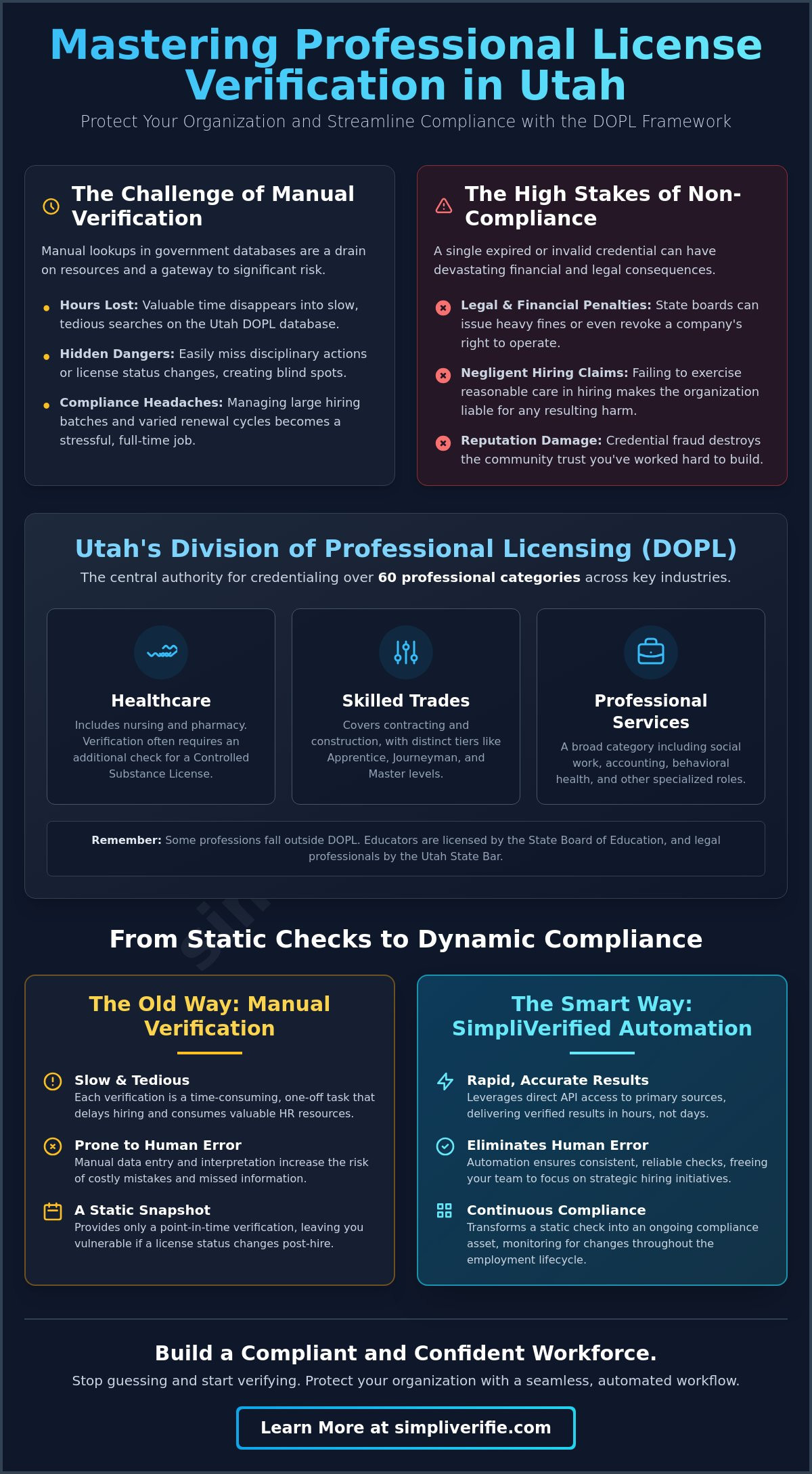
It's tempting to rely on free tools as a budget-saving measure. However, the hidden costs of manual professional license verification Utah tasks often outweigh the initial savings. When your HR team spends hours typing names and downloading individual records, they aren't just losing time. They're increasing the risk of data entry errors. A single typo or a missed middle initial can lead to an incorrect "clear" result. This leaves your organization vulnerable to regulatory action. Free databases serve a purpose, but they don't offer the proactive protection required for a modern workforce.
The "same name" challenge is a frequent hurdle in Utah's professional community. Distinguishing between two practitioners with identical names requires more than a quick search. Without cross-referencing birth dates or other identifiers, your team might inadvertently clear the wrong individual. Professional screening services eliminate this ambiguity by using multi-factor identity matching. This ensures the license you're verifying actually belongs to the person you're hiring. It's about precision, not just speed.
While Utah's official license verification portal is an excellent starting point, it's essentially a snapshot in time. It shows the status of a license at the exact second you hit "search." If a practitioner's license is suspended the following day, you won't know until your next manual audit. This data latency creates a dangerous compliance gap. The system also doesn't provide automated alerts. If a nurse's status changes in the middle of a shift, your compliance officer remains in the dark. For firms hiring remote workers, the LLV provides no visibility into out-of-state credentials.
Primary Source Verification (PSV) is the recognized gold standard for high-stakes hiring. It involves obtaining data directly from the issuing authority rather than relying on secondary documents or candidate-provided copies. Professional services like SimpliVerified go beyond a simple status check. We cross-reference DOPL data with federal databases like the OIG and SAM exclusion lists. This integrated approach is essential for any of the regulated industries we serve. It ensures that your screening process remains fully compliant with the Fair Credit Reporting Act (FCRA). This protects both the candidate's rights and your corporate interests simultaneously.
Establishing a repeatable strategy is the difference between a reactive HR department and a proactive one. While government databases provide raw data, they don't offer a roadmap for compliance. A successful professional license verification Utah workflow ensures that no candidate slips through the cracks due to administrative gaps. By standardizing your approach, you create a culture of safety and reliability that protects your organization's reputation. It's about moving from a state of doubt to a state of certainty with every hire you make.
A comprehensive workflow should follow these five essential steps:
Deciding when to verify is a strategic choice. While some firms wait until a post-offer background check, high-risk industries often benefit from pre-offer screening to save time. If you encounter a candidate with an "Active-Probation" status, your HR policy should clearly define the acceptable levels of risk. Standardizing these decisions in your employee handbook ensures that every candidate is treated fairly and consistently. It removes the guesswork from complex hiring scenarios.
Utah law requires you to prove that you've exercised due diligence. Your files must contain the specific data points from the time of hire, including the license's expiration date and any public records associated with the practitioner. SimpliVerified simplifies this by providing digitized, searchable reports that are ready for immediate review during a state audit. We help you maintain these records for the required retention periods, ensuring you're always prepared. If you're ready to secure your hiring process with a dependable partner, get started with SimpliVerified today to automate your credentialing workflow.
Managing the fine details of compliance shouldn't slow down your hiring momentum. SimpliVerified removes the friction from professional license verification Utah by replacing manual lookups with advanced technology. We utilize direct API access to the Utah DOPL database and national primary sources to ensure accuracy. This technology allows us to reduce turnaround times from several days to just a few hours. For critical healthcare hires or urgent construction projects, this speed is a competitive necessity. You get the data you need without the administrative wait.
We believe in providing a holistic view of every candidate. Our platform allows you to build customized screening packages that combine license checks with criminal background checks and drug testing. This integrated approach ensures that every facet of a candidate's history is vetted through a single, reliable partner. You won't have to juggle multiple vendors or login credentials. SimpliVerified acts as your dedicated support team, providing clear results that you can trust immediately.
Modern HR leaders require tools that fit into their existing workflows. SimpliVerified offers seamless integration with your current ATS or HRIS platform, allowing you to trigger verifications without leaving your primary workspace. Our single dashboard provides a bird's eye view of both local and national credentials. This is especially helpful for organizations managing a mix of Utah-based employees and remote staff. You can explore our SimpliVerified industry solutions to see how we tailor our technology to meet the specific demands of your sector.
A license that's valid on a Monday could be suspended by Friday. Relying on a one-time check at the point of hire creates a significant long-term risk for your organization. Our recurring monitoring service solves this problem by providing real-time alerts on license status changes or new disciplinary actions. This proactive surveillance protects your culture and your legal standing year-round. It's the ultimate "set it and forget it" solution for busy compliance officers. If you're ready to modernize your approach, schedule a consultation with SimpliVerified to automate your Utah license checks and hire with absolute serenity.
Maintaining a safe and legally sound workplace depends on your ability to verify credentials with total precision. You've seen how relying solely on manual lookups creates dangerous gaps in your defense. A truly effective professional license verification Utah strategy requires more than a one-time search; it demands continuous oversight and direct integration with primary sources. By moving away from static government databases and adopting automated monitoring, you eliminate the risk of hiring "blind spots" that lead to negligent hiring claims.
SimpliVerified provides the technology and expertise to handle this complexity for you. We offer fast turnaround times for Draper businesses and national firms, delivering comprehensive FCRA-compliant reporting through direct primary source integration with Utah DOPL. You don't have to navigate these regulatory shifts alone. When you partner with us, you gain a dedicated team focused on protecting your corporate reputation and culture. Automate Your Utah License Verifications with SimpliVerified today. We're here to help you hire with confidence and grow your organization with peace of mind.
You can verify a license by using the Utah Division of Professional Licensing (DOPL) online search tool or by partnering with a screening provider like SimpliVerified. To get started, you'll need the individual's full legal name or their specific license number. While the state portal provides basic status info, a professional service ensures you receive a comprehensive report that includes any hidden disciplinary actions or public records.
DOPL oversees more than 60 professional categories, including nurses, contractors, social workers, and architects. It's a common misconception that all licensed roles fall under this agency. For example, the Utah State Board of Education handles teacher licenses, and the Utah State Bar regulates attorneys. Always confirm the specific oversight board for your industry to ensure your professional license verification Utah process is accurate.
An "Active-Probation" status indicates the professional is legally allowed to work but must follow specific restrictions set by the state. These restrictions often involve extra supervision, limited job duties, or mandatory reporting requirements. You should always review the associated public documents to understand the nature of the probation. This helps you decide if the candidate’s current status aligns with your company’s safety and liability standards.
Standard criminal background checks don't typically include license verification unless you specifically request it as an add-on service. Many employers assume a "clean" background check means the candidate is cleared to practice, but these are two separate data points. SimpliVerified allows you to bundle these services into a single package. This ensures you're vetting both the person’s character and their legal right to perform their job.
You should re-verify licenses at least every two years to match the standard DOPL renewal cycle. Some professions, like educators, have longer five-year cycles, but waiting that long increases your risk. The most effective strategy is to implement continuous monitoring. This technology provides real-time alerts if a status changes, so you don't have to wait for a manual audit to discover a problem.
Yes, you can verify Utah credentials for remote staff using the same primary source protocols used for local hires. If the role requires the employee to perform services for Utah-based clients or patients, they must hold a valid state-issued license. SimpliVerified makes this easy by offering a centralized dashboard where you can manage professional license verification Utah tasks alongside out-of-state credentials for your entire remote workforce.
A license is a mandatory legal requirement issued by the state to practice a specific profession. In contrast, a certification is usually a voluntary credential issued by a national organization to recognize specialized expertise. While certifications look great on a resume, they don't grant the legal right to work in regulated fields. You must always prioritize verifying the state-issued license to maintain regulatory compliance.
The employee must stop all regulated work immediately to prevent your organization from facing heavy fines or lawsuits. Practicing on an expired license is a serious violation that can lead to a permanent revocation of the individual's credentials. It's vital to have a policy that suspends the staff member until they provide proof of renewal. Automated reminders from a screening partner can help you avoid these stressful situations entirely.