Hiring
Drug Testing
Employment Screening


A single oversight in your hiring process could cost your Utah healthcare facility $22,363 per claim in civil monetary penalties under current federal guidelines. It's a staggering figure that highlights why a robust OIG exclusion list check Utah is no longer optional for providers. You're likely already aware that maintaining Medicaid compliance is a top priority. The pressure to keep up with the Utah Office of Inspector General's rigorous standards often leads to administrative burnout. Between managing patient care and tracking complex regulations, finding the time for meticulous manual searches feels nearly impossible.
We'll help you turn this bureaucratic hurdle into a streamlined, automated process. This 2026 guide empowers you to master the essential steps for screening everyone from clinical leaders to administrative staff. You'll learn how to align your internal processes with the Utah Medicaid Section I Provider Manual while transitioning to efficient monthly monitoring. We'll show you how to build a system that delivers audit-ready documentation and total peace of mind. Our goal is to ensure your facility remains secure and compliant without the friction of traditional methods.
Protecting your healthcare facility starts with understanding the federal and state frameworks that govern hiring. The List of Excluded Individuals and Entities (LEIE) is the primary database maintained by the Office of Inspector General (OIG). It identifies parties barred from participating in federal healthcare programs due to past misconduct. In Salt Lake City and across the state, the Utah Office of Inspector General (UOIG) works alongside federal agencies to monitor Medicaid compliance. Utah Medicaid providers have a strict legal mandate. They can't use federal or state funds to pay for any items or services provided by an excluded individual.
Federal OIG exclusions differ from Utah-specific Medicaid sanctions. While the federal LEIE has national reach, the Utah Department of Health and Human Services (DHHS) maintains its own state-level oversight. A provider might be cleared at the federal level but still face state-specific restrictions. Performing a thorough OIG exclusion list check Utah ensures you capture both layers of risk. Failing to do so can lead to mandatory repayment of Medicaid funds and fines exceeding $22,000 per claim as of 2024. It's a simple step that preserves your facility's integrity and financial health.
Compliance extends far beyond the clinical team. While doctors and nurses are obvious candidates, Utah Administrative Rule R414-1-31 mandates broader oversight. You must screen every employee, contractor, and volunteer who contributes to Medicaid-funded services. This includes IT staff managing patient records, billing specialists processing claims, and HR personnel. If their work is even partially funded by Medicaid, they require a monthly check to stay compliant with state standards.
The OIG categorizes exclusions into mandatory and permissive groups. Mandatory exclusions occur when an individual is convicted of Medicare or Medicaid fraud, which accounted for approximately 42% of all exclusions in recent federal reporting periods. Convictions for patient abuse or neglect also trigger an immediate, non-negotiable ban. Additionally, the unlawful manufacture or distribution of controlled substances remains a top reason for placement on the LEIE. Permissive exclusions might stem from professional license revocations or defaulting on health education loans. Staying proactive with an OIG exclusion list check Utah allows you to identify these red flags before they impact your operations.
Hiring an excluded individual isn't just a minor clerical error. It's a financial landmine that can jeopardize your entire organization. In Utah, failing to perform a consistent OIG exclusion list check Utah triggers a chain reaction of legal and fiscal consequences. The federal government and state regulators view the employment of excluded persons as a direct violation of the Social Security Act. This oversight leads to immediate payment denials and aggressive recovery efforts that often catch providers off guard.
The financial impact begins with Civil Monetary Penalties. These fines are calculated for every single item or service provided, ordered, or prescribed by an excluded person. Current inflation-adjusted rates place these penalties at $22,427 per instance. If an excluded nurse treats fifty patients, the base fine alone exceeds $1.1 million. CMPs are administrative fines imposed on healthcare entities for each instance of non-compliance, and 2026 enforcement trends indicate a shift toward real-time digital monitoring of payroll data against the OIG Exclusions Program to catch unauthorized labor immediately.
The multiplier effect makes these situations even more dangerous. Regulators often demand up to three times the amount claimed for each service. This triple-damage provision transforms a standard salary expense into a multi-million dollar liability. You don't just lose the money you paid the employee; you lose triple the revenue they generated for your facility.
The Utah Office of Inspector General (UOIG) actively audits provider records to identify "excluded" labor within the state's healthcare network. When the UOIG discovers an excluded individual on your payroll, they initiate a rigorous clawback process. They don't just stop at current records. Utah law allows for a look-back period of six years to reclaim funds paid for services involving excluded staff. This means a single bad hire from 2020 could still result in a massive repayment demand in 2026.
Beyond the financial drain, the risk of permanent debarment looms over every non-compliant provider. If the state determines that your failure to screen was "willful" or "reckless," you may be banned from the Utah Medicaid program entirely. This "death penalty" for healthcare businesses effectively ends your ability to serve a significant portion of the local population. It's a heavy price to pay for a process that could be handled through automated background checks that offer total clarity.
Reputational damage in Utah's tight-knit healthcare communities is equally devastating. Patient trust is the foundation of any practice. News of OIG sanctions or Medicaid fraud investigations travels fast through local networks and online reviews. Regaining that trust after a public enforcement action is often more difficult than paying the fines themselves.
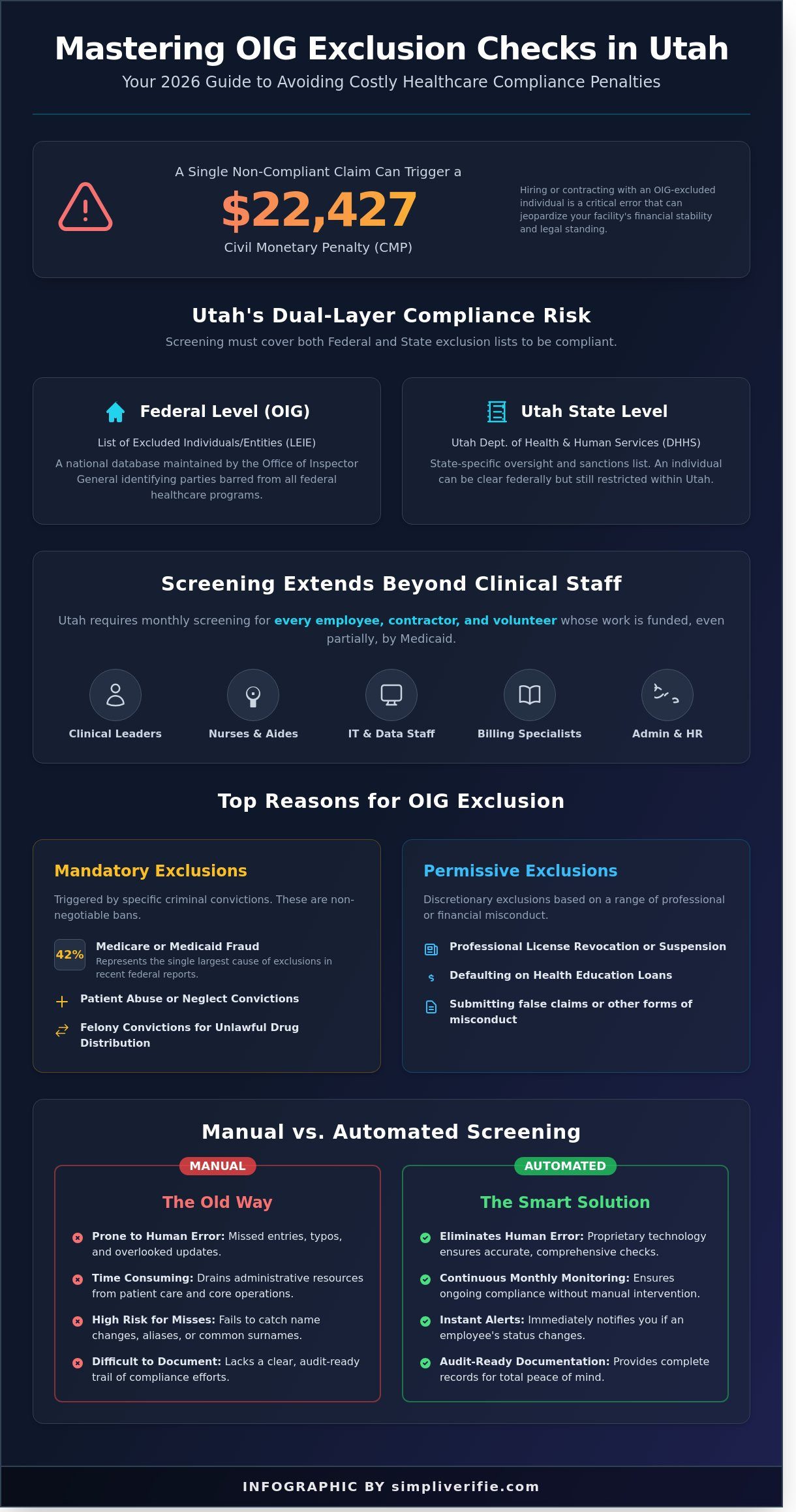
Utah healthcare providers often face a choice between manual labor and automated technology. The free OIG Exclusions List portal serves as the primary source for data, but relying on it for an entire workforce creates significant compliance gaps. Manual searches are prone to human error. A single typo or a missed maiden name can lead to an excluded individual slipping through your screening process. This oversight triggers heavy Civil Monetary Penalties (CMPs) that frequently exceed $10,000 for each item or service claimed while the excluded individual was employed.
Common surnames and name changes present another hurdle. Public portals often require a Social Security Number (SSN) to confirm a match, but manually entering sensitive data for dozens of employees monthly is a security risk. It also consumes vast amounts of administrative time. A facility with 75 employees might spend over eight hours each month just on basic data entry and documentation. This figure doesn't include the time spent resolving false positives or filing results for future audits. The manual approach is a reactive strategy that leaves your organization vulnerable to oversight.
Performing a single OIG exclusion list check Utah at the time of hire isn't enough to maintain compliance in 2026. Exclusions happen every month. If an employee is added to the list two months after they start, a manual system won't catch it until the next scheduled audit. Public portals also lack a robust paper trail. You must manually save screenshots or PDFs to prove to auditors that you conducted the search on a specific date. This fragmented record-keeping often fails during rigorous state or federal inspections because it lacks centralized verification.
Professional screening services replace manual stress with automated precision. These systems provide monthly monitoring and real-time alerts the moment a match appears. This proactive approach ensures peace of mind and eliminates the risk of missing a mid-year exclusion. Integration is another key advantage. By combining OIG checks with your existing employment verification workflows, you create a unified compliance profile for every staff member. It makes the entire onboarding and retention process fluid and transparent.
Modern platforms offer consolidated reporting. Instead of managing hundreds of individual screenshots, you receive a single, timestamped report ready for auditors. This level of organization transforms a complex bureaucratic task into a streamlined, reliable process. It allows your HR team to focus on patient care and staff development rather than spreadsheets and database searches. Automation isn't just a convenience; it's a strategic shield for your facility's reputation and financial health.
Achieving compliance requires a systematic approach that eliminates guesswork. A manual search might seem simple, but the 2026 regulatory environment demands precision to avoid heavy fines. Following a standardized protocol ensures your facility remains eligible for federal funding and protects your reputation in the Utah healthcare market.
Accuracy begins with the quality of your data. You must collect full legal names, dates of birth, and Social Security Numbers (SSNs) for every employee and contractor. Relying on a single name is a common mistake; 22% of identification errors in healthcare screening occur because of unreported maiden names or nicknames. Your team should verify these details against government-issued IDs before starting the search. This rigorous data collection aligns with modern healthcare compliance monitoring standards, ensuring your OIG exclusion list check Utah starts on a solid foundation.
A compliant search isn't limited to one website. You must check the OIG’s List of Excluded Individuals and Entities (LEIE) and the System for Award Management (SAM). In Utah, you also need to cross-reference the state-specific Medicaid exclusion list. When you find a "Potential Match," don't take immediate adverse action. Federal law requires you to verify the identity using the SSN or National Provider Identifier (NPI) to confirm the individual is actually the person on the list. This step prevents wrongful termination and protects employee rights while maintaining the integrity of your workforce.
If the Office of Inspector General audits your facility, "we checked it" isn't a valid defense. You need a digital or physical log that documents every search. According to the Utah Medicaid Provider Manual, your records should include:
Utah providers must retain these records for at least 10 years to meet federal record-keeping requirements. To stay fully compliant, establish a recurring 30-day monitoring cycle. Monthly checks are the only way to catch new exclusions that appear after the initial hire date. This proactive rhythm transforms a bureaucratic hurdle into a streamlined process that provides total peace of mind for your administration.
Ready to automate your monthly monitoring and eliminate manual errors? Get started with SimpliVérifié today for fast, accurate compliance results.
Managing an OIG exclusion list check Utah doesn't have to be a manual, error-prone task; it's a critical component of your safety protocol that deserves professional automation. SimpliVerified automates the entire verification cycle. Our system ensures your facility remains compliant 365 days a year without requiring constant manual oversight. Our proprietary technology doesn't just check at the point of hire. It provides recurring monthly monitoring that scans federal and state databases automatically. If an employee or vendor appears on a list, our system triggers instant alerts. This allows you to take immediate action before a violation occurs, protecting your organization from heavy fines and loss of billing privileges.
We've designed our platform to streamline your entire onboarding workflow. Our system offers seamless integration with our pre-employment drug test services and comprehensive criminal background checks. This unified approach eliminates the need for multiple vendors. It reduces administrative friction and ensures all your compliance data sits in one secure, digital location. By centralizing these tasks, you gain a clear, bird's-eye view of your facility's compliance health.
Local expertise matters when you're dealing with state-specific mandates. Headquartered in Draper, UT, SimpliVerified understands the nuances of Utah's regulatory environment better than national firms that lack a local presence. We deliver fast, accurate results that often reduce the time-to-hire for medical staff by 40%. Our solutions are scalable; they work for small clinics in Provo and large hospital networks in Salt Lake City alike. We provide the expert support you need for Utah Medicaid and UOIG audit preparation. Our team ensures your documentation is audit-ready at all times, removing the stress of unexpected inspections from state authorities. Our team specializes in the OIG exclusion list check Utah providers need to stay ahead of changing 2026 regulations.
Moving from manual spreadsheets to automated monitoring is the best way to protect your license and your revenue. SimpliVerified guarantees accuracy, speed, and total compliance. We've helped hundreds of providers transition away from messy, outdated tracking methods and into a streamlined, digital-first compliance model. It's time to replace your compliance anxiety with absolute certainty and professional peace of mind. We handle the technical details so you can focus on patient care. Schedule your Utah OIG compliance consultation with SimpliVerified today and secure your facility's future.
Maintaining a compliant workforce in 2026 requires more than occasional manual searches. The OIG can impose civil monetary penalties exceeding $20,000 for every single item or service billed while an excluded individual is on your payroll. Relying on outdated spreadsheets puts your facility at risk of federal sanctions and lost Medicaid funding. By shifting to automated systems, you eliminate human error and ensure every staff member is vetted against 1,000+ state and federal databases in real time.
SimpliVerified provides the local expertise you need from our headquarters in Draper, Utah. We've designed our platform to deliver audit-ready reporting that aligns perfectly with UOIG standards, giving you total transparency during inspections. Conducting a regular OIG exclusion list check Utah becomes a seamless part of your workflow rather than a stressful administrative hurdle. It's about protecting your patients and gaining true peace of mind with a partner that understands the local regulatory landscape. Let's make your compliance process faster and more reliable today.
Automate Your Utah OIG Compliance Checks Now
You should perform an OIG exclusion list check Utah monthly to maintain compliance with federal and state standards. The OIG updates the List of Excluded Individuals and Entities (LEIE) around the middle of every month with new entries. Utah Medicaid requires providers to screen employees and contractors upon hire and monthly thereafter. This regular cadence prevents the loss of federal funding and avoids Civil Monetary Penalties that can exceed $20,000 per item claimed.
The exclusion rule applies to all staff members, including non-medical roles like IT, billing, and administrative personnel. If a person's work contributes to a claim for Utah Medicaid or Medicare reimbursement, they can't be on the exclusion list. The OIG Special Advisory Bulletin of 2013 clarifies that this prohibition extends to any role that provides items or services paid for by federal programs. Hiring an excluded janitor or accountant can trigger the same penalties as hiring an excluded physician.
You must immediately terminate the individual's involvement with federal healthcare programs and self-disclose the violation to the OIG or Utah Medicaid. Under the OIG's Self-Disclosure Protocol, providers often pay a multiplier of 1.5 times the amount claimed rather than the standard 3.0 multiplier. Failure to report can result in fines of $22,322 per service provided as of the 2024 inflation adjustments. This oversight often leads to a Corporate Integrity Agreement that mandates external monitoring for 3 to 5 years.
A federal LEIE check alone isn't enough because Utah requires verification against the Utah Department of Health and Human Services (DHHS) exclusion records. While the OIG list covers federal exclusions, state lists often include individuals who haven't yet appeared on the national registry. Utah Medicaid Provider Manual Section 1-11 mandates that providers screen against both the LEIE and the System for Award Management (SAM). Checking multiple databases ensures you catch 100% of restricted individuals before they enter your workforce.
An excluded individual can't work in any capacity where federal healthcare dollars pay their salary, regardless of their direct patient contact. The OIG's payment prohibition is broad and covers administrative, clerical, and support roles. If your Utah facility receives a single dollar of Medicare or Medicaid funding, you can't use those funds to pay an excluded person. In 2023, several providers faced audits because they assumed non-clinical roles were exempt from these strict federal regulations.
You must verify potential matches by entering the individual's Social Security Number (SSN) into the OIG's online verification portal. Name matches are common, but the SSN provides a definitive confirmation of identity. If the system confirms a match, the OIG provides a verification code for your records. Keep a screenshot of this confirmation or the no match result to prove you performed a diligent OIG exclusion list check Utah during your 2026 audit.
The LEIE is managed by the Office of Inspector General and focuses specifically on healthcare-related crimes like patient abuse or fraud. The System for Award Management (SAM) is broader and includes exclusions from all federal agencies, such as debarments for tax delinquency or contract breaches. Since 2013, the OIG has recommended checking both lists to ensure full compliance. While the LEIE has about 75,000 active exclusions, SAM includes thousands of additional entities that could affect your supply chain.
You must screen all employees against the Utah Medicaid Restricted Provider List maintained by the State's Office of Inspector General of Medicaid Services. This list tracks individuals and entities specifically barred from the Utah Medicaid program. In addition to this, checking the Utah Division of Professional Licensing (DOPL) database is a standard 2026 best practice for verifying active licenses. Combining these state resources with federal checks creates a robust compliance framework that protects your organization from 100% of known exclusion risks.