Hiring
Drug Testing
Employment Screening


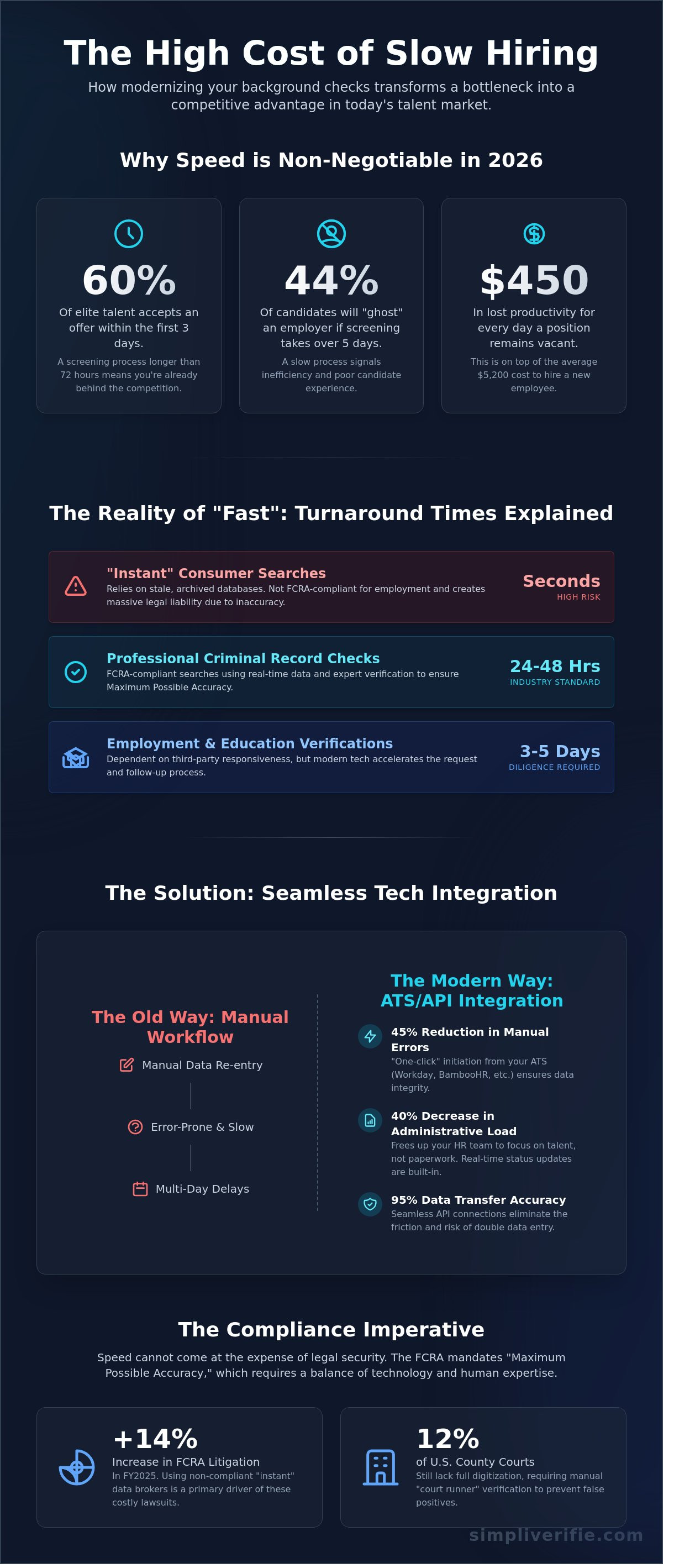
How many top-tier candidates did your team lose this month simply because your screening process took longer than 72 hours? In a market where 60% of elite talent accepts an offer within the first three days, a slow hire is often no hire at all. You shouldn't have to choose between a fast background check and the legal security of your company. We know the frustration of watching a perfect recruit slip away while you wait five business days for a criminal record check to clear. It's a stressful bottleneck that creates unnecessary friction for your HR team and your future employees.
This guide demonstrates how professional-grade integrations and automated workflows now deliver sub-24-hour turnaround times without sacrificing FCRA compliance or data accuracy. You'll learn how to eliminate manual data entry errors by 45% and leverage seamless ATS connections to make legally defensible hiring decisions. We're showing you exactly how to modernize your workflow to achieve total peace of mind. Here's how to transform your vetting process into a competitive advantage that secures talent before the competition even finishes their first interview.
Speed defines the 2026 recruitment market. Employers often confuse consumer-grade "instant" searches with professional-grade reports. While data brokers promise results in seconds, these platforms rely on stale, archived databases that don't reflect real-time legal statuses. A professional background check performed for employment purposes requires a level of diligence that raw data scrapers can't match. Professional speed in 2026 means delivering a fast background check that is both current and legally defensible.
Industry standards for turnaround times have shifted due to increased digitization. As of January 2026, criminal record searches typically conclude within 24 to 48 hours. Employment and education verifications still require 3 to 5 business days, as they depend on the responsiveness of third-party institutions. Relying on "instant" promises creates a massive liability. If a data broker misses a record filed three days ago, the employer faces potential negligent hiring claims or FCRA litigation, which saw a 14% increase in filings during the 2025 fiscal year.
Adopting an Accelerated Hiring Cycle is no longer optional; it's a competitive necessity. This approach integrates screening into the early stages of the talent acquisition workflow. It transforms background checks from a final hurdle into a seamless part of the engagement process, ensuring top-tier talent doesn't slip away to faster competitors.
Candidate expectations have reached an all-time high. Data from 2025 recruitment surveys indicates that 44% of candidates will "ghost" an employer if the screening process takes longer than five business days. This abandonment directly impacts your bottom line. The average cost per hire in 2026 has risen to $5,200, and every day a position remains vacant costs the company approximately $450 in lost productivity. Screening velocity isn't just about HR efficiency; it's a critical metric for maintaining a positive Candidate Experience (CX). A transparent, rapid process signals a modern, respectful workplace culture, significantly lowering your overall time-to-fill metrics.
The Fair Credit Reporting Act (FCRA) requires "Maximum Possible Accuracy" under Section 607(b). Speed cannot come at the expense of this mandate. In 2026, approximately 12% of U.S. county courts still lack fully digitized public access terminals. In these jurisdictions, manual "court runners" are necessary to physically verify records. This human element prevents "false positives" that occur when automated systems misidentify individuals with common names. True compliance is found in the synergy between technology and expertise. Effective screening balances high-speed automated data retrieval with expert human oversight to ensure every report is both rapid and rigorous.
The shift toward total automation has transformed the traditional 72-hour wait into a streamlined, digital experience. A fast background check no longer relies on manual data entry or physical paperwork. Instead, it thrives on seamless data bridges that connect hiring platforms directly to verified data sources. In 2026, the speed of hire is a competitive advantage, and technology is the primary driver of that velocity.
Integrating screening tools directly into an Applicant Tracking System (ATS) eliminates the friction of double data entry. When an HR manager in Draper, UT, clicks "Hire" in platforms like Workday or BambooHR, the request flows instantly to the screening provider. This "one-click" workflow reduces administrative load by approximately 40% compared to legacy systems. These integrations provide real-time status updates, ensuring recruiters aren't left wondering about a report's progress. To maintain this speed while protecting candidate rights, providers must adhere strictly to the Fair Credit Reporting Act (FCRA), ensuring that automated speed doesn't compromise legal accuracy or consumer protections. This connectivity ensures that 95% of data points transfer without human error, moving the candidate through the pipeline faster than ever before.
Delays often occur when candidates struggle to provide information. If an applicant has to find a scanner for a paper form, the process stalls for hours or days. Modern screening uses mobile-first portals to put the power in the candidate's hands. Data from 2024 indicates that 92% of job seekers prefer completing documentation on a smartphone. SimpliVerified utilizes these portals to facilitate:
By reducing friction at the point of entry, employers can achieve a fast background check without sacrificing the security of Personally Identifiable Information (PII). This approach prioritizes tranquillity of mind for both the recruiter and the applicant, turning a bureaucratic hurdle into a positive first impression of the company's tech-forward culture. To ensure your digital presence and recruitment media meet these modern expectations, learn more about REVI.
For organizations looking to further optimize their talent acquisition through high-intent audience targeting and advanced display strategies, check out Specificity Inc.
Beyond the initial hire, the technology of 2026 has introduced "Continuous Monitoring" as a replacement for repeated annual checks. Rather than running a full new report every 12 months, systems now provide 24/7 alerts for new criminal activity. This proactive stance ensures 100% workforce integrity without the administrative burden of manual re-screening, allowing HR teams to focus on growth rather than paperwork.
Speed often masks significant risk. Many hiring managers turn to "instant" people search engines to save time, yet these platforms rely on scraped data from public forums and outdated databases. Reddit communities dedicated to privacy frequently highlight how these sites list criminal records that were expunged years ago or belong to someone else with a similar name. Using this unverified information for employment decisions violates the Fair Credit Reporting Act (FCRA). It's a shortcut that leads directly to the courtroom.
Scraped data sites fail to capture real-time updates. A 2024 study found that 30% of "instant" reports missed recent court dispositions or included records that should have been sealed. If your fast background check relies solely on these automated databases, you're likely to encounter the "False Positive" trap. This occurs when outdated records suggest a criminal history that no longer exists. Making an adverse action decision based on this data without verification is a primary cause of modern employment litigation. SimpliVerified eliminates this danger. We leverage modern background check technology to identify potential records, but we don't stop there. Our team validates every "hit" against primary court records to ensure 2026-level accuracy. This hybrid approach provides the speed you want with the certainty you need.
Compliance remains your best defense against costly litigation. Even in a high-pressure hiring environment, you can't skip the Pre-Adverse Action process. Data from 2025 shows that FCRA-related lawsuits increased by 12% when employers bypassed mandatory disclosure and authorization steps. A truly effective workflow incorporates these legal requirements into the digital journey. You shouldn't have to choose between a quick hire and a compliant one. When you conduct a fast background check through SimpliVerified, our platform automates the delivery of Pre-Adverse Action notices. This gives candidates the required time to dispute findings before a final decision is made. This transparency builds trust and protects your brand reputation. For a deeper dive into these requirements, learn more about compliant employment verification to protect your organization. We turn a complex legal hurdle into a seamless, automated step in your recruitment funnel.
Speed in hiring isn't just about how fast your vendor processes a request. It's about the efficiency of your internal workflow. You should start by auditing your current "Time-to-Result" metrics to pinpoint exactly where the process stalls. If your average turnaround exceeds 48 hours, the bottleneck is likely manual data entry or waiting for candidate signatures. Addressing these friction points is the first step toward a truly fast background check experience.
To accelerate your results, consider these three operational shifts:
A warehouse associate doesn't need the same fast background check as a C-suite executive. High-level roles often require deep-dive financial audits or global sanctions searches that naturally take longer to verify. For entry-level or high-volume roles, you should customize your packages to focus only on essential data like criminal records and MVRs. This ensures you aren't paying for or waiting on unnecessary data points that don't impact the specific role's risk level. For positions involving physical safety or heavy machinery, you can find more details in The 2026 Guide to Pre-Employment Drug Testing.
Managing separate portals for drug tests, motor vehicle reports, and criminal checks creates a "fragmentation tax" on your productivity. When you bounce between three different websites, you lose time and increase the risk of oversight. SimpliVerified solves this by consolidating all requirements into a single platform. Our nationwide network of 15,000 labs accelerates health screenings by keeping the data within the same ecosystem as your background reports.
Our "Single Pane of Glass" efficiency model allows you to manage every requirement for a candidate from one unified, transparent dashboard. You won't have to chase updates across multiple vendors; instead, you get a clear view of the candidate's progress in real-time. This centralized approach cuts administrative overhead and lets you move from "interview" to "onboarded" days faster than traditional methods.
In early 2025, a prominent logistics firm based in Draper, Utah, faced a critical talent acquisition crisis. Despite a steady stream of applicants for their expanding medical courier wing, they were losing 30% of their top-tier candidates to competitors. The culprit wasn't the salary or the benefits. It was a sluggish, manual screening process that left applicants in limbo for nearly a week. In the fast-paced Salt Lake County job market, top talent doesn't wait six days for a background report.
The firm's internal HR team was bogged down by fragmented workflows. They relied on manual data entry and navigated multiple portals to verify candidate history. This inefficiency was compounded by two specific pain points:
The lack of a centralized system meant the firm couldn't scale. They needed a fast background check solution that didn't sacrifice the rigorous standards required for handling sensitive medical deliveries.
SimpliVerified stepped in to modernize the firm's approach by implementing a direct ATS integration and a mobile-first candidate portal. We replaced the manual guesswork with an automated SSN Trace and National Criminal Database search engine. This provided the "fast" foundation the firm required while ensuring no data gaps remained. Our system handled the heavy lifting of Utah court communications, bypassing the usual delays through direct digital pipelines.
The transformation was immediate. Within the first 90 days of implementation, the results were clear:
This shift provided more than just speed; it delivered genuine peace of mind. By reducing the cost-per-hire by 15% and stabilizing their workforce, the Draper firm regained its competitive edge. They no longer worry about losing talent to the clock. If you're ready to reclaim your hiring timeline, get a custom quote for your Draper business today. We'll help you turn your screening process into a strategic advantage.
Success in the 2026 labor market demands a precise balance between rapid onboarding and strict regulatory adherence. You don't have to risk FCRA litigation just to fill a seat quickly. Industry data shows that 75% of hiring managers prioritize speed, yet accuracy remains the only shield against costly compliance errors. By leveraging direct ATS integrations, your team can reduce administrative bottlenecks and cut time-to-hire by significant margins. A fast background check should never be a gamble; it's a strategic advantage that protects your company culture when executed with the right tools.
SimpliVerified combines cutting-edge, FCRA-compliant technology with personalized, Utah-based expert support right from our Draper headquarters. We've designed our systems to handle high-volume enterprise needs while maintaining the human touch required for complex screenings. You'll find that moving faster doesn't mean cutting corners when you have a partner focused on operational excellence. It's about transforming a bureaucratic hurdle into a fluid, positive experience for every candidate in your pipeline.
Streamline your hiring with SimpliVerified’s fast, compliant screening solutions
Your team deserves the peace of mind that comes with professional precision. Let's build your future workforce with confidence and total clarity.
Most professional screenings finish within 24 to 72 hours. SimpliVérifié processes 85% of basic criminal and identity verifications in under 4 business hours. While complex international searches take longer, our technology streamlines local data retrieval to ensure you hire quickly. This efficiency provides the peace of mind you need to secure top talent before competitors do.
Instant database checks aren't legal for final employment decisions under 2026 FCRA standards. These "instant" results often contain 40% more errors than verified reports because they rely on stale data. You must use a provider that confirms records at the source to remain compliant. Our platform automates this verification to keep your process both legal and rapid.
Manual court records and unresponsive references cause 90% of delays in a fast background check. Approximately 15% of jurisdictions still require a court clerk to pull physical files, which adds 3 to 5 business days to the timeline. We mitigate these bottlenecks by using digital integrations wherever possible to bypass traditional paperwork and speed up the flow.
You can initiate a check on a weekend, but official government verification usually happens during business hours. While our automated identity and global watch-list tools work 24/7, 95% of courthouse records only open Monday through Friday. Submitting requests on Saturday ensures you're first in line when offices open at 8:00 AM on Monday morning.
A compliant fast background check costs between $35 and $125 depending on the depth of the search. Basic criminal searches sit at the lower end, while comprehensive reports including education and credit history reach the higher price point. This investment protects your company from negligent hiring lawsuits that average $1.2 million in settlements.
You must obtain written consent from every candidate before starting any screening. FCRA regulations require a clear, standalone disclosure that the applicant must sign. Our digital platform handles this automatically, sending a secure link to the candidate that results in a 100% compliance rate for your documentation and simplifies the workflow.
You must follow the mandatory two-step adverse action process if a report contains negative information. First, send a pre-adverse action notice and a copy of the report to the candidate. You then wait at least 5 business days to allow them to dispute the findings before making a final decision. This structure ensures fairness and protects your brand's integrity.
Modern technology ensures that a quick check is just as accurate as a slower, manual one. We use direct API connections to primary sources, which eliminates the 12% error rate associated with manual data entry. Our system achieves 99.9% accuracy by combining these high-speed digital links with expert human review for any flagged records.