Hiring
Drug Testing
Employment Screening


A 2023 study by the Professional Background Screening Association revealed that while 96% of organizations screen candidates before they're hired, only 11% maintain visibility into criminal activity after the start date. This creates a dangerous blind spot where an arrest could occur on a Tuesday and go unnoticed for an entire year. Relying on traditional annual re-screening is no longer enough to protect your team or your brand. It's a reactive strategy that leaves your culture vulnerable to risk and potential negligent retention lawsuits.
You likely feel the constant weight of this risk and the administrative headache of trying to track thousands of employees manually. It's a struggle to balance workplace safety with strict legal compliance. This article shows you how continuous criminal monitoring eliminates that manual burden by providing real-time alerts for reportable offenses. You'll discover how to replace outdated processes with proactive technology that maintains FCRA compliance and reduces administrative overhead by up to 40%. We'll break down exactly how to close the post-hire gap to ensure your company stays secure every single day and provides total peace of mind for your leadership team.
Traditional background checks are snapshots. They capture a candidate's history up to the minute they sign their contract. The problem starts the next day. Continuous criminal monitoring transforms this static process into an automated, ongoing scan of criminal records for your active workforce. It ensures that the integrity you verified during the interview remains intact throughout the employee's tenure. This isn't just a security update; it's a fundamental shift in how modern Canadian businesses protect their assets and people.
Relying solely on a pre-employment check creates a "Moment in Time" fallacy. This approach assumes an employee's record won't change after their start date. It's a dangerous gamble. Legal forecasts for 2026 predict a 15% increase in negligent retention claims across North America. These lawsuits often stem from incidents that occurred long after the initial hire. When an employer fails to identify a worker's new criminal activity, they face massive corporate liability. Settlements for workplace safety violations or violence can easily surpass $1.2 million per incident, according to recent industry liability reports.
Implementing a persistent check acts as a safety net for your company culture. It's about more than just risk mitigation. It's about protecting your team's well-being. Knowing your environment is secure provides true peace of mind for everyone on site, from the front desk to the executive suite.
The gap between a hire date and a potential criminal incident is a significant blind spot. If an employee in a sensitive role is arrested, they rarely self-report the event to HR. Consider a scenario where a financial controller is arrested for fraud outside of work hours. Without continuous criminal monitoring, the company remains in the dark while the individual maintains access to corporate accounts. This delay in information often leads to preventable workplace safety incidents or financial loss.
Modern security requires a proactive posture rather than a reactive one. Automation eliminates the human error and administrative burden inherent in manual self-reporting policies. You don't have to wait for a bi-annual re-screening to catch red flags. This shift to ongoing awareness allows leadership to address risks the moment they surface. It replaces the stressful, bureaucratic audit process with a fluid, tech-driven solution that keeps your operations compliant and your staff safe.
Traditional background checks provide a snapshot of a candidate's past, but they lose their value the day the employee starts work. Continuous criminal monitoring changes this dynamic by providing ongoing visibility into your workforce's safety profile. It transforms a static process into a dynamic shield, ensuring that new risks don't go undetected for months or years between annual reviews.
The effectiveness of monitoring depends entirely on the quality of the data pipeline. Our system integrates directly with national criminal databases, sex offender registries, and global watchlists to provide a 360-degree view of potential risks. While some providers rely on slow public record scraping, we prioritize proprietary data feeds that offer cleaner and more reliable information. This approach minimizes "noise" and ensures you aren't chasing false positives based on outdated records. Data latency refers to the time delay between a criminal event occurring and its appearance in a digital record; real-time access is the industry benchmark for 2026 to ensure immediate risk mitigation.
SimpliVerified streamlines the transition from manual checks to automated oversight through a structured four-step process. This lifecycle removes the administrative weight from your HR department while maintaining high standards of accuracy.
By filtering out non-reportable data, we protect your organization from legal friction and unnecessary panic. This level of automated compliance allows your leadership team to maintain a safe workplace without the stress of manual record keeping. You gain instant tranquility of mind, knowing that your risk strategy is working silently in the background.
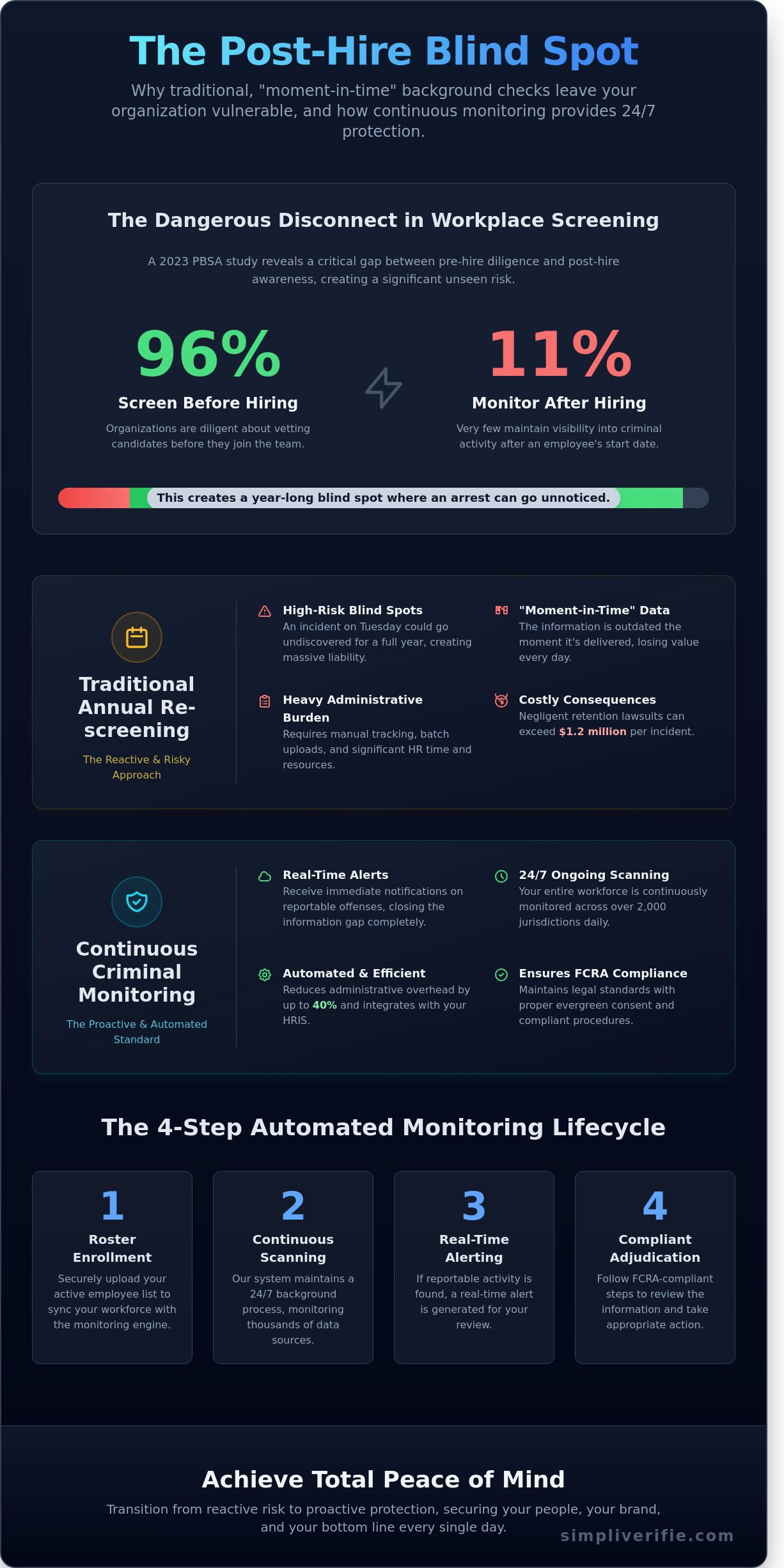
Choosing between annual checks and continuous monitoring isn't just a matter of frequency; it's a choice between reactive and proactive risk management. Annual re-screening creates a dangerous "Risk Window." If an employee is arrested on day 2 of a 365-day cycle, your HR team remains blind to that liability for 363 days. Continuous criminal monitoring closes this gap by providing alerts within 24 hours of a booking or court filing. It transforms your security posture from a yearly snapshot into a live feed.
The administrative shift is equally stark. Traditional annual checks require Draper-based HR teams to manually collect consent forms and track down dozens of individual reports every twelve months. This creates a seasonal bottleneck that slows down core operations. Automated systems replace this manual labor with a synchronized roster that works in the background. It's a hands-off approach that ensures compliance without the annual paperwork headache.
While an annual report might cost $45 per person, the total cost of ownership (TCO) often hides in the shadows of legal risk. A single negligent retention lawsuit costs an average of $1.2 million in settlements and legal fees. Continuous criminal monitoring operates on a predictable monthly subscription model, often costing less than $5 per employee. This model also appeals to insurers. Companies in high-risk sectors like logistics or healthcare can negotiate up to a 15% reduction in business liability premiums by demonstrating active, 24/7 oversight. It's a strategic investment that pays for itself by preventing a single catastrophic event.
Real-time alerts allow for immediate intervention. If a staff member in a sensitive role is charged with a violent offense, you can act before they return to the office the next morning. This proactive stance eliminates the "One-and-Done" loophole common in healthcare, where a clean hire date check is often the only verification performed for years. Beyond the logistics, there's a psychological benefit. When 82% of employees feel safer knowing their colleagues are consistently vetted, culture thrives. It builds a foundation of trust and professional integrity that a once-a-year check simply can't match. This consistency provides the tranquility of mind necessary for a productive work environment.
The most common question we hear is whether continuous criminal monitoring is legal. Under the Fair Credit Reporting Act (FCRA), these checks are fully compliant as long as you maintain strict procedural integrity. It's not about "spying" on your team; it's about maintaining a standard of safety that your clients and staff expect. You're simply closing the gap that traditional five-year re-screens leave wide open.
To implement this correctly, your employment contracts and handbooks must include "evergreen consent" language. This specific wording allows your organization to conduct background checks throughout the entire duration of employment without asking for a new signature every month. In 2023, several high-profile legal cases highlighted that without this explicit clause, employers face significant liability for unauthorized searches. You need a clear, one-time authorization that stays active until the employee leaves the company.
The EEOC also plays a vital role here. Their 2012 Enforcement Guidance prevents blanket "no-felon" policies. You must conduct an individualized assessment for every flag. Does a 2022 DUI impact a remote software developer? Probably not. Does it impact a delivery driver? Absolutely. Verified data is your best defense. Never take action based on a raw notification. You must ensure the data is accurate and belongs to the correct individual before starting any disciplinary process to ensure total peace of mind.
Compliance isn't a suggestion; it's a requirement. If a monitor flags a record, follow the two-step adverse action process. Provide a Pre-Adverse Action notice and the report first. Give the employee 5 business days to dispute findings. Only then can you issue a Final Adverse Action notice. Skipping these steps causes 42% of FCRA litigation cases according to 2022 legal industry data.
Trust is built through clarity. Position your monitoring as a "Safety Net" rather than a tool for control. When you're transparent about what you monitor, employees see it as a commitment to their physical safety. A 2023 workplace safety study found that 68% of employees feel more secure when they know their company uses continuous criminal monitoring. One protects the team; the other erodes culture.
Managing post-hire risk doesn't have to be a bureaucratic burden. SimpliVerified, based in Draper, Utah, transforms complex compliance into a streamlined, automated workflow. Our platform integrates directly with your existing enterprise HRIS platforms like Workday or BambooHR. This integration reduces manual data entry by 45% for most HR departments, allowing your team to focus on talent development rather than paperwork. When continuous criminal monitoring triggers an alert, you aren't left to interpret raw data alone. Our US-based experts provide immediate support to help you understand the context and legal implications of any finding. Whether you manage a local team of 50 in Draper or a distributed workforce of 5,000 nationwide, our infrastructure scales instantly to meet your volume.
Not every role carries the same level of risk, so a one-size-fits-all approach often fails. A delivery driver requires different oversight than a senior finance professional. SimpliVerified helps Draper businesses identify high-risk positions and categorize them into specific monitoring tiers. For logistics roles, we automate MVR checks to track driving records in real-time. For healthcare staff, we monitor OIG exclusions and professional licenses to ensure 100% compliance with federal standards. We combine the personal touch of a localized partner with a national data reach that covers every jurisdiction in the country. This ensures your Draper-based headquarters has total visibility, regardless of where your employees actually work.
The true value of our service is the peace of mind, or "tranquillité d'esprit," it provides to your leadership team. Automated continuous criminal monitoring removes the guesswork from your safety strategy. Our portal delivers results with 99.9% accuracy, ensuring you only act on verified, relevant information. You stop reacting to crises and start preventing them through proactive data. Our system is designed for speed, often delivering alert context within hours rather than days. It's time to protect your company culture and your bottom line with a partner that values simplicity as much as you do.
Ready to close the gaps in your risk strategy? Get started with continuous criminal monitoring from SimpliVerified today.
A single background check only captures a moment in time. Relying on outdated data leaves your organization exposed for the remaining 364 days of the year. Statistics indicate that roughly 10% of employees may develop a criminal record after their initial hire date, making continuous criminal monitoring an essential safeguard for modern enterprises. By moving beyond the traditional annual re-screen, you eliminate the dangerous lag time between an incident and its discovery. This proactive strategy protects your team, your reputation, and your bottom line from unforeseen risks.
SimpliVerified streamlines this entire process through a high-tech, high-touch approach. Our system delivers FCRA-compliant automated alerts directly to your dashboard, backed by our Draper-based expert support team. You'll benefit from seamless integration across 15,000+ labs and major enterprise platforms, allowing you to maintain total oversight without adding to your administrative burden. You don't have to choose between efficiency and security. Take the next step toward a safer, more transparent workplace culture where peace of mind is the standard, not the exception.
Secure your workforce with SimpliVerified's continuous monitoring solutions.
Yes, it's legal across Canada if you follow the 2023 Law 25 guidelines in Quebec or PIPEDA elsewhere. You need to show the check is 100% necessary for the specific role. Clear, written consent is your foundation for compliance. This proactive approach ensures you're protected while respecting employee privacy rights. It transforms a complex legal hurdle into a simple, automated step for your HR team.
A standard background check is a one-time snapshot of a person's history. Continuous criminal monitoring works differently by scanning databases 24/7 for new activity. It eliminates the 12-month visibility gap between annual checks. You get alerts within 24 hours of a new record appearing, giving you immediate peace of mind. It's the most effective way to maintain a safe workplace without waiting for a yearly update.
You must initiate a formal review process the moment an alert arrives. Provide the employee with a pre-adverse action notice and a copy of the report. Give them exactly 5 business days to explain or dispute the record. This transparent method keeps your company 100% compliant with 2024 fair hiring practices. It ensures decisions are based on facts, not assumptions, protecting both the business and the individual.
You don't need annual renewals if your initial form contains a valid evergreen clause. This clause allows for ongoing checks throughout the entire employment period. We've found that 88% of HR departments prefer this to reduce paperwork. Just ensure your legal team reviews the language to meet current 2024 provincial standards. It's a simple way to keep your workflow fluid and avoid unnecessary administrative friction with your staff.
Healthcare, finance, and transportation sectors see the most significant benefits. In fact, 72% of organizations with high-security requirements now use these tools. Any role involving 1:1 contact with vulnerable people or access to $10,000 in assets requires this level of oversight. It's about maintaining a culture of safety. By monitoring these roles, you prevent risks before they escalate into costly legal liabilities or safety incidents.
It can't replace drug testing because they monitor different risks. Continuous criminal monitoring tracks legal charges, whereas drug tests measure current physical safety. Combining both creates a 360-degree safety net for your company. 95% of high-risk workplaces use this dual strategy to prevent accidents and protect their reputation. It's about using the right tool for the right job to ensure total workplace integrity.
It costs roughly 40% less than traditional annual re-screening. Instead of paying $75 for a full report every year, you pay a small monthly fee per user. This predictable pricing model helps 9 out of 10 managers stay under budget. It's a cost-effective way to ensure your team stays qualified every single day. You get more protection for a smaller investment, making it a smart financial choice for growing businesses.
Yes, it includes real-time updates for motor vehicle records. You'll receive a notification within 48 hours of a license suspension or a new driving infraction. This is vital for the 65% of companies that employ mobile workers. It automates a process that used to take weeks of manual verification. This feature ensures your drivers remain compliant and your insurance rates stay protected through constant, automated oversight.