



What if the applicant with the perfect credit score and glowing references is actually hiding a history of three evictions in the Salt Lake County Justice Court? Most landlords in Draper know the stress of trying to distinguish a reliable tenant from a "professional" one who knows how to exploit the system. If you've struggled with a civil records search for landlords Draper, you aren't alone. It's easy to feel overwhelmed by the differences between Utah District Court records and local small claims filings while trying to remain compliant with the Fair Credit Reporting Act.
This guide helps you master the complexities of civil record searches to protect your property and ensure a seamless screening process. At SimpliVerified, we believe that clarity shouldn't be a luxury for busy property owners. We'll explain exactly what these records reveal, how to navigate the $20,000 small claims limit, and how to build a compliant process that reduces the risk of property damage. You'll gain the confidence to make informed decisions that protect your bottom line and your peace of mind while ensuring your rental business remains secure and profitable.
Key Takeaways
- Understand why non-criminal legal disputes are essential indicators of a tenant's future reliability and financial responsibility.
- Learn to distinguish between the Draper City Justice Court and the Utah 3rd District Court to find relevant small claims and litigation data.
- Protect your business from FCRA compliance risks by utilizing a professional civil records search for landlords Draper instead of relying on raw court data.
- Identify high-risk indicators like prior evictions and money judgments that standard criminal background checks often overlook.
- Discover how to integrate localized Draper court data into a holistic screening process for faster and more accurate leasing decisions.
What is a Civil Records Search for Landlords in Draper?
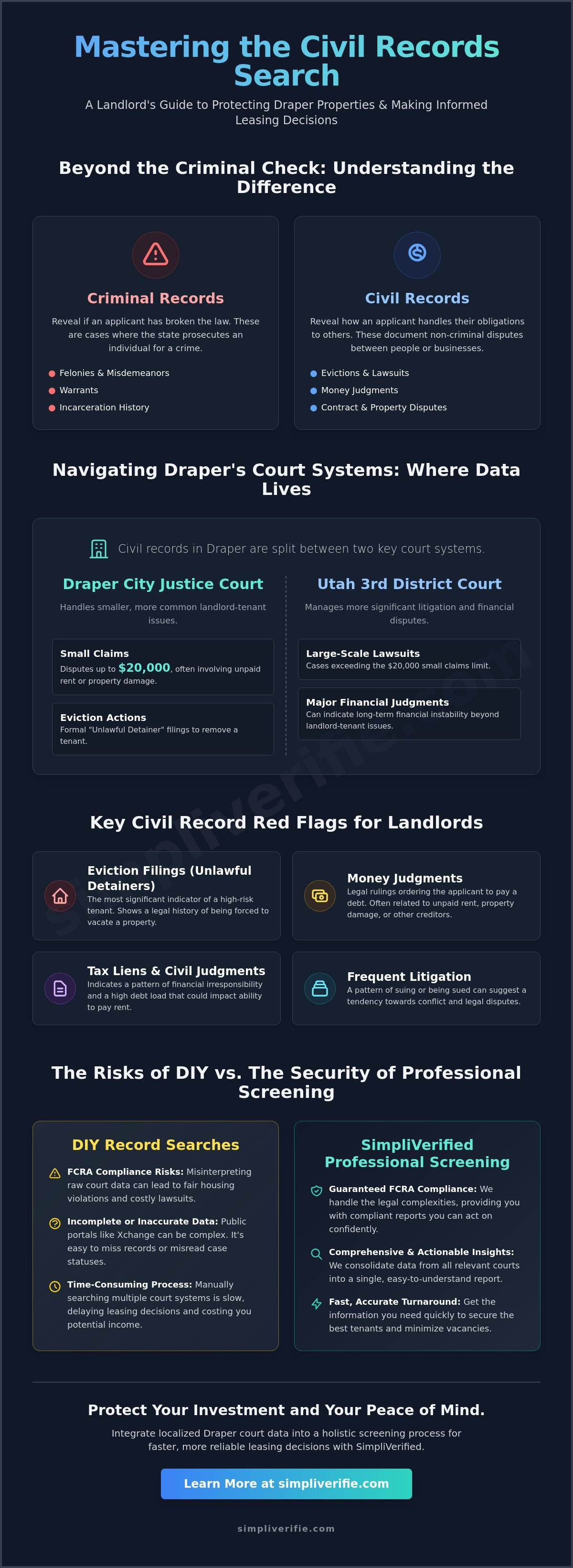
A civil records search is a deep dive into the non-criminal legal history of an individual. While a criminal background check tells you if a person has broken the law, a civil records search for landlords Draper reveals how they handle their obligations to others. These records document disputes between individuals, businesses, or government entities. In 2026, where rental markets are increasingly competitive, understanding this data is a vital part of a professional tenant screening process. It provides a window into a candidate's financial responsibility and respect for contractual agreements. For landlords in Salt Lake County, this search bridges the gap between a simple credit score and a full picture of a tenant’s character.
The distinction between criminal and civil records is crucial. Criminal records involve the state prosecuting a person for a crime. Civil records, however, involve lawsuits over money, property, or contracts. In Draper's current legal environment, these records are often spread across different court systems, making a thorough search essential for risk mitigation. By looking beyond criminal history, you protect your investment from "professional tenants" who may have a clean criminal record but a long history of civil judgments or evictions.
The Role of Civil Records in Modern Tenant Screening
Screening isn't just about spotting past crimes. It's about predicting future behavior. Civil searches uncover risks that criminal checks simply miss, such as a history of suing previous employers or being sued by debt collectors. If a tenant has a recurring pattern of civil litigation, it might suggest they're difficult to work with or prone to legal disputes. This is particularly relevant for those in specific industries where reliability is non-negotiable. Verifying the information on a rental application against court records ensures that the person moving into your property is exactly who they claim to be. It's about building a foundation of trust through verified data rather than just taking an applicant's word for it.
Types of Civil Records Relevant to Draper Properties
For Draper landlords, specific records carry more weight than others. Eviction filings, known legally in Utah as Unlawful Detainer actions, are the most significant red flag. These records show if a tenant has been legally forced to vacate a property. Additionally, small claims judgments often reveal unpaid rent or property damage from past tenancies. In 2026, the jurisdictional limit for small claims in Utah Justice Courts is $20,000, making these courts a frequent stop for landlord-tenant disputes. Tax liens or civil judgments can also indicate a tenant’s overall debt load. This information is vital because it directly impacts their ability to pay rent on time each month. SimpliVerified helps you navigate these records efficiently, turning complex court data into actionable insights for your property management strategy.
Navigating Draper’s Court Systems: Where Civil Data Lives
Finding accurate information requires knowing exactly where to look. In Draper, civil data isn't stored in a single, convenient bucket. Instead, it's split between different jurisdictions based on the nature and dollar amount of the dispute. A thorough civil records search for landlords Draper must account for both the Draper City Justice Court and the Utah 3rd District Court. While the Justice Court handles smaller disputes, the District Court manages significant litigation that could signal a tenant's long-term financial instability. Understanding this divide is the first step toward a reliable screening process.
The Utah Xchange system serves as the primary digital gateway for these records, aggregating data from courts across the state. However, raw data from Xchange can be difficult to interpret without legal expertise. Misreading a filing date or a case status can lead to unfair housing denials. Because federal law requires landlords to follow strict accuracy standards under the FCRA, relying on unverified digital snippets is a significant gamble. Manual retrieval from a court clerk remains an option, but it's often slow and prone to human error, especially during peak leasing seasons.
Draper City Justice Court vs. 3rd District Court
The Draper City Justice Court is where you'll find most small claims cases. As of 2026, the jurisdictional limit for small claims in Utah is $20,000. This court is the frontline for evictions and disputes over unpaid rent or minor property damage. For claims exceeding $20,000, cases move to the Utah 3rd District Court. Landlords should monitor District Court records for major breach of contract suits or large-scale financial judgments. These records provide a clearer picture of an applicant's total debt load and their history with high-stakes legal obligations.
Accessing Public Records via Draper NextRequest
Draper City uses the NextRequest portal to handle GRAMA (Government Records Access and Management Act) requests. While this promotes transparency, it isn't designed for the fast-paced world of property management. Filing a request and waiting for a clerk's response can take days or even weeks. This delay often results in losing qualified applicants to faster competitors. Public portals also lack the specialized filters needed to weed out "false positives" where an applicant shares a common name with a defendant. For those managing properties across various industries, these delays and inaccuracies create unnecessary friction.
Relying on slow government portals can stall your leasing momentum and leave your property vacant longer than necessary. To maintain a competitive edge, many local property owners choose professional tenant screening services to handle the heavy lifting of court data retrieval. This approach ensures you receive verified, compliant results without the administrative headache of manual filing.
The Risks of DIY Records Searches vs. Professional Screening
While the Utah Courts Xchange Public Case Search is a valuable tool for public transparency, it isn't a substitute for a professional screening report. Many property owners mistakenly believe that having access to public records is the same as being compliant. In reality, a DIY civil records search for landlords Draper often lacks the necessary safeguards required by federal law. Using raw court data to make a housing decision without following proper protocols can lead to costly legal disputes. You're responsible for the accuracy of your data, and mistakes can be expensive.
Consistency is a critical factor that many DIY landlords overlook. If you search some applicants more thoroughly than others, you open the door to discrimination claims. A professional report provides a standardized process for every candidate. This consistency is essential for those operating across multiple industries or managing several properties. Beyond the legal safety, there's a massive time cost to DIY searching. Manually digging through court filings can take hours that most property managers don't have. SimpliVerified delivers fast, accurate results, allowing you to focus on your business instead of playing detective in court archives.
FCRA Compliance for Draper Landlords
Landlords don't always realize that "googling" a tenant or pulling records from a public portal carries significant legal weight. Under the Fair Credit Reporting Act (FCRA), you must have a permissible purpose to run a search and provide clear applicant disclosures. If you deny an application based on a record you found yourself, you're still legally obligated to provide an Adverse Action notice. Professional screening agencies like SimpliVerified automate this process. We ensure that every step of the search meets federal standards, protecting you from lawsuits that arise from improper DIY methods.
Accuracy and the Danger of Name Matching
One of the biggest risks in Draper and across Utah County is the frequency of common names. Relying on a name-only match in a public database often results in "false positives." You might see an eviction for a "John Smith" and assume it's your applicant, only to find out later it was someone else entirely. SimpliVerified eliminates this doubt by using Social Security Number (SSN) traces to confirm record ownership. This level of precision is impossible with manual searches. It ensures you don't unfairly disqualify a great candidate or miss a high-risk history because of a clerical naming error.
Key Civil Indicators: What Every Draper Landlord Should Screen For
Knowing where court data lives is only half the battle. The real value lies in your ability to interpret that data to predict a tenant's future behavior. A civil records search for landlords Draper acts as a financial character check, highlighting red flags that a standard credit score often overlooks. While a credit report shows a numerical summary of debt, civil records reveal the stories behind that debt. They show you if an applicant is prone to legal disputes or if they have a history of failing to meet their contractual obligations to previous property owners.
Focusing on specific indicators allows you to build a robust risk management framework. You aren't just looking for "bad news"; you're looking for patterns of instability. For example, a single medical judgment from five years ago might not be a dealbreaker. However, a series of recent filings for unpaid rent suggests a recurring problem. By analyzing these records, you can make a more nuanced decision that protects your property while remaining fair to the applicant. If you're managing properties across different industries, this level of detail is even more critical to maintain high occupancy standards.
Understanding Utah Eviction Records
Eviction records, or Unlawful Detainer actions, are the most reliable predictor of future tenancy issues. It's important to distinguish between an eviction filing and a final judgment. A filing means the process started, while a judgment confirms the court ruled against the tenant. Multiple filings from different property management companies are a major red flag, even if the tenant eventually paid to stay. In Utah, these records can remain visible for years, providing a long-term view of a tenant's history. You should look for cases where a tenant was forced to move out, as this often correlates with property damage or significant loss of rent.
Financial Liens and Judgments
Money judgments provide insight into a tenant's current debt load and their ability to prioritize rent payments. Unpaid utility liens or hospital judgments can lead to wage garnishments, which significantly reduce an applicant's net income. When reviewing these, always check the status of the judgment. A "satisfied" judgment means the debt was paid, showing a level of responsibility. An "unsatisfied" judgment suggests the debt remains outstanding. Under the Utah Fit Premises Act, tenants have specific rights regarding habitable conditions, but a history of unsatisfied judgments often points to a lack of financial follow-through rather than a legitimate dispute over property maintenance.
Identifying "litigious tenants" is also a priority for savvy Draper property owners. These are individuals who have a history of filing lawsuits against previous landlords for minor infractions. While Utah law requires landlords to provide at least 24 hours' notice before entering a property, a tenant who frequently sues over such rules can become an administrative nightmare. To avoid these risks and ensure you have the most accurate data, get a comprehensive tenant screening report from a partner who understands the local Draper legal landscape.
Streamlining Your Draper Tenant Screening with SimpliVerified
Success in property management often hinges on the quality of your data. While some landlords still rely on intuition, a professional civil records search for landlords Draper replaces guesswork with verified facts. SimpliVerified provides a streamlined approach that fits into your existing workflow without adding administrative burden. Our platform delivers the rapid results you need to keep your units occupied while ensuring every applicant meets your specific standards. By centralizing your screening process, you eliminate the friction of manual court searches and reduce the risk of costly vacancies.
Our local expertise in Draper and Salt Lake County gives you a distinct advantage. We understand the nuances of the Utah court system, from justice court filings to district court litigation. This specialized knowledge ensures that your reports are not only fast but also contextually accurate. Whether you operate in residential leasing or other industries, having a steady screening partner allows you to focus on growth. You can move forward with confidence, knowing that your tenant selection process is backed by rigorous data and compliant with all state and federal regulations.
Comprehensive Screening Beyond Civil Records
A civil search is just one piece of the puzzle. To truly protect your investment, you need a holistic view of every applicant. We integrate civil data into our broader tenant screenings to provide a 360-degree perspective. This includes detailed credit reports that highlight financial health and debt-to-income ratios. Because tenants often move across state lines, we ensure every background check covers all 50 states. This national reach prevents applicants from hiding a problematic history simply by moving to Draper from another region.
Getting Started with SimpliVerified in Draper
Setting up your account is a simple, intuitive process designed for busy professionals. Once registered, you can request a civil records search for landlords Draper and receive a clear, easy-to-read report in record time. Our dedicated support team is available to help Draper property managers interpret complex results and maintain compliance. We prioritize clarity over jargon, making even the most technical court data feel manageable. Protecting your investment requires diligence, but it shouldn't be a source of stress. Partnering with SimpliVerified ensures your screening process is efficient, accurate, and built for long-term success.
Strengthening Your Draper Property Management Strategy
Effective screening is about more than avoiding bad tenants; it's about building a stable and profitable rental community. You've seen how a thorough civil records search for landlords Draper exposes hidden risks like small claims judgments and eviction filings that often slip through standard checks. By distinguishing between local justice court data and broader district litigation, you gain a clear view of an applicant's financial reliability and character.
Don't risk the legal liabilities or accuracy errors associated with DIY searching. SimpliVerified provides FCRA-compliant reporting and specialized Utah-based expertise to ensure your screening process is both fast and dependable. We bring enterprise-level accuracy to independent landlords, helping you navigate complex Draper Justice Court records with ease. Secure Your Property with Professional Draper Tenant Screening. You're now equipped with the tools to protect your investment and choose tenants who will respect your property for years to come.
Frequently Asked Questions
How far back do civil records go in Draper, Utah?
Civil records in Utah are typically accessible for at least seven years, matching the standard reporting window under the Fair Credit Reporting Act. While court archives may hold older data, professional screening reports generally focus on this seven-year period to ensure relevance and legal compliance. This timeframe provides a sufficient window to identify patterns of financial or legal instability in an applicant's history.
Can I deny a tenant based on a dismissed eviction case in Draper?
You can technically consider eviction filings, but denying an applicant solely on a dismissed case carries significant legal risk. A dismissed case means the court didn't find the tenant at fault or the parties settled privately. It's better to look for final judgments or a recurring pattern of filings across multiple properties. Always ensure your criteria are applied consistently to all applicants to avoid potential discrimination claims.
What is the difference between a criminal and a civil record search?
A criminal search identifies violations of the law prosecuted by the state, while a civil search reveals private legal disputes between individuals or businesses. For a property owner, a civil records search for landlords Draper is often more telling of a tenant's daily reliability. It highlights issues like unpaid rent, property damage suits, and breach of contract that standard criminal checks simply miss.
How much does a civil records search cost for a Draper landlord?
The cost of a civil search varies depending on the depth of the search and whether it includes both justice and district court records. While we don't provide a flat rate here, SimpliVerified offers customized pricing models tailored to the volume and specific needs of Draper property managers. Investing in a professional search is significantly more affordable than the cost of a single contested eviction.
Are all Draper court records available online via Xchange?
Most modern records are available through the Utah Xchange system, but it isn't an exhaustive list of every historical filing. Some older cases or specific documents might still require a manual request from the Draper court clerk to verify accuracy. Relying solely on a digital portal can lead to gaps in an applicant's history that a professional screening partner would catch through more rigorous verification methods.
Do civil records show up on a standard credit report?
No, most civil judgments and tax liens no longer appear on standard credit reports following changes to national reporting standards. This is why a dedicated civil records search for landlords Draper is so essential in 2026. If you only look at a credit score, you'll miss critical data regarding past evictions or lawsuits that don't currently affect the numerical score but still represent a risk.
How long does it take SimpliVerified to return a civil records search?
SimpliVerified typically returns results for standard civil record searches in less than 24 hours. We understand that the Draper rental market moves quickly and you can't afford to leave a unit vacant while waiting for data. Our automated systems and local expertise ensure you get the information you need to make a decision without the administrative delays common with DIY methods.
Is a civil records search required by Utah law for landlords?
Utah law doesn't require landlords to perform a civil records search, but it's a vital part of professional due diligence. While not legally mandated, performing these searches helps you fulfill your obligation to maintain a safe environment for other tenants. It also protects your financial interests by ensuring you choose applicants with a proven history of meeting their contractual lease obligations.