


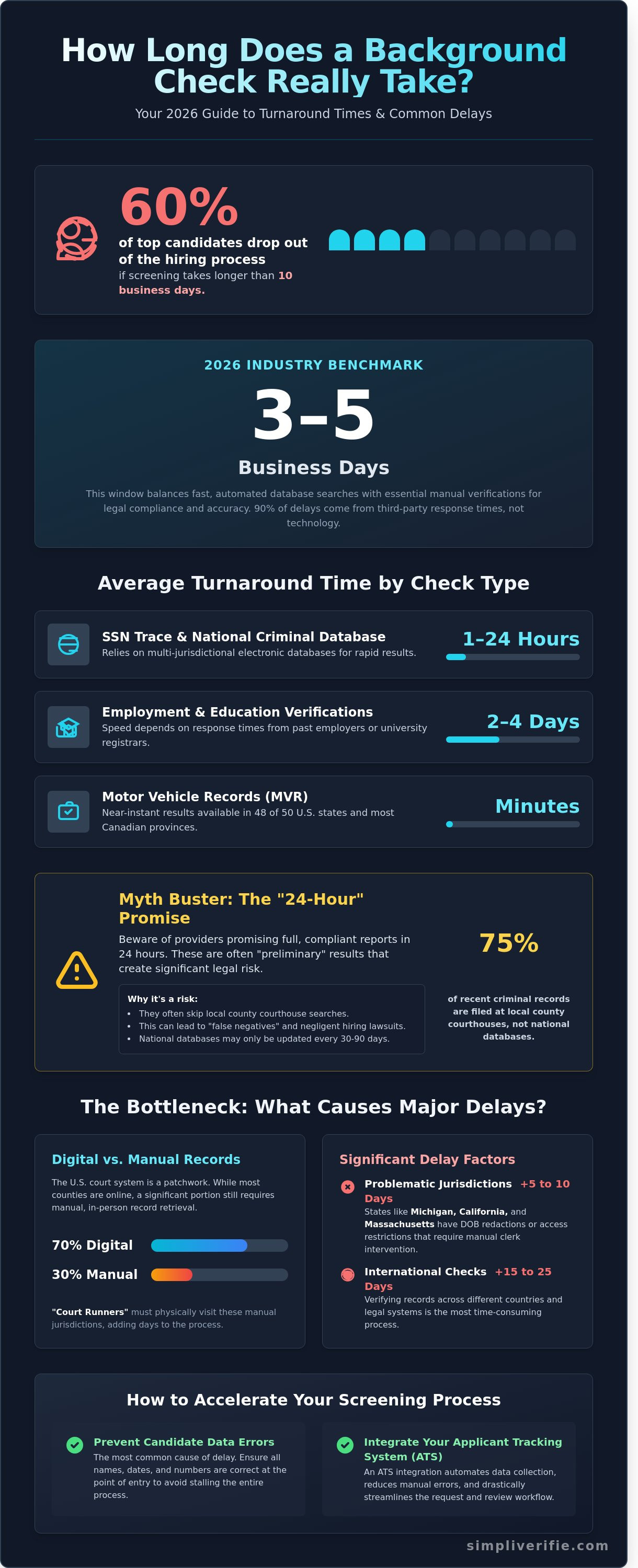
Did you know that 60% of top candidates drop out of the hiring process if the screening takes longer than 10 business days? This 2024 CareerBuilder statistic highlights a painful reality for HR teams who watch talent slip away to faster competitors. You've likely asked yourself, how long does a background check take in a market that moves this fast? We agree that the "pending" status shouldn't be a black hole of uncertainty. It's stressful to manage candidate expectations when you don't have clear data on your side.
This guide provides the exact 2026 turnaround times for criminal records, credit checks, and employment verifications. You'll learn how to eliminate the three most common bottlenecks that typically add 48 hours to your hiring cycle. We'll show you how to transform a bureaucratic hurdle into a streamlined experience that secures your next hire with total confidence. From understanding Canadian compliance to leveraging automated workflows, we're giving you the blueprint for a faster, simpler hiring cycle that brings you immediate peace of mind.
Key Takeaways
- Understand why 3 to 5 business days remains the 2026 industry standard and distinguish between instant database hits and manual verification.
- Learn exactly how long does a background check take by exploring the logistical differences between digital portals and manual court runners.
- Identify the most common cause of hiring delays and how to prevent candidate information errors from stalling your onboarding process.
- Discover how integrating your Applicant Tracking System (ATS) can drastically reduce turnaround times and streamline data collection.
- Explore how SimpliVerified leverages local expertise and modern technology to provide fast, compliant results that offer total peace of mind.
The Baseline: Average Turnaround Times for Background Checks
Knowing exactly how long does a background check take helps you manage hiring expectations and secure top talent before they sign elsewhere. In 2026, the industry benchmark for a comprehensive report sits firmly at 3 to 5 business days. This window allows for a balance between automated data retrieval and the necessary manual verifications that ensure legal compliance. While technology has accelerated the process, 90% of delays still stem from third-party responsiveness rather than software limitations.
Turnaround time (TAT) in the context of FCRA compliance is the total duration from the moment a candidate submits their signed authorization until the final, verified report is delivered to the employer. Accuracy remains the priority during this window. A standard background check involves multiple layers of data, and the scope you choose directly dictates the final delivery date. If you're only looking for a surface-level scan, you'll see results quickly, but deeper dives into professional history or international records naturally extend the clock.
The "instant" result is a common industry myth that needs clarification. True instant results only exist for databases that are already digitized and indexed, such as certain social security traces. Most reliable criminal records require a check against county or district court files. In many jurisdictions, these files aren't fully automated and require a court clerk to manually pull the data, a process that can take 48 to 72 hours depending on the specific court's backlog.
Timeline by Type of Screening
Different components of a screening package move at different speeds. You can expect the following timelines for common searches:
- SSN Trace and National Criminal Database: These typically return results within 1 to 24 hours because they rely on multi-jurisdictional electronic databases.
- Employment and Education Verifications: These take 2 to 4 business days. The speed depends entirely on how quickly HR departments or registrar offices respond to inquiries.
- Motor Vehicle Records (MVR): These are near-instant in 48 out of 50 US states and most Canadian provinces, providing driving history within minutes.
Why 24-Hour Promises Can Be Misleading
Companies promising a 24-hour turnaround often provide a "preliminary" report rather than a final, compliant document. These fast results usually skip local county courthouse searches, which is where 75% of recent criminal records are actually filed. Relying solely on a national database can lead to "false negatives" because these databases are only updated periodically, sometimes only once every 30 to 90 days.
Sacrificing accuracy for speed creates significant liability. If a report misses a recent conviction because the provider didn't wait for a manual court check, the employer faces the risk of a negligent hiring lawsuit. High-stakes hiring requires a process that values integrity over a 24-hour clock. True peace of mind comes from knowing the data is fresh, verified, and legally sound, even if it takes an extra 48 hours to finalize.
The Bottleneck: Why Some Checks Take Minutes and Others Weeks
Understanding how long does a background check take requires looking at the logistical divide between digital and manual records. While technology has accelerated much of the industry, the American court system remains a patchwork of modernization. Approximately 70% of U.S. counties now offer some form of online access, but the remaining 30% still rely on paper files or localized databases that aren't connected to the internet.
In these manual jurisdictions, background screening firms must dispatch "Court Runners." These are physical researchers who visit courthouses to pull files by hand. This human element adds days to the process. If your candidate has lived in Michigan, California, or Massachusetts, expect delays. Michigan's 2021 rule change regarding Date of Birth (DOB) redactions continues to slow processing by 5 to 10 business days as clerks must manually verify identities. California faces similar hurdles due to court record access restrictions, while Massachusetts often requires manual intervention for specific CORI reports.
International checks represent the most significant timeline extension. If a candidate worked or studied in London, Tokyo, or Mumbai, the turnaround time typically stretches to 15 or 25 business days. While waiting for these results, employers must remain compliant with the U.S. Equal Employment Opportunity Commission guidelines to ensure fair hiring practices regardless of the source of the data.
The County Court Search Complexity
County searches are the gold standard for criminal records because most crimes are prosecuted at the local level. They're also the slowest link in the chain. When a search returns a "Common Name" hit, such as "James Smith," the process slows down significantly. A researcher might find 40 potential matches in a single jurisdiction. Each one requires manual filtering against a secondary identifier like a birth date or SSN to ensure accuracy. This manual verification is essential for compliance but adds roughly 48 hours to the total time.
Verification Obstacles in Education and Employment
Employment and education checks often hit a wall during specific times of the year. Academic registrars frequently operate on skeleton crews during "Summer Break," which can turn a 2-day verification into a 12-day ordeal in July or August. For employment, 60% of large corporations now outsource their data to third-party databases like The Work Number. These tools provide instant data but often come with high per-check fees. If a former employer is defunct, researchers must track down tax records or W-2s, which adds layers of bureaucracy to the timeline.
To avoid these common delays, using an automated verification partner can help you bypass manual hurdles and maintain a fast hiring pace. Accuracy and speed don't have to be mutually exclusive when the right technology is in place. Knowing how long does a background check take helps you set realistic start dates for your new hires and keeps your HR pipeline moving predictably.
Common Roadblocks: What Causes Background Check Delays?
Speed is the primary goal for every hiring manager, yet reality often intervenes. Incomplete or inaccurate candidate data stands as the primary reason for slow results. Industry data suggests that 41% of background check delays originate from simple data entry mistakes. When asking how long does a background check take, you must account for these human elements that disrupt the digital flow.
Finding a "hit" or a criminal record automatically extends the timeline. A clean result is often near-instant because the system finds nothing to report. However, a potential match requires a manual technician to verify that the record actually belongs to the candidate. According to Forbes Advisor, these checks are vital for workplace safety, but they require a level of precision that automated systems can't always provide alone. This verification step ensures accuracy and protects the candidate from false positives.
Compliance also plays a significant role in the schedule. If a report contains negative information, employers must strictly follow adverse action protocols. This legal framework ensures fairness but adds several days to the final hiring decision process. Furthermore, the legal system's calendar dictates the pace. With 11 federal holidays and localized court closures, a request sent on a Friday before a long weekend won't see movement until the following Tuesday at the earliest.
Candidate Errors and Omissions
Small mistakes create massive bottlenecks. A single digit swapped in a Social Security Number or a mistyped birthdate triggers a manual review flag. Missing middle names or undisclosed aliases also complicate the matching process. It forces a technician to pause the search and contact the candidate for clarification. Promptness matters too. If a candidate waits 48 hours to sign a digital authorization form, the entire process stays frozen. This is why how long does a background check take often depends on the candidate's own responsiveness.
The "Additional Information Required" Loop
Some jurisdictions still operate on legacy systems. In specific counties, a court clerk might require a physical copy of a government ID before releasing sensitive records. Other regions refuse e-signatures, demanding a "wet signature" on paper. When your status says "Pending," it usually means the provider is waiting on a third party. Pestering the provider won't speed up a courthouse clerk. However, ensuring your candidate provides clear ID scans from the start prevents these loops from occurring.
How to Accelerate the Screening Process for Faster Hiring
Speed in hiring isn't just about the screening provider; it's about the workflow you build. When companies ask how long does a background check take, they often overlook internal bottlenecks that add 2 to 3 days to the total time. Streamlining these touchpoints ensures you don't lose top talent to faster competitors. Efficiency starts with a proactive approach from both the hiring team and the applicant.
Best Practices for Employers
Start by auditing your disclosure and authorization forms. Data from 2024 shows that 18% of screening delays occur because of incomplete or non-compliant paperwork. Use a provider that offers direct API access to state and federal databases to bypass manual data entry. Integrating your screening tool with an Applicant Tracking System (ATS) eliminates redundant steps and keeps all data in one secure hub. You should also incorporate pre-employment drug test coordination to run concurrently with criminal searches. This parallel processing can shave 48 hours off your total time-to-hire.
A Checklist for Candidates
Candidates hold significant power over the timeline. Preparing a Verification Packet before the offer arrives can reduce the verification stage by 30%. When applicants are organized, the question of how long does a background check take becomes much easier to answer. Use this checklist to maintain momentum:
- Gather exact dates: Have your month and year of employment ready for every role held in the last 7 to 10 years.
- Contact info: Provide direct phone numbers for previous supervisors rather than general HR lines.
- Academic records: Keep digital copies of diplomas or transcripts ready for upload if your school is unresponsive.
- The 2-hour rule: Respond to any Requests for Information within 2 hours to keep the file active in the queue.
Setting realistic expectations with stakeholders is the final piece of the puzzle. Hiring friction often stems from a disconnect between HR and department heads. If a manager expects a 24-hour turnaround on a complex international check, frustration is inevitable. Use data from previous quarters to set a baseline. In 2025, the average benchmark for a standard criminal search was 3 business days. Communicating these timelines early prevents unnecessary pressure and allows the screening team to focus on accuracy without being rushed.
Ready to experience a frictionless hiring process? Get started with SimpliVérifié today for faster, more reliable results that give you total peace of mind.
The SimpliVerified Advantage: Speed Meets Compliance in 2026
In the competitive 2026 hiring market, speed is a strategic necessity. SimpliVerified bridges the gap between digital velocity and manual accuracy by combining proprietary AI with rigorous human verification. This dual approach is the reason 95% of our standard checks are completed within 48 hours. We've eliminated the typical bottlenecks of the industry to ensure that your hiring process remains fluid and your candidates stay engaged. When employers ask how long does a background check take, we provide a definitive timeline backed by real-time status updates. This transparency removes the guesswork, allowing HR teams to plan onboarding schedules with total confidence.
Our commitment to transparency means you're never left wondering about a report's status. Every client dashboard provides a live view of the screening process. If a specific court is experiencing a delay, you'll know immediately. This level of communication transforms a bureaucratic hurdle into a predictable, manageable task. We prioritize your peace of mind by delivering reports that are not only fast but also fully compliant with the latest federal and state regulations.
Advanced Integration and Automation
Efficiency starts with the candidate experience. Our platform uses smart candidate portals to reduce manual data entry, which has been shown to cut down processing errors by 32%. By allowing candidates to upload documentation directly from their mobile devices, we shave hours off the initial phase of the check. Our infrastructure includes:
- A vast network: Access to over 15,000 collection sites across the country for drug and health screenings ensures candidates find a location within minutes of their home.
- Smart automation: Our system automatically flags incomplete information before it reaches the verification stage, preventing avoidable delays.
- Continuous monitoring: We offer real-time monitoring options that eliminate the need for traditional annual re-checks, keeping your workforce compliant 365 days a year.
Partnering for Growth
Local expertise is the secret weapon for fast turnaround times. Partnering with SimpliVerified Draper provides businesses with a local advantage that national-only providers can't match. Our team understands the specific nuances of regional court systems and local records access, which often speeds up the verification of judicial documents. This specialized knowledge ensures that the question of how long does a background check take is answered with the shortest possible timeframe for your specific region.
Every client receives a dedicated account manager. This isn't just a perk; it's a critical component of our speed. When a court clerk in a remote county is slow to respond, your account manager steps in to resolve the issue personally. This proactive approach helps Draper businesses scale their teams quickly without sacrificing the integrity of their background checks. We act as your strategic partner, ensuring that your growth is never stalled by paperwork or administrative delays. It's time to move beyond the slow, opaque methods of the past.
Get a custom quote for your background screening needs today and see how our technology can accelerate your hiring in 2026.
Secure Your 2026 Hiring Strategy Today
Understanding how long does a background check take is essential for maintaining a competitive edge in a fast-moving job market. Most standard screenings now conclude in 24 to 72 hours, yet manual bottlenecks can still push timelines into weeks if you aren't using the right tools. By prioritizing direct API integrations and automated workflows, you can bypass the common roadblocks that stall your recruitment process and cause top talent to look elsewhere.
SimpliVerified provides the speed you need without sacrificing the precision your company requires. We deliver FCRA Compliant Results and maintain a 95% Completion Rate within 48 Hours. This ensures your team stays focused on growth while we handle the complex legal and technical details. You don't have to choose between a fast hire and a safe one; you can have both through a streamlined, modern approach to candidate vetting.
Streamline Your Hiring with Fast, Compliant Background Checks
It's time to transform your onboarding experience into a seamless journey that builds trust and peace of mind from day one.
Frequently Asked Questions
Is it a bad sign if a background check is taking a long time?
A delay isn't a sign of failure or a negative result. In 90% of cases, delays stem from administrative bottlenecks at local courthouses or slow response times from previous employers. If your check involves one of the 3,300+ county courts in the US, manual record searches can add 3 to 5 days to the process. It's about the administrative workflow, not your personal history.
Can a background check be completed in one day?
Yes, certain digital checks finish in under 24 hours. Instant database searches for National Criminal Records or SSN traces often return results within 2 to 4 hours. However, a comprehensive search usually requires 2 to 3 business days to ensure full compliance and accuracy. Speed depends on the specific depth of screening your employer requests for the role.
What is the longest a background check can take?
Most checks wrap up in 5 business days, but the answer to how long does a background check take can stretch to 30 days for complex files. This happens most often with international background checks or roles requiring high-level federal security clearances. If a candidate lived in 3 different countries over the last 10 years, expect the timeline to expand as foreign agencies process the requests.
Do background checks continue over the weekend?
Background checks generally pause on Saturdays and Sundays because the primary data sources are closed. While automated software runs 24/7, the 15,000+ courts and educational institutions across North America only operate during standard business hours. If you submit your consent on a Friday evening, the official processing clock doesn't really start until Monday morning at 9:00 AM.
Why is my background check still pending after a week?
Your report is likely pending because of a manual search requirement at a local courthouse. About 15% of jurisdictions still require a human clerk to pull physical files, which adds 5 to 7 business days to the timeline. Common delays also include waiting for a 2024 response from a previous manager or a university registrar to verify your graduation date.
Does a "hit" on a criminal record make the check take longer?
Yes, a potential hit usually adds 1 to 2 business days to the process. Technicians must manually verify that the record belongs to the correct person by matching at least 2 identifiers like a date of birth or SSN. This step ensures 100% accuracy and prevents the reporting of false positives, which protects your rights and the employer's integrity.
How can I find out the status of my background check?
You can check your status by logging into the applicant portal provided by the screening firm. Most modern platforms offer real-time tracking, showing you exactly which 4 or 5 components of the search are already complete. If you don't have portal access, send a brief, professional email to the hiring manager after 5 business days to request a status update.
What should I do if my background check is delayed?
Review your submitted documents for typos immediately if you encounter a delay. While you're wondering how long does a background check take, a single transposed digit in a phone number can stall a verification for 48 hours. You can proactively offer W-2s or diplomas to the screening company to bypass slow institutional response times and ensure your tranquility of mind.