


Could your facility survive a $10,000 penalty for every day an excluded employee stays on your clock? In 2026, the OIG isn't just looking for honest errors; they're enforcing rigorous standards that can cost unprepared organizations millions in a single calendar year. For local administrators, staying ahead of healthcare sanctions screening Draper requirements is no longer a back-office task. It's a critical shield that maintains your facility's integrity and protects your bottom line from devastating regulatory action.
You've likely felt the stress of managing multiple vendors just to clear one new hire for their first shift. It's frustrating to navigate the complex maze of FACIS levels while your hiring pipeline slows to a crawl. We've designed this guide to replace that confusion with total clarity. You'll learn exactly how to master federal and Utah-specific compliance to keep your Draper facility audit ready. We'll show you how to consolidate your verifications into one intuitive platform to achieve faster turnarounds, better patient safety, and true peace of mind.
Key Takeaways
- Understand why standard criminal checks fail to detect administrative exclusions and how specialized screening protects your facility from hidden risks.
- Navigate the complexities of OIG, SAM, and FACIS levels to ensure your federal compliance is airtight and audit-ready.
- Identify critical gaps between federal and Utah-specific Medicaid exclusion lists to prevent local regulatory fines and safety issues.
- Build a robust healthcare sanctions screening Draper workflow that accurately aligns screening depth with specific clinical and administrative risk levels.
- Learn how to simplify your compliance process with fast, accurate reporting that transforms bureaucratic hurdles into operational efficiency.
Understanding Healthcare Sanctions Screening for Draper Providers
Healthcare sanctions screening Draper providers rely on is a specialized process that goes far beyond a standard background check. It's a targeted search for administrative disciplinary actions, exclusions, and debarments issued by state and federal regulatory bodies. While a criminal check identifies arrests or convictions, a sanctions search identifies professional "death sentences" that prevent a provider from working in the medical field. It’s an essential filter that ensures every physician, nurse, and technician in your facility maintains the integrity required by law.
Standard criminal background checks often miss these administrative sanctions because they don't always result from a courtroom trial. A nurse might lose their license for a documentation error or a billing discrepancy, which never appears on a local police blotter. In Draper, where the healthcare landscape ranges from specialized pediatric clinics to large facilities like Lone Peak Hospital, the diversity of staff makes this distinction critical. You aren't just hiring a person; you're inheriting their professional history and any baggage they carry from previous jurisdictions.
The medical community in Draper is built on a foundation of trust and high patient standards. Securing your facility with robust screening protects this local patient culture. It transforms a complex, bureaucratic requirement into a streamlined path toward peace of mind. By proactively identifying disqualified individuals, you remove the friction of potential legal battles and ensure your team remains focused on what matters most: patient care.
The High Stakes of Compliance in Utah
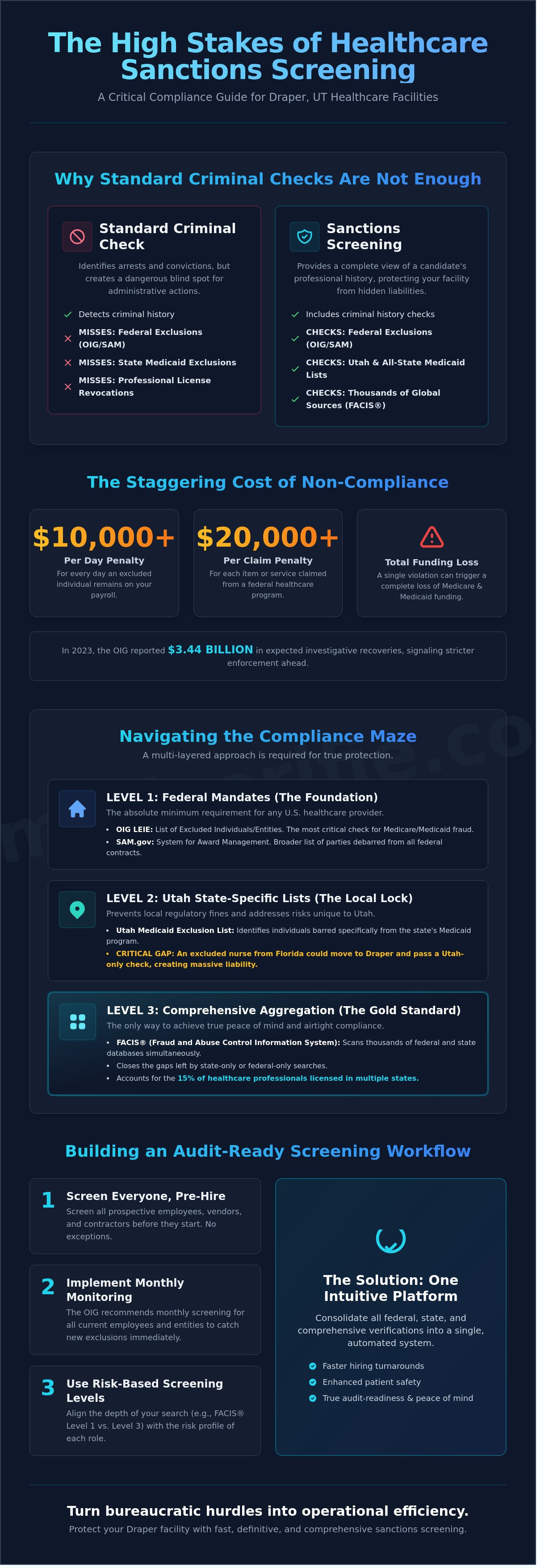
Financial penalties for compliance failures are reaching record highs. The Office of Inspector General (OIG) reported $3.44 billion in expected investigative recoveries in 2023 alone. Looking toward 2026, the OIG is signaling even stricter enforcement of Civil Monetary Penalties (CMPs) for facilities that fail to screen monthly. If your Draper facility employs an excluded person, you face fines that can exceed $20,000 per item claimed, plus triple damages.
Compliance isn't just about avoiding fines; it's about survival. Federal funding through Medicare and Medicaid is the lifeblood of most Utah healthcare institutions. A single violation can trigger a total loss of these funds, effectively shutting down a clinic or hospital wing. An Excluded Individual is someone barred from participating in federal healthcare programs because of fraud, patient abuse, or license revocation.
Why "Good Enough" Screening is a Liability
Relying on a Utah-only criminal search is a dangerous gamble for any employer. Many HR managers mistakenly believe that if a candidate has a clean record in Salt Lake County, they're safe to hire. This logic fails to account for the mobility of modern healthcare workers. Data shows that 15% of healthcare professionals hold licenses in multiple states, making regional searches insufficient for true protection.
Consider a scenario where an excluded nurse from Florida moves to Draper to escape a tarnished reputation. A local criminal check won't flag their federal exclusion. They could be hired and work for months before an audit reveals their status, leaving your facility liable for every dollar of federal reimbursement they generated. This gap in data creates a massive vulnerability for your organization.
SimpliVerified solves this by "lifting the doubt" through comprehensive multi-state data aggregation. We don't just check the local box; we scan thousands of federal and state databases simultaneously. This proactive approach ensures that healthcare sanctions screening Draper providers receive is both fast and definitive. We turn a high-stakes legal requirement into a simple, automated step that safeguards your staff and your patients.
The Core Components: OIG, SAM, and FACIS Levels
Establishing a robust protocol for healthcare sanctions screening Draper medical facilities can rely on requires a deep dive into three primary pillars: OIG, SAM, and FACIS. These aren't just acronyms; they're the gatekeepers of your clinic's reputation and financial health. When you're vetting a new physician or administrative staff member, you aren't just checking a box. You're actively preventing federal "program exclusion" risks that could cost your practice thousands of dollars in daily penalties.
The first and most critical component is the OIG List of Excluded Individuals/Entities (LEIE). Managed by the U.S. Department of Health and Human Services, this list identifies those barred from participating in Medicare, Medicaid, and all other federal healthcare programs. Since the enactment of the Health Insurance Portability and Accountability Act in 1996, the OIG has held the authority to exclude individuals for reasons ranging from patient neglect to healthcare fraud. Hiring someone on this list is a direct violation of federal law, and as of 2024, civil monetary penalties for such violations can reach $22,363 for each item or service claimed.
While the OIG focuses on healthcare, the System for Award Management (SAM) provides a broader safety net. SAM consolidated the older Excluded Parties List System (EPLS) in 2012 to create a single platform for federal contracting. It tracks debarments across all government agencies. If a vendor or employee is barred from military contracts or federal housing programs, they'll appear here. For a healthcare sanctions screening Draper strategy to be effective, it must monitor both databases to ensure no gaps exist in the candidate's history.
OIG LEIE vs. SAM: What is the Difference?
The OIG database is specialized. It targets individuals who've committed crimes specifically related to healthcare delivery or financial misconduct within the medical field. SAM is much wider; it includes entities debarred for things like tax delinquency or national security concerns. A Draper clinic needs both because an individual might be cleared by the OIG but remain debarred under SAM for non-healthcare federal crimes. Using both ensures you're never inadvertently funneling federal dollars to a sanctioned party.
Beyond the federal minimums, the industry relies on the Fraud and Abuse Control Information System (FACIS). This is often called the gold standard because it aggregates data that federal lists frequently miss, such as state-level disciplinary actions and letters of reprimand. It's a private database that provides a 360-degree view of a professional's career across all jurisdictions.
Choosing the Right FACIS Level
FACIS offers different depths of investigation. Level 1 meets the basic federal requirements by searching OIG and SAM. Level 3 is the most comprehensive, scanning over 5,000 sources across all 50 states. We recommend FACIS Level 3 for any Draper hire with direct patient contact or financial authority. It captures state board actions that haven't yet trickled up to federal databases. You can simplify your compliance workflow by choosing a level that matches the risk profile of each specific role.
To keep your facility compliant, consider these standards for different roles:
- Direct Patient Care: FACIS Level 3 (Includes all 50 states and thousands of sources).
- Administrative/Non-Clinical: FACIS Level 1M (OIG, SAM, and various state-specific lists).
- Contractors/Vendors: FACIS Level 1 (Minimum federal requirements).
By layering these searches, you create a shield around your practice. This proactive stance doesn't just satisfy regulators; it builds a culture of integrity that patients in the Draper community can trust. It's about moving from simple background checks to a sophisticated system of continuous protection.
Utah Medicaid Exclusions and State-Level Sanctions
Federal databases provide a solid foundation for compliance, but they don't always tell the whole story. Relying solely on national lists creates a dangerous visibility gap. In Utah, the Department of Health & Human Services (DHHS) often implements sanctions or exclusions months before they appear on federal radars. Data from 2023 indicates that state-level reporting to federal agencies can lag by 60 to 120 days. For a facility in Draper, hiring a provider during this "dark period" leads to immediate non-compliance and potential clawbacks of Medicaid reimbursements.
Effective healthcare sanctions screening Draper requires a strategy that looks at both the macro and micro levels. You can't assume that a clean record in Washington D.C. means a clean record in Salt Lake City. Cross-referencing is the only way to ensure 100% accuracy. To build a bulletproof screening protocol, administrators must verify five critical entities for every hire:
- OIG LEIE: The Office of Inspector General’s List of Excluded Individuals and Entities.
- System for Award Management (SAM.gov): This U.S. General Services Administration database tracks debarments across all federal programs.
- FACIS: The Fraud and Abuse Control Information System, which aggregates thousands of sources.
- Utah DHHS: The state-specific Medicaid exclusion list managed by the Utah Department of Health & Human Services.
- HIPAA: Records of past privacy violations that might not trigger a full exclusion but indicate high risk.
Achieving total compliance means checking these sources simultaneously. If a physical therapist was barred from the Utah Medicaid program last Tuesday, that information exists at the state level today. It won't hit the OIG list for weeks. Localized healthcare sanctions screening Draper ensures you catch these discrepancies before the first paycheck is issued.
Navigating Utah-Specific Regulatory Requirements
Utah tracks its 54,000+ licensed healthcare professionals through the Division of Professional Licensing (DOPL). Verifying a license isn't just a "yes or no" question. It involves checking for active stipulations, past probations, or pending disciplinary actions that haven't reached the exclusion stage yet. For doctors, nurses, and therapists in Draper, these local nuances are vital. SimpliVerified is headquartered in Draper, so we understand these Utah-specific regulatory shifts intimately. We don't just pull data; we interpret it within the context of Utah's specific DHHS and DOPL standards, ensuring your facility stays ahead of state auditors.
The Role of Continuous Monitoring
A "one and done" background check at the time of hire is a significant compliance gap. People's lives change. A provider who was clear in January might face a sanction in June. By 2026, industry standards are shifting toward a mandatory monthly re-screening model for all Medicaid-participating entities. This automated trend eliminates the human error of manual annual audits. To protect your organization from civil monetary penalties, you should implement continuous criminal monitoring. This proactive approach identifies new state-level sanctions or local arrests in real-time. It transforms compliance from a stressful yearly event into a quiet, automated process that runs in the background. This creates the "tranquillité d'esprit" or peace of mind that allows Draper healthcare leaders to focus on patient outcomes rather than paperwork.
Building a Compliant Screening Workflow in Draper
Establishing a repeatable process for healthcare sanctions screening Draper ensures your facility avoids the $22,331 per-claim fines often levied by the OIG. A fragmented approach creates gaps that federal auditors quickly identify. You need a linear, documented path from the moment a candidate applies to their five-year work anniversary. This workflow protects your patient safety and your bottom line.
- Step 1: Identify the risk level of the position. Not all roles require the same depth of investigation. Clinical staff at Lone Peak Hospital who handle controlled substances or direct patient care carry higher regulatory weight than part-time administrative staff. Distinguishing between Administrative and Clinical roles allows you to allocate your compliance budget effectively.
- Step 2: Select the appropriate screening package. For clinical roles, FACIS Level 3 is the gold standard. It scans over 5,000 sources including OIG, SAM, and all state-level exclusion lists. Pair this with Professional License Verification through the Utah Division of Professional Licensing (DOPL) to ensure credentials are current and unencumbered.
- Step 3: Obtain proper FCRA-compliant consent. You can't skip the paperwork. The Fair Credit Reporting Act requires a clear, standalone disclosure and written authorization from the Draper candidate. Using digital consent forms reduces errors and accelerates the start of the background check.
- Step 4: Review results and apply a consistent adjudication policy. When a report returns, don't make arbitrary decisions. Use a pre-defined adjudication matrix. This ensures every candidate is treated fairly and reduces the risk of discrimination claims. If a "hit" appears, verify it's a true match before taking action.
- Step 5: Implement a recurring monitoring schedule. Initial hiring screens are just the beginning. 12% of healthcare professionals face some form of disciplinary action or sanction during their careers. Monthly monitoring catches post-hire sanctions that would otherwise go unnoticed until the next annual audit.
Integrating Screening into Draper HR Systems
Modern API integrations transform how local clinics manage their workforce. The efficiency of healthcare sanctions screening Draper depends on how well it talks to your existing ATS. By connecting your hiring platform directly to SimpliVerified, you can reduce time-to-hire by 48 hours or more. This speed is vital when competing for specialized talent in the Draper medical corridor. Managing all staff through a single, intuitive dashboard eliminates the need for multiple logins and messy spreadsheets. It keeps your data organized and audit-ready at all times.
Handling "Hits" and Adverse Action
If a Draper candidate appears on a sanction list, you must follow a strict legal protocol. You can't simply rescind the offer. The law requires a two-step Adverse Action process. First, send a Pre-Adverse Action notice along with a copy of the report and a summary of their rights. You must provide the candidate at least 5 business days to dispute any inaccuracies. If no valid dispute is raised, you then issue the Final Adverse Action notice. SimpliVerified automates these compliance steps, sending the required documents and tracking timelines so your HR team stays focused on people, not paperwork.
Ready to simplify your compliance process? Get started with SimpliVerified today to secure your facility and streamline your hiring.
Why Draper Healthcare Facilities Choose SimpliVerified
Draper healthcare facilities operate in a high-stakes environment where compliance isn't just a suggestion; it's a legal necessity. SimpliVerified bridges the gap between sophisticated national screening technology and the personalized touch of a local partner. We provide the infrastructure needed to scan thousands of databases while maintaining a physical presence right here in the community. Our team understands that a single oversight can lead to massive financial penalties or loss of accreditation.
The "Simplicity" promise drives every report we generate. It represents a streamlined workflow that typically delivers results in 24 to 48 hours. Most automated systems generate high volumes of "false positives," which force HR teams to waste hours manually verifying names. SimpliVerified eliminates this friction. Our human-in-the-loop approach ensures that every potential match is reviewed by a compliance expert before the report reaches your desk. This rigorous process reduces administrative overhead by approximately 40% for local medical groups.
Implementing a robust program for healthcare sanctions screening Draper ensures that your facility remains eligible for federal funding while protecting patient safety. We don't just provide data; we provide clarity. Our reports are formatted for immediate action, highlighting clear "pass" or "flag" statuses. This level of precision is why 95% of our clients report higher confidence in their hiring decisions after switching from purely automated vendors.
We take the guesswork out of complex regulatory requirements. Whether you're managing a small clinic or a large surgical center, the stakes remain high. Our screening covers the OIG List of Excluded Individuals/Entities (LEIE), GSA/SAM exclusions, and dozens of other federal and state databases. We monitor these lists daily to ensure your staff remains in good standing long after the initial hire. You don't have to worry about the technical details because our systems stay updated with the latest federal changes automatically.
The Local Advantage for Draper Organizations
Our headquarters on E Draper Pkwy gives us a unique perspective. We aren't a faceless corporation in another time zone. We understand the specific nuances of Utah's healthcare landscape, including the intricacies of the Utah Medicaid Fraud list and state-specific licensing requirements managed by the Division of Professional Licensing (DOPL). SimpliVerified provides Draper healthcare providers with the same technology used by national hospital chains, delivered with local Utah service. This proximity allows for rapid support and face-to-face consultations that national vendors simply can't match. When you call us, you're talking to a neighbor who knows the local regulatory climate.
Ready to Secure Your Draper Facility?
Compliance shouldn't feel like a burden or a bureaucratic maze. By partnering with a firm that prioritizes accuracy and human oversight, you protect your facility from the heavy fines associated with OIG exclusions. These penalties often exceed $22,000 per violation in 2024. Securing your facility means choosing a partner that values your time, your budget, and your professional reputation. You can stop worrying about audits and start focusing on patient care. Our team is ready to build a screening program that fits your specific workflow and volume needs.
Take the first step toward total compliance today:
Get a Quote for Healthcare Screening in DraperFuture-Proof Your Draper Healthcare Compliance Today
Maintaining a 100% compliant workforce in 2026 requires more than occasional checks. You must integrate OIG, SAM, and FACIS Level 3 data with specific Utah Medicaid exclusion lists to avoid federal fines that often exceed $20,000 per violation. Navigating these layers doesn't have to drain your administrative resources. Effective healthcare sanctions screening Draper facilities utilize should be automated, persistent, and locally informed. SimpliVerified simplifies this entire process from our headquarters in Draper, UT. We provide 100% FCRA compliant processes that shield your organization from litigation risks while our automated continuous monitoring alerts you to new sanctions within 24 hours of their publication. This proactive stance transforms a complex bureaucratic hurdle into a streamlined asset for your HR team. We're here to ensure your facility remains a safe, reputable environment for every patient you serve. Trust a local partner who understands the Utah regulatory landscape inside and out. Let's make your compliance journey effortless.
Partner with Draper’s Healthcare Screening Experts
Frequently Asked Questions
What is the difference between OIG and SAM screening?
OIG screening targets the List of Excluded Individuals and Entities (LEIE), which focuses specifically on healthcare fraud and patient abuse. The SAM database includes broader federal exclusions for contractors and vendors across all government agencies. While the OIG list contains roughly 78,000 active exclusions, SAM covers a wider net of debarments. Using both ensures compliance with CMS guidelines and protects your facility's federal funding eligibility.
How often should healthcare sanctions screening be conducted?
You should conduct healthcare sanctions screening in Draper once every 30 days to maintain compliance with OIG and CMS recommendations. Monthly checks are essential because the LEIE updates its database by the middle of each month. Since 2013, the OIG has emphasized that providers are responsible for checking current exclusion status before billing for services. Frequent monitoring prevents the accumulation of massive overpayment penalties that accrue daily.
Does a standard criminal background check include healthcare sanctions?
A standard criminal background check doesn't include healthcare sanctions data. Criminal reports focus on local, state, and federal convictions, while sanctions are administrative actions taken by regulatory bodies like the OIG or state Medicaid offices. Over 40 individual state exclusion lists exist that a typical criminal search will miss. You need a specialized healthcare sanctions screening Draper service to capture these specific professional debarments and board disciplinary actions.
What are the penalties for hiring an individual on the OIG exclusion list?
Penalties for hiring an excluded individual include Civil Monetary Penalties of up to $22,363 for each item or service claimed. You'll also face an assessment of up to three times the amount claimed for those services. In 2023, the OIG collected over $3.44 billion in investigative receivables. Beyond financial loss, your clinic risks losing its Medicare and Medicaid provider agreements, which often leads to permanent closure.
What is FACIS Level 3 and why do I need it for my Draper clinic?
FACIS Level 3 is the gold standard for screening because it searches over 5,000 primary sources across all 50 states. It covers the OIG, SAM, and thousands of state-level boards and licensing agencies. For a Draper clinic, this level of detail is vital because it identifies providers sanctioned in other states before they move to Utah. Relying on Level 1 or 1M leaves gaps that expose your practice to federal audits.
How long does a healthcare sanctions check take in Draper, UT?
A professional healthcare sanctions check in Draper, UT, typically takes between 24 and 48 hours to complete. Digital platforms integrated with primary sources provide near-instant results for 95% of searches. If a potential match occurs, our experts manually verify the data against Social Security numbers or NPI records within 1 business day. This speed allows you to onboard qualified staff quickly without compromising on regulatory safety or patient care quality.
Can I run healthcare sanctions checks on volunteers and contractors?
You must run healthcare sanctions checks on all volunteers, contractors, and third-party vendors who provide services paid for by federal healthcare programs. The OIG's 2013 Updated Special Advisory Bulletin explicitly states that the payment prohibition applies to all employees, regardless of their role in direct patient care. If a volunteer helps with billing or a contractor maintains medical equipment, their exclusion status can still trigger significant federal fines and repayment demands.