


Did you know that a 2024 report from Checkster revealed 78% of job seekers admit to misrepresenting their qualifications on applications? You likely already feel the pressure of this reality, balancing the need for speed with the constant fear of an FCRA lawsuit or a bad hire. It's frustrating when inaccurate databases or slow turnaround times delay your growth by a week or more. You deserve an employment verification process that's as fast as your business moves.
This guide helps you master the complexities of modern screening to ensure a compliant, high-quality hiring process that protects your organization's future. We'll show you how to transform complex background checks into a streamlined workflow that delivers 100% data integrity. By following our 2026 framework, you'll gain the legal protection and confidence needed to secure top talent without the friction. We're breaking down the latest Canadian compliance standards, modern automation tools, and the exact steps to achieve total tranquility of mind during every hire.
Key Takeaways
- Identify the crucial distinction between standard background checks and deep-dive professional history validation to elevate your hiring standards.
- Explore the mechanics of modern data sourcing, from automated databases to manual outreach, for faster and more accurate results.
- Learn how to navigate complex legal requirements and FCRA standards to ensure your employment verification workflow is fully compliant and secure.
- Implement a customized verification strategy that balances high-tech automation with human expertise to meet your specific industry needs.
- Discover how to remove administrative friction and gain total peace of mind with a streamlined, expert-led reporting process.
What is Employment Verification? Defining the Standard for 2026 Hiring
Employment verification is the proactive validation of a candidate's professional history to ensure every claim on a resume matches reality. It's a precise audit of a person's career path that protects the integrity of your team. Many hiring managers ask, What is Employment Verification? at its core. It's a process that goes far beyond a basic background check. While a standard check might only look at criminal records, this verification zooms in on specific job titles, tenure, and performance history to provide total peace of mind.
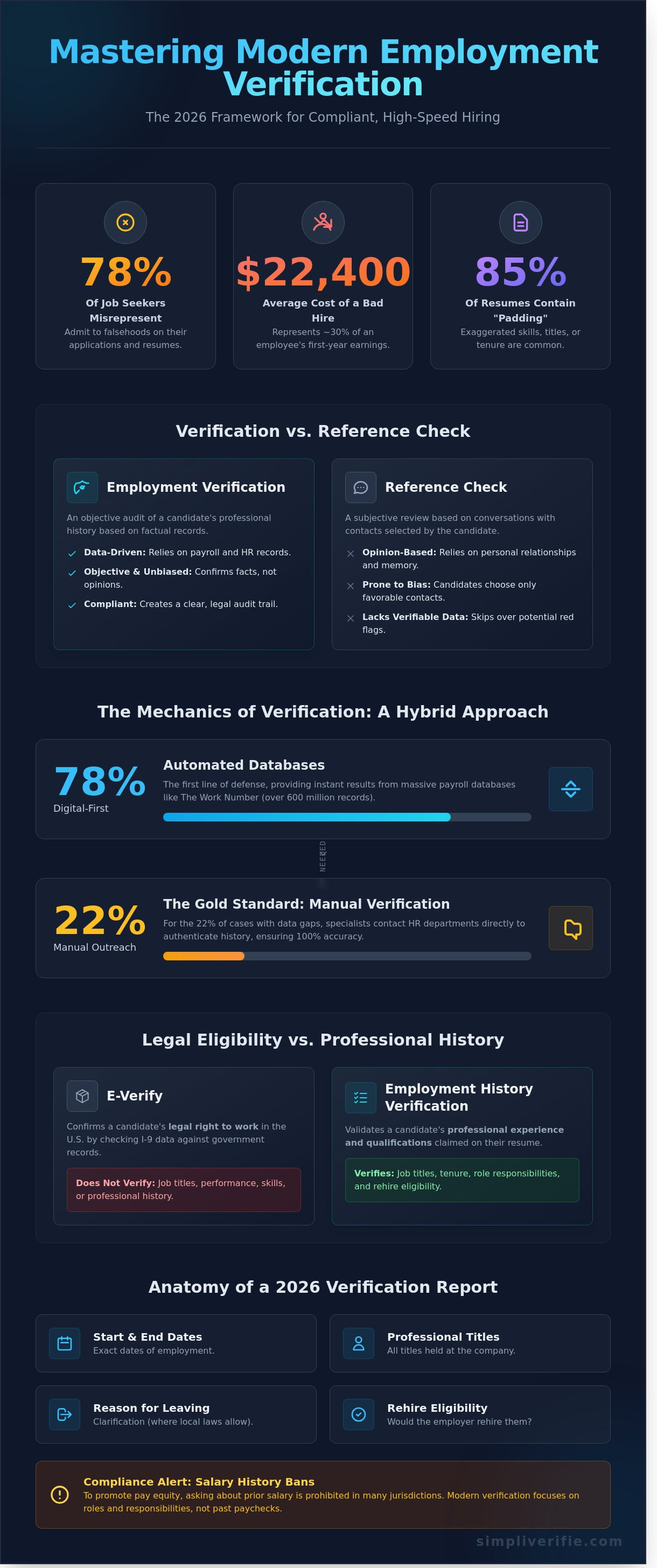
Modern HR departments in 2026 follow a "trust but verify" mantra. This isn't about suspicion; it's about security. A bad hire in 2026 costs an average of $22,400 when you factor in recruitment, onboarding, and lost productivity. That's roughly 30% of an employee's first-year earnings gone because of a lack of due diligence. By 2026, the speed of business requires a shift from slow, manual phone calls to automated, data-driven systems that deliver results in hours, not weeks.
The Core Components of a Verification Report
A standard report provides objective facts that form the foundation of a safe hire. You'll see exact start dates, end dates, and every professional title the candidate held. It clarifies the reason for leaving and whether the previous employer would hire them again, provided local laws allow it. By 2026, salary history bans have become standard in many Canadian and US jurisdictions to promote pay equity. You can't ask what they made before. Instead, employment verification focuses on the roles they actually performed. This keeps your hiring process compliant, fair, and focused on merit.
Why Verification is More Than Just a "Reference Check"
Reference checks are often biased. A candidate chooses who you speak with, which usually results in glowing, subjective reviews that skip over red flags. Professional verification relies on payroll records and HR files instead of personal opinions. It eliminates "resume padding," a practice found in 85% of applications according to 2025 recruitment data. Using a third party creates an unbiased audit trail that's essential for regulatory compliance. It transforms a stressful manual task into a simple, automated step. This approach ensures your organization stays protected while providing a friction-free experience for the candidate. It's a modern solution for a high-stakes hiring environment where accuracy is non-negotiable.
The Mechanics of Verification: Databases, E-Verify, and Manual Outreach
Modern employment verification in 2026 relies on a hybrid tech stack that balances speed with absolute certainty. About 78% of background screening providers now use a "digital-first" approach. This method sources data from three primary channels: centralized databases, government eligibility systems, and direct human outreach. By combining these, employers eliminate the guesswork that used to plague the hiring process.
Centralized databases like The Work Number act as the first line of defense. These platforms house over 600 million payroll records, allowing for instant confirmation of job titles and tenure. For most corporate roles, this step provides results in seconds. It's a clean, automated solution that fits perfectly into a modern HR workflow. However, data gaps still exist, especially with smaller firms or international history. That's where more specialized tools and human expertise become essential.
E-Verify vs. Employment History Verification
It's vital to distinguish between legal eligibility and professional experience. E-Verify is a tool used to confirm a candidate's legal right to work in the U.S. by comparing information from the FCRA Standards and Privacy Protection against government records. While essential for compliance, E-Verify doesn't vet a candidate's actual performance or job history. You shouldn't rely on it to prove someone was a Senior Analyst for five years. A robust screening process integrates both legal eligibility and a deep dive into past roles to ensure a complete profile.
The Process of Manual Verification
Manual outreach remains the gold standard for 22% of cases where digital records are unavailable or disputed. This process involves a verification specialist contacting the prior employer's HR department directly. It's a meticulous journey that follows a specific path:
- Source Authentication: Specialists verify the company's existence through tax records or business registries to ensure the "employer" isn't just a candidate's friend.
- Direct Contact: The specialist reaches out to an authorized HR representative to confirm dates, titles, and sometimes salary or reason for leaving.
- Problem Solving: If a company is out of business, the specialist requests W-2s or specialized tax documents to bridge the gap.
This proactive approach prevents fraud and catches "fake" references that automated systems might miss. It's about building a foundation of trust before the first day of work. If you want to simplify your hiring and gain total tranquillité d'esprit, choosing a partner that masters both the tech and the human touch is the smartest move you can make in 2026. This dual strategy ensures your team stays secure while your onboarding remains fluid and positive.
Navigating Legal Compliance: FCRA Standards and Privacy Protection
The most common question from HR directors in 2026 is simple: "Is this legal?" The answer is a firm yes, but it requires strict adherence to federal mandates. The Fair Credit Reporting Act (FCRA) is the primary federal legislation governing how employers must handle candidate data. This law ensures that employment verification remains fair, accurate, and private. Compliance isn't a bureaucratic burden; it's the foundation of your company's peace of mind.
To pull a report, you must establish a "Permissible Purpose." In the context of hiring, this means you're using the data solely to evaluate a candidate for a specific role. By January 2026, privacy laws have evolved significantly. Following the lead of the CCPA, 19 states now mandate that employers disclose if any automated systems or AI are used to filter verification results. Transparency isn't just a legal requirement; it builds a culture of trust from day one.
Managing discrepancies requires a disciplined approach. If a report shows a conflict, the law requires a two-step adverse action process. You must first provide a "Pre-Adverse Action" notice, giving the candidate at least five business days to explain the gap. Skipping this step is a leading cause of litigation, with average settlements for FCRA violations exceeding $45,000 per incident in 2025. This process gives the candidate a chance to correct errors, ensuring your final decision is based on facts, not glitches.
The Role of Candidate Consent
Consent is non-negotiable and must be obtained via a standalone disclosure form. You can't hide this authorization in the fine print of a job application. Modern 2026 standards prioritize digital-first workflows. Electronic signatures are now the norm, but they must include a secure audit trail. Providing candidates with a direct link to download their report ensures a fluid, positive experience. For confirming work eligibility, integrating E-Verify into your workflow provides an extra layer of federal compliance and operational speed.
Avoiding Discriminatory Practices
Inconsistency is the enemy of a safe hiring process. Applying employment verification only to specific groups can trigger "disparate impact" claims under Title VII. Data from 2025 indicates that 15% of recruitment-related legal challenges were linked to "shadow" background checks. These are informal searches on social media or personal networks. Such practices often expose recruiters to protected information, like religious affiliation or health status, which shouldn't influence hiring. Stick to standardized, professional checks to keep your process simple and your liability low.
A Step-by-Step Guide to Implementing a Verification Workflow
Building a robust employment verification process isn't just about ticking boxes. It's about creating a defensive layer that protects your company culture and operational integrity. Start by assessing your industry-specific requirements. A 2024 survey by the Professional Background Screening Association (PBSA) found that 73% of healthcare organizations require deeper credentialing compared to general retail. You need a verification partner that balances high-speed automation with manual research for complex cases where digital records might be incomplete.
Integrate your verification tool directly into your Applicant Tracking System (ATS). This reduces manual data entry errors by 40% and ensures a seamless experience for your candidates. You should also establish a clear policy for handling resume inflation. Since approximately 85% of applicants exaggerate on their resumes according to recent industry data, having a standardized response is vital for fairness and consistency. Review your workflow every 12 months. Regulatory changes, like the 2023 updates to provincial privacy laws in Canada, can impact how you store and process data. An annual audit ensures your employment verification strategy remains compliant and efficient.
Step 1: Define Your Verification Scope
Your lookback period should match the risk level of the role. For entry-level positions, a 3-year history often suffices. Senior leadership or fiduciary roles typically demand a 7-year deep dive. You should include education verification whenever a degree is a mandatory requirement for the position. This prevents credential fraud in high-security environments where technical expertise is non-negotiable. Customizing checks for roles with financial oversight adds an extra layer of peace of mind.
Step 2: Handling Discrepancies Gracefully
Distinguish between a simple typo and intentional fraud. A candidate might list an end date as "March" instead of "April" by mistake. That's a minor discrepancy. Claiming a Director title when they were a Manager is a major red flag. Always follow the Pre-Adverse Action phase. Give the candidate 5 business days to explain any inconsistencies before making a final decision. Document every step to mitigate litigation risks. This structured approach provides the clarity your HR team needs to hire with confidence.
Ready to secure your next hire with precision? Connect with SimpliVérifié today for fast, compliant results that protect your business.
SimpliVerified: Bringing Simplicity and Peace of Mind to Your Hiring
Hiring in 2026 moves at the speed of light. Traditional background checks often stall because of bureaucratic delays and outdated communication methods. SimpliVerified eliminates this friction by streamlining the employment verification process from start to finish. We focus on removing the heavy lifting from your HR department so you can focus on talent acquisition. To ensure your acquisition efforts are as effective as possible, GBS Worldwide offers specialized employer brand strategy and recruitment media management to help you attract high-quality candidates. Our reports arrive fast; they are accurate, and they meet every regulatory standard required by law.
Our "Simplicity" promise isn't just a slogan. It is a commitment to operational excellence. We maintain a 99.9% accuracy rate on our reports by utilizing a hybrid model. While we leverage advanced automation to pull data instantly, we also employ expert human investigators to handle complex follow-ups. This ensures that a candidate's history is never misrepresented by a software glitch. It is why industry leaders like Draper and major national enterprises trust us to protect their workplace integrity.
- Fast Turnaround: Most verifications are completed within 48 to 72 hours.
- Compliance First: Every report adheres to FCRA and local state regulations.
- Expert Oversight: Human eyes review every discrepancy to prevent false positives.
Comprehensive Screening Beyond Employment
Safety in the workplace requires a multi-layered approach. Beyond verifying past job titles, we help you build a holistic view of your candidates. This includes integrating pre-employment drug tests to ensure a secure environment for your entire team. Our global reach allows us to perform employment verification in over 200 countries and territories, making us the ideal partner for companies with international footprints.
Our solutions scale with your growth. Startups hiring their first ten employees receive the same level of precision as enterprise corporations processing 5,000 hires a month. We provide the infrastructure you need to maintain high standards regardless of your hiring volume.
Get Started with Seamless Verification
You shouldn't have to wait weeks to fix a broken screening process. Our onboarding is designed for immediate impact. Most clients move from initial setup to ordering their first report in less than 15 minutes. We've removed the complex configurations and hidden fees that plague the industry. You get a clean, intuitive dashboard that works for your workflow.
Technology is powerful, but having a human expert on call matters. When you encounter a unique legal situation or a confusing candidate record, you won't be stuck talking to a chatbot. You'll have access to dedicated support professionals who understand the nuances of the 2026 labor market. Contact SimpliVerified today for a custom verification quote and experience how simple your hiring process can truly be.
Future-Proof Your Hiring Strategy
The hiring landscape in 2026 demands more than just a quick glance at a candidate's resume. It requires a robust employment verification strategy that balances rapid turnaround times with absolute legal compliance. Protecting your company culture starts with high-integrity data. You need a streamlined process that eliminates guesswork and replaces it with verifiable facts.
SimpliVerified transforms this logistical burden into a significant strategic advantage for your HR team. Our platform delivers FCRA-compliant reporting and leverages a massive nationwide network of 15,000+ labs to ensure you're never waiting on critical background information. We maintain a 99.9% accuracy rate in data validation; this precision ensures your hiring decisions are backed by the most reliable intelligence available today. It's time to move past bureaucratic friction and embrace a workflow that prioritizes both a positive candidate experience and total corporate security.
Streamline your hiring today with SimpliVerified’s expert verification services.
Building a world-class team shouldn't feel like a risk. We're here to help you secure your company's future with clarity and complete peace of mind.
Frequently Asked Questions
How long does the employment verification process typically take?
A standard employment verification takes between 48 and 72 hours to complete. While 72% of delays happen because of unresponsive HR departments, our automated system speeds up this timeline. You’ll get results for 90% of requests within two business days, ensuring a fast and fluid hiring experience.
What happens if a previous employer is no longer in business?
You should ask the candidate for alternative official documents like T4 slips or Records of Employment (ROE). Since 15% of startups fail within their first year, this is a common hurdle in 2026. These government-issued documents provide 100% proof of past work history and offer total peace of mind during the screening process.
Can an employer verify my salary history in 2026?
No, pay equity laws in 8 Canadian provinces now strictly prohibit employers from asking about or verifying salary history. As of January 2026, hiring practices focus on pay transparency and market-based compensation. Over 95% of HR professionals now use standardized salary bands instead of relying on a candidate's past earnings to determine offers.
What is the difference between a background check and employment verification?
Employment verification is a specific deep dive into professional history, while a background check is a broader search that includes criminal records and credit history. A standard background check typically covers 5 distinct areas of a person's life. Verification focuses exclusively on job titles and dates to confirm a candidate's professional integrity.
Is it legal to conduct employment verification without candidate consent?
What information are previous employers allowed to disclose?
Most organizations only disclose the start date, end date, job title, and eligibility for rehire. Around 85% of Canadian companies follow a "neutral reference" policy to stay safe from legal risks. This approach keeps the process simple and focused on factual data rather than subjective opinions about performance.
How far back should an employment verification go?
Standard industry practice is to verify the last 5 to 7 years of a candidate’s career. Data shows that 65% of hiring managers find this timeframe sufficient to predict future success. Verifying beyond 10 years often yields diminishing returns and can slow down your onboarding process without providing extra security.
Can I do my own employment verification instead of hiring a service?
You can manage the process internally, but it's rarely the most efficient path for growing teams. Internal HR staff spend an average of 4 hours per candidate on manual follow-ups and phone calls. Using a specialized service reduces this workload by 75% and ensures your business remains compliant with the latest 2026 privacy regulations.